Peptide Lyophilization (Freeze-Drying) Explained
How freeze-drying removes water to stabilize peptides, what a well-formed lyophilized cake looks like, and why residual moisture matters.
 EMElena Marsh, PhDSenior Research Analyst, Analytical Chemistry~6 min read
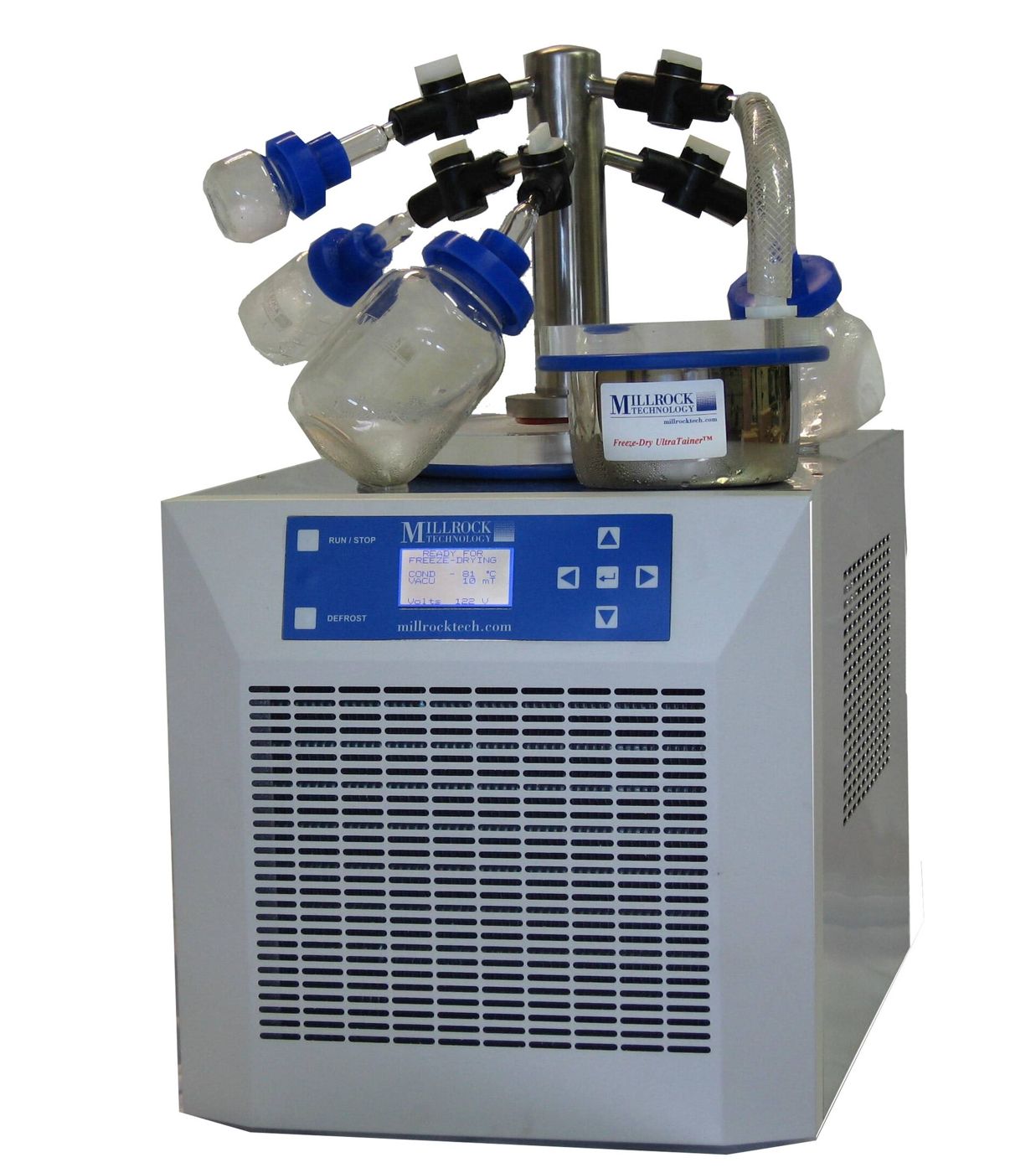 FormulationPhoto: Millrock / Wikimedia Commons, Public domain
Most research peptides arrive as a dry, white solid at the bottom of a sealed vial. That solid is the product of peptide lyophilization, a freeze-drying process that removes water from a frozen solution by sublimation rather than by evaporation. Because water drives most of the chemical and physical degradation pathways that affect peptides, taking it out under controlled conditions is one of the most effective ways to give a synthetic peptide a practical shelf life.
This article covers the three stages of a freeze-drying cycle, why a dried peptide outlasts the same molecule in solution, how to judge a lyophilized cake and its residual moisture, and how to bring dried material back into solution for in-vitro work.
What Freeze-Drying Actually Does
Lyophilization exploits the phase behavior of water. If ice is held below its triple point (roughly 0.006 atm and 0.01 °C), it passes directly into vapor when heat is supplied, without melting. A freeze-dryer creates those conditions: a chamber under deep vacuum, temperature-controlled shelves that supply the heat of sublimation, and a condenser cold enough to trap the vapor as ice. The peptide, its counter-ion and any excipients stay behind as a porous solid occupying roughly the volume of the frozen liquid.
Peptides purified by reversed-phase HPLC are collected in aqueous acetonitrile, and freeze-drying is the standard way to recover them as a weighable solid. Finished lyophilized research peptides supplied in vials are typically filled as a solution and then dried in the vial itself, so that every vial in a lot carries the same nominal quantity of material.
Freezing, Primary Drying and Secondary Drying
Freezing
The cycle begins by cooling the filled vials on the shelves until the contents are completely solid. As ice crystals grow, the remaining liquid becomes progressively more concentrated in peptide and excipients until it either crystallizes, as mannitol or glycine can, or solidifies into an amorphous glass. The temperature at which that concentrated phase becomes rigid, the glass transition of the maximally freeze-concentrated solution (Tg′) or the eutectic temperature for crystalline systems, sets the ceiling for the next stage. Freezing rate also matters, because it sets ice crystal size and therefore the pore network through which vapor later escapes.
Primary drying
With the product frozen, the chamber pressure is lowered and the shelves are warmed carefully. Ice sublimes from the top of the cake downward, and the vapor travels through the already dried layer to the condenser. The critical parameter is product temperature, which must stay below the collapse temperature. If the sublimation front warms past that point, the amorphous matrix softens and flows, closing pores and producing a shrunken or collapsed cake. Tang and Pikal’s practical guide frames cycle design largely around keeping product temperature safely below collapse.
Secondary drying
Primary drying removes ice, but a meaningful amount of water remains adsorbed to or dissolved in the amorphous solid. Secondary drying raises the shelf temperature further to desorb this water. The aim is a target residual moisture chosen on the basis of stability data rather than simply as low as possible. Vials are then usually stoppered inside the chamber before the vacuum is released.
Why Lyophilized Peptides Are More Stable
In solution, peptides are exposed to several degradation routes: backbone hydrolysis (notably at aspartate-containing bonds), deamidation of asparagine and glutamine, oxidation of methionine and cysteine, and aggregation. Each depends on molecular mobility, and hydrolysis also needs water as a reactant. Drying the peptide into a glassy solid sharply reduces that mobility, so reactions that proceed over days in solution can slow to months or longer in the solid state, provided storage stays well below the glass transition of the dried material.
The protection is not absolute. Wang’s review of lyophilized protein pharmaceuticals stresses that dried products still degrade, only more slowly, and that the rate depends on residual moisture, storage temperature relative to the glass transition, and the excipients present. Larger molecules are often formulated with sucrose or trehalose, which form a stable glass and substitute for hydrogen bonds otherwise supplied by water. Short synthetic research peptides, by contrast, are frequently lyophilized as the peptide plus its counter-ion, with no added excipients. Our overview of peptide stability and degradation covers the underlying chemistry in more detail.
What a Good Lyophilized Cake Looks Like
Visual inspection is a quick first check. A well-formed cake is an intact, uniform, porous solid that fills roughly the original fill height and may pull slightly away from the vial wall. Its color should be even, usually white to off-white. Small cracks or slight shrinkage are usually cosmetic.
Some appearances deserve a closer look. Collapse shows up as a shrunken, glassy or sticky mass, sometimes with a denser region at the base; it signals that primary drying ran above the collapse temperature and often accompanies higher residual moisture and slower dissolution. Meltback, where part of the product looks as though it liquefied and resolidified, suggests ice remained when the shelves were warmed. Discoloration can indicate chemical change. With very small fills, typical of milligram-scale research vials, the solid may look like a thin film or a few flakes rather than a defined cake, and that alone is not a defect. If a vial from our research peptides range looks unexpected, comparing it against the lot’s certificate of analysis and contacting the supplier is a better first step than discarding it.
Residual Moisture and How It Is Measured
Residual moisture is the water left in the solid after secondary drying, expressed as percent by weight. It matters because water acts as a plasticizer: it lowers the glass transition temperature of the dried solid, raising molecular mobility and accelerating degradation at a given storage temperature. Because over-drying can also harm some proteins, moisture targets are set from stability studies.
The standard measurement is Karl Fischer titration, described in USP general chapter <921> Water Determination, with coulometric methods suited to the small sample masses typical of peptide vials. Loss on drying is an alternative, though it also registers other volatiles such as residual acetic acid. Water content is one reason net peptide content on a certificate of analysis is lower than the gross weight of solid in the vial. Moisture can also re-enter after manufacture if a stopper is poorly seated or a cold vial is opened and condensation forms, a point covered in our guide to peptide storage.
Returning a Lyophilized Peptide to Solution in the Lab
For in-vitro experiments, analytical work or assay development, the dried peptide has to be dissolved to a known concentration. Let the sealed vial reach room temperature before opening, so that atmospheric moisture does not condense on the cold solid. Choose the solvent from the sequence: many short hydrophilic peptides dissolve in water or buffer, while hydrophobic or strongly charged sequences may need a small amount of dilute acid, dilute base or an organic cosolvent such as DMSO before dilution into the final buffer. Swirl gently rather than vortexing hard, since vigorous agitation can promote aggregation of some sequences.
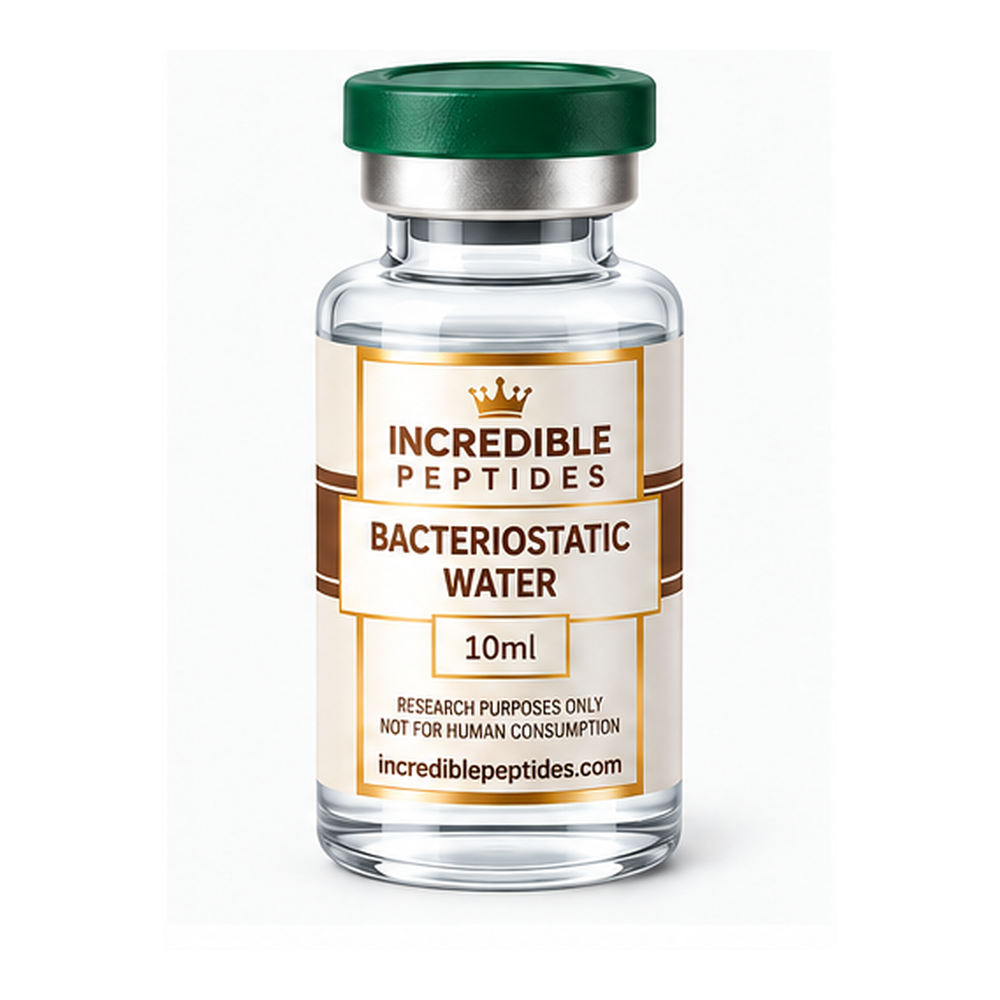
The choice of diluent also determines how long the solution can be kept. Sterile water or buffer without preservative suits solutions used immediately or divided into aliquots and frozen. Where a lab needs a stock vial that will be sampled repeatedly over a period, a preserved diluent such as bacteriostatic water containing benzyl alcohol is sometimes used to limit microbial growth between withdrawals. Its compatibility with the specific peptide and assay should be confirmed first, because preservatives can affect some proteins and some cell-based systems. Whatever the diluent, record the solvent, concentration, date and storage conditions so that every solution can be traced back to its source lot.
Practical Takeaways for Researchers and QC Staff
Freeze-drying turns a fragile solution into a solid that tolerates shipping and storage far better, but the quality of that solid depends on a cycle designed around the formulation’s critical temperatures. For anyone receiving lyophilized material, the useful checks are straightforward: inspect the cake or film, confirm that the certificate of analysis reports identity and purity for the lot, store sealed vials cold and dry, and handle the solid so that moisture does not undo what the process achieved.
References
- Tang X, Pikal MJ. Design of freeze-drying processes for pharmaceuticals: practical advice. Pharmaceutical Research. 2004;21(2):191-200.
- Wang W. Lyophilization and development of solid protein pharmaceuticals. International Journal of Pharmaceutics. 2000;203(1-2):1-60.
- Carpenter JF, Pikal MJ, Chang BS, Randolph TW. Rational design of stable lyophilized protein formulations: some practical advice. Pharmaceutical Research. 1997;14(8):969-975.
- Manning MC, Chou DK, Murphy BM, Payne RW, Katayama DS. Stability of protein pharmaceuticals: an update. Pharmaceutical Research. 2010;27(4):544-575.
- United States Pharmacopeia. General Chapter <921> Water Determination.
Research Product in This Article
Educational content for research use only. Not for human consumption. Nothing here is medical advice or a claim about safety or efficacy.