Peptide Blends Explained: Formulation and Testing of Multi-Peptide Vials
Why multi-peptide vials exist, what makes peptides compatible in one formulation, and how analysts resolve, identify and quantify each component of a blend.
 EMElena Marsh, PhDSenior Research Analyst, Analytical Chemistry~5 min read
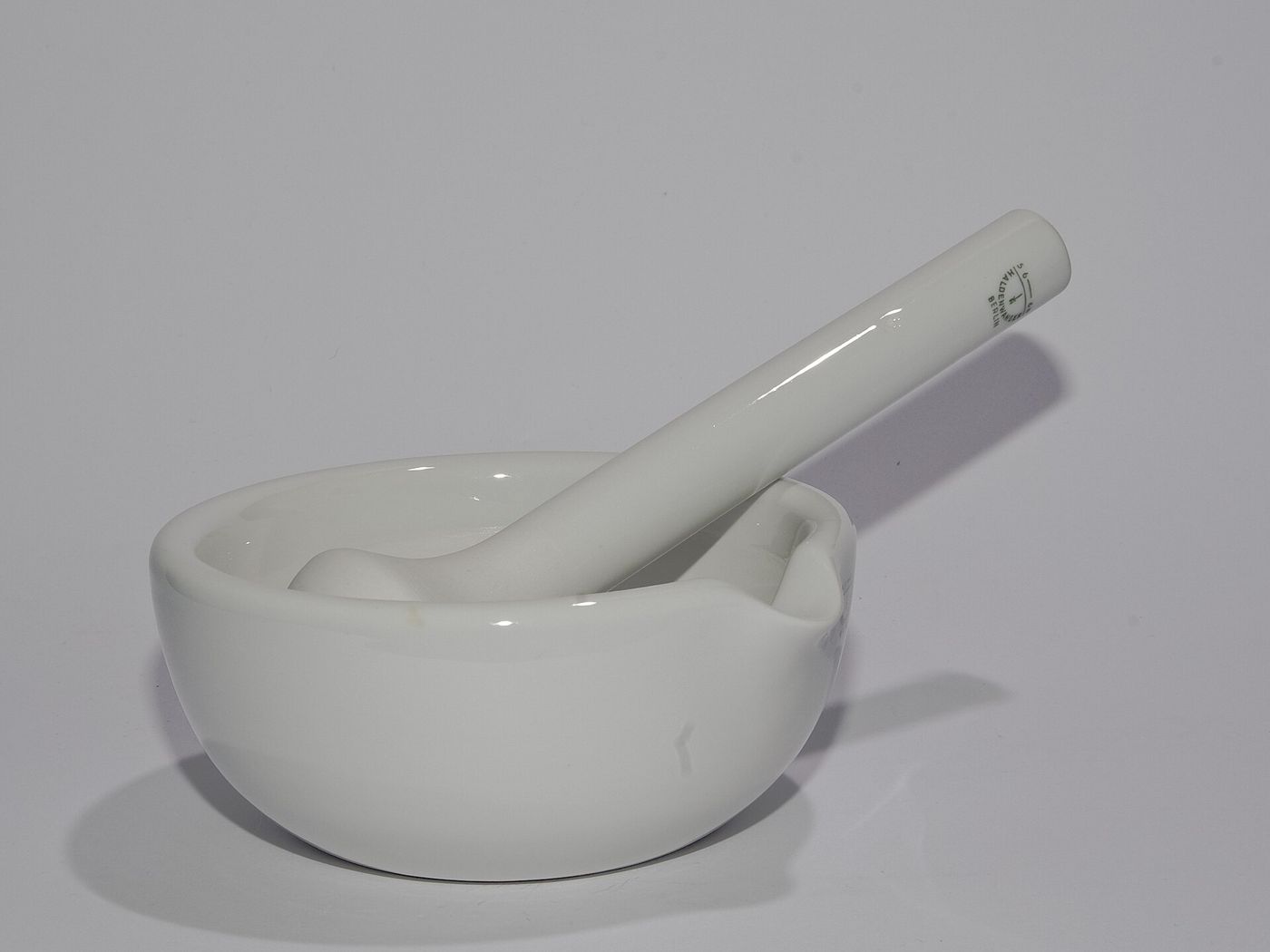 FormulationPhoto: Nadine90 / Wikimedia Commons, CC BY-SA 3.0
Peptide blends are vials that contain two or more distinct peptides co-formulated and usually lyophilized together. For a laboratory they offer convenience and a fixed ratio between components; for an analytical chemist they multiply the work, because every identity, purity and content question has to be answered once per component and then again for the mixture as a whole.
This article explains why blends exist as a research format, what makes two peptides compatible in one vial, the analytical challenges of resolving and quantifying several peptides at once, and what a blend’s label and certificate of analysis should state. The focus is formulation science and quality testing in a laboratory context.
What a Peptide Blend Is
A blend is defined by its components and their nominal amounts. A label such as “5/5 mg” indicates two components at 5 mg each, while a single total figure such as “30 mg” says nothing about the ratio unless the composition is stated elsewhere. Our peptide blend category includes examples of both styles: the G1-S/C-Amylin Blend 5/5mg combines the lipidated GLP-1 receptor agonist semaglutide with the amylin analogue cagrilintide, the pairing often called CagriSema, and other vials pair a GHRH analogue with a ghrelin receptor agonist, or BPC-157 with TB-500. For multi-component vials whose listings do not state a composition, such as GLOW, KLOW or the Deadpool blend, any composition you see described elsewhere should be regarded as “commonly described” and confirmed against the listing and the lot COA.
Why Blends Exist as a Research Format
The main scientific rationale is the study of two pathways together. A pituitary cell assay that examines GHRH receptor and ghrelin receptor signaling side by side, or a receptor panel that pairs amylin and GLP-1 receptor agonists, may be simpler to run when the components arrive at a defined ratio. Pre-blending also reduces the weighing error that comes with handling very small masses of two separate powders.
The trade-off is flexibility. With a fixed ratio, a researcher cannot vary one component’s concentration independently, so concentration-response work for each peptide still requires single-component material. Good experimental design also calls for single-component arms alongside the blend, so that any combined effect can be attributed correctly. Our article on experimental controls in peptide research discusses how to structure those comparisons.
Formulation and Compatibility
Not every pair of peptides belongs in the same vial. Several properties determine whether co-formulation is sensible.
Solubility and charge
Peptides differ widely in hydrophobicity and isoelectric point. A lipidated sequence such as semaglutide behaves very differently in solution from a short, hydrophilic peptide. If the two components prefer different pH ranges or solvents, a shared solvent for in vitro work may compromise one of them. Opposite net charges can also promote association between components, which may show up as turbidity or as altered chromatographic behavior.
Chemical stability in a mixture
Familiar degradation routes, including methionine and cysteine oxidation, deamidation at asparagine (especially Asn-Gly motifs), and aspartimide formation, still apply in a blend, but they can be harder to monitor because degradation products of one component may elute near the other. Reactive groups matter as well: a peptide carrying a free thiol or a maleimide-containing modification would be a poor partner for components it could react with. Formulators also consider the counterions each peptide carries, typically trifluoroacetate or acetate, and whether excipients or a bulking agent are needed to give a stable lyophilized cake. Background on those choices is in our article on excipients in peptide formulations.
Analytical Challenges of Multi-Peptide Vials
Resolving multiple peaks
Reversed-phase HPLC is the workhorse for peptide purity, and a blend demands a method that separates every component from every other component and from each component’s related impurities. A gradient that gives a clean single-peptide chromatogram may leave a truncated sequence of one component co-eluting with the main peak of the other. Method development therefore often involves adjusting gradient slope, column chemistry, temperature and ion-pairing agent until all species of interest are resolved, followed by validation along the lines of ICH Q2(R2). Our quality testing overview describes how identity, purity and content are approached for catalog materials.
Area percent is not a mass ratio
UV absorbance at 214 to 220 nm is dominated by the peptide bond, but the response per milligram still varies with sequence length and with aromatic residues such as tryptophan and tyrosine. Two components present at equal mass rarely give equal peak areas. A chromatogram can show that both components are present and estimate the purity of each, but accurate per-component quantitation requires calibration against a characterized reference standard for each peptide.
Identity for each component
Mass spectrometry should confirm the identity of every component. LC-MS is particularly useful here because it links each chromatographic peak to a measured mass, making it possible to assign peaks and to recognize impurities belonging to either peptide. For larger or lipidated peptides, deconvolution of multiply charged ions is usually needed to recover the intact mass.
Stability testing
Stability studies for blends track each component separately. The principles in ICH Q1A(R2) still apply, but the analysis must detect whether one peptide degrades faster in the mixture than it does alone, which only a resolved, component-specific method can show.
Labeling and Documentation
A blend label should give the name of the blend, each component and its nominal amount, the lot number and a statement that the material is for laboratory research use only and not for human or veterinary use. The certificate of analysis should report identity by mass spectrometry for each component, purity for each component under a stated method, and, where measured, content or ratio data. A single overall purity figure for a two-component vial is difficult to interpret and should prompt questions. When reviewing a blend before purchase, compare the listing with the lot COA, and use our peptide purity testing standards for multi-component materials as a reference for what documentation to expect.
Working With Blends in the Laboratory
A blend is a reasonable choice when an experiment genuinely needs a fixed ratio of two characterized peptides and when single-component controls are available. It is a poor choice for experiments that need to vary each component independently. Before use, confirm the composition on the lot COA, record the lot number in your notebook, and store the vial under conditions appropriate to the less stable component. For chromatographic background, see our guide to peptide HPLC purity testing.
References
- ICH Q2(R2). Validation of Analytical Procedures. International Council for Harmonisation.
- ICH Q1A(R2). Stability Testing of New Drug Substances and Products. International Council for Harmonisation.
- ICH Q6B. Specifications: Test Procedures and Acceptance Criteria for Biotechnological/Biological Products. International Council for Harmonisation.
- USP General Chapter <621> Chromatography. United States Pharmacopeia.
- Snyder LR, Kirkland JJ, Dolan JW. Introduction to Modern Liquid Chromatography. 3rd ed. Wiley.
Educational content for research use only. Not for human consumption. Nothing here is medical advice or a claim about safety or efficacy.