Common Excipients in Peptide Formulations
What bulking agents, buffers, surfactants and preservatives such as benzyl alcohol each contribute to a peptide formulation, and how to record them.
 EMElena Marsh, PhDSenior Research Analyst, Analytical Chemistry~5 min read
 FormulationPhoto: VictorMartin / Wikimedia Commons, Public domain
An excipient is any part of a formulation other than the active substance. Peptide excipients come in a few main kinds. Bulking agents give a freeze-dried cake its shape. Buffers hold the pH. Sugars and surfactants help stop the peptide from clumping. Preservatives keep a vial that is sampled many times from growing microbes. None of these is the reason the material exists. Yet each one can decide whether a peptide stays intact. Each one can also change what a researcher measures later.
This article explains what the main kinds of excipients do. It looks most closely at bulking agents, at buffers, and at preservatives such as benzyl alcohol. It ends with how to write down excipients so that results still make sense.
What an Excipient Is, and Why It Matters to Researchers
In drug science, excipients are working parts of a formulation. Each one is picked for a clear job and has its own set of quality limits, called a specification. Books such as the Handbook of Pharmaceutical Excipients list their properties, grades and known clashes with other materials. The key idea is simple. An inactive ingredient is not the same as an ingredient with no effects. An excipient can change how well a peptide dissolves. It can also shift pH, salt strength, osmolality (the total amount of dissolved material) and the risk of oxidation. In cell tests, it can even change how cells respond.
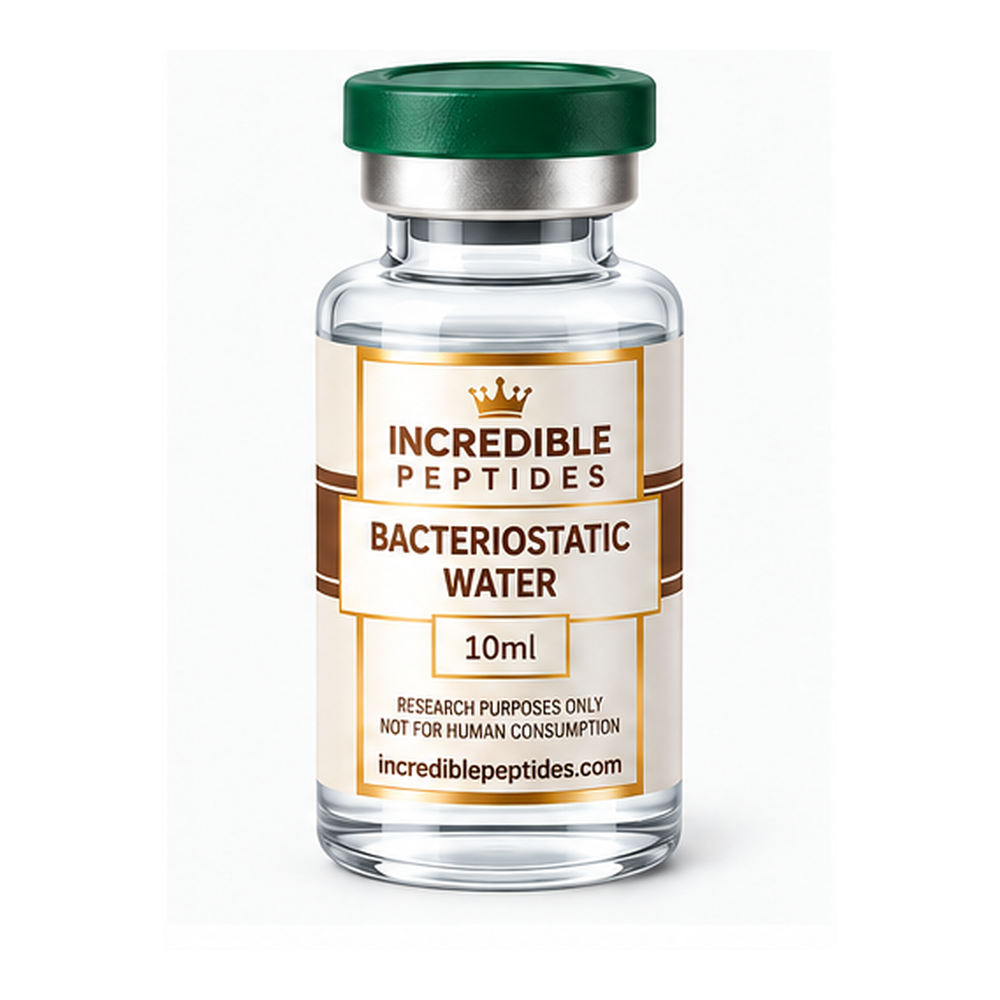
For lab researchers, this has real use. Highly pure synthetic peptides are often supplied as just the peptide and its counter-ion. The counter-ion is a charged partner left over from making and cleaning up the peptide. It is most often trifluoroacetate or acetate. It is not added on purpose as an excipient, but it acts like one. It affects the pH of a solution. Trifluoroacetate has also been reported to get in the way of some cell-based tests. More excipients come in when the lab makes a solution. Even a plain diluent is a small formulation. For example, our Research-Grade Diluent 10ml is sterile water with benzyl alcohol added as a preservative against microbes. Knowing what each part adds helps a researcher foresee how parts will interact. It also helps in setting up proper vehicle controls. For the bigger picture, see our guide to peptide formulation basics.
Bulking Agents
Bulking agents give a freeze-dried (lyophilized) product mass and shape. Sometimes a vial holds only a tiny amount of active material. It may then dry into a thin film you can barely see. That film is hard to check, and escaping vapor can carry it out of the vial. A bulking agent instead forms a solid cake. The cake has a set look and dissolves in a way you can predict.
Mannitol is the most widely used example. It tends to form crystals as it freezes. This is most likely when the cycle has an annealing step, a hold at a set temperature that lets crystals grow. A crystal frame helps the cake resist collapse, so drying can go faster. But crystal mannitol does not form a glass with the active molecule. So on its own it does little to keep the peptide stable. That is why it is often paired with an amorphous stabilizer, one that stays glassy and does not form crystals. Partial crystal growth is a known risk. If mannitol forms crystals later, during storage, it can release water into the cake.
Sucrose and trehalose work in a different way. They stay amorphous and form a glass with the peptide or protein. This keeps the molecule stable in two ways, by trapping it in glass and by taking the place of water. Carpenter and colleagues discuss both of these ideas. The downside is that these sugars have a low glass transition temperature when frozen. That is the point where the frozen glass starts to soften. So the drying must be cooler and slower.
Buffers
Buffers control pH. pH is usually the single biggest factor in how a peptide breaks down. Common buffers are acetate, citrate, histidine, phosphate and Tris. Each works best within about one unit of its pKa, the pH where it holds pH most firmly. When a formulation is meant to be freeze-dried, the choice of buffer matters even more. Sodium phosphate can form crystals on its own as it freezes. This can cause large pH swings in the cold, concentrated liquid left between ice crystals. Some buffers, such as ammonium acetate or ammonium bicarbonate, can turn to gas. Part of them can be lost during drying. So the dried product may not keep the same buffer mix it started with.
Buffer strength is a trade-off. With too little buffer, pH drifts. It can drift as the solution takes up carbon dioxide from the air, or because of the acid in the peptide counter-ion. With too much buffer, it adds salt strength and may speed up some reactions. In a dried product, it can also lower the glass transition of the solid. For a researcher, the test being run usually narrows the choice first. Phosphate forms a solid with calcium and drops out of solution. Tris has a primary amine. That amine competes in labeling methods that react with amines. Citrate binds metal ions that some enzymes need.
Preservatives Such as Benzyl Alcohol
Some solutions are sampled again and again. Each time the vial is opened or sampled, microbes may get in too. Preservatives that fight microbes lower that risk. In drug products made for many uses, the most common are benzyl alcohol, phenol and m-cresol. Parabens show up in some older formulations. A preservative’s power is shown by challenge testing. In this test, the preserved product is spiked with set microorganisms. Then the drop in living microbes is tracked over time. USP general chapter <51> Antimicrobial Effectiveness Testing describes this method.
Benzyl alcohol is a common preservative in laboratory diluents. A typical example is sterile water with 0.9% (w/v) benzyl alcohol. In the lab, a preserved research-grade diluent like this is used when a solution needs to be sampled several times over a period. But preservatives do not suit every molecule. Studies on formulated proteins have found that benzyl alcohol and phenol-type preservatives can partly unfold proteins and make them clump. This effect varies a lot from one molecule to the next. Preservatives can also harm cells at high enough levels, which matters in cell culture. Meyer and colleagues review these trade-offs in choosing a preservative. The sensible plan has three parts. Check that the preservative works with your peptide. Include a vehicle control with the same diluent. And use water or buffer with no preservative when the test does not need a stock you sample many times.
Surfactants, Tonicity Agents and Antioxidants
A few other kinds of excipients round out the picture. Nonionic surfactants are mainly polysorbate 20 and polysorbate 80. They help stop clumping where liquid meets air or a solid surface. They also cut losses from the peptide sticking to surfaces. But these surfactants break down too, through oxidation and through reaction with water. Kerwin reviewed this, and it means they need quality checks as well. Sodium chloride, mannitol or glycerol set the tonicity, which is how the solution’s dissolved content compares with that of cells. Methionine is sometimes added as a decoy antioxidant that gets oxidized in place of the peptide. EDTA or citrate bind trace metals that speed up oxidation. Each addition should answer a clear risk found for that sequence.
Reporting Excipients
Excipients that go unrecorded become hidden variables. A good methods section, notebook entry or certificate of analysis lists every part of a solution or formulation. That means the name and grade of each excipient and how much is present. It also means the buffer and final pH, the diluent and the date it was made. For supplied materials, the papers should make clear one key point. Is the product just the peptide and counter-ion, or is it a formulated mix? This changes how net content and purity are read. Our page on peptide purity testing describes the test data that come with each lot. Our guide to reading a peptide COA explains how to make sense of that data.
When a test uses a vehicle, the control samples should get the same vehicle. That includes any preservative, cosolvent or surfactant, at the same strength. Without that match, an effect caused by benzyl alcohol or DMSO can easily be blamed on the peptide by mistake.
Treating Excipients as Experimental Variables
Every excipient in a peptide formulation should earn its place. Bulking agents shape the cake. Buffers hold pH. Sugars and surfactants protect structure. Preservatives guard solutions that are sampled many times. But each one also brings trade-offs that can change stability or test results. When you record them with care and match them in controls, excipients become a part of the test design you can manage. They stop being an unexplained source of noise.
References
- Handbook of Pharmaceutical Excipients. Pharmaceutical Press and American Pharmacists Association (multiple editions).
- Carpenter JF, Pikal MJ, Chang BS, Randolph TW. Rational design of stable lyophilized protein formulations: some practical advice. Pharmaceutical Research. 1997;14(8):969-975.
- Kerwin BA. Polysorbates 20 and 80 used in the formulation of protein biotherapeutics: structure and degradation pathways. Journal of Pharmaceutical Sciences. 2008;97(8):2924-2935.
- Meyer BK, Ni A, Hu B, Shi L. Antimicrobial preservative use in parenteral products: past and present. Journal of Pharmaceutical Sciences. 2007.
- United States Pharmacopeia. General Chapter <51> Antimicrobial Effectiveness Testing.
- Manning MC, Chou DK, Murphy BM, Payne RW, Katayama DS. Stability of protein pharmaceuticals: an update. Pharmaceutical Research. 2010;27(4):544-575.
Research Product in This Article
Educational content for research use only. Not for human consumption. Nothing here is medical advice or a claim about safety or efficacy.