Peptide Purification: Cleavage, Prep HPLC and Salt Forms
From cleavage cocktail to dried powder: how crude synthetic peptides are purified by preparative HPLC, converted between salt forms and released.
 EMElena Marsh, PhDSenior Research Analyst, Analytical Chemistry~5 min read
 SynthesisPhoto: Nadine90 / Wikimedia Commons, CC BY-SA 3.0
Peptide purification is where a crude synthetic mixture becomes a defined research material. Solid-phase synthesis leaves the target sequence surrounded by deletion sequences, truncated chains, incompletely deprotected species and scavenger adducts, many of them differing from the product by a single residue or a few daltons. Separating them requires a careful cleavage step, a preparative chromatographic separation tuned to the individual peptide, disciplined fraction pooling, and a decision about the salt form in which the peptide will be isolated.
This article follows that sequence from the resin to the dried, tested powder. It covers cleavage cocktails and scavengers, reading the crude profile, preparative reversed-phase HPLC, TFA and acetate salts, lyophilization and the release tests that make up the quality testing of research lots. The assembly chemistry that comes before it is covered in our overview of peptide synthesis.
Peptide cleavage and global deprotection
In Fmoc chemistry, a single acidic step releases the peptide from the resin and removes the side-chain protecting groups. Concentrated trifluoroacetic acid (TFA) does the chemical work, but the cocktail around it determines product quality. As tert-butyl, trityl and Pbf groups come off, they generate reactive carbocations and sulfonyl species. Left unchecked, these alkylate electron-rich side chains, particularly tryptophan, methionine, cysteine and tyrosine. Scavengers are added to intercept them.
| Scavenger | Main role |
|---|---|
| Water | Quenches tert-butyl cations |
| Triisopropylsilane (TIS) | Reduces trityl and other stabilized cations |
| 1,2-Ethanedithiol (EDT) | Protects cysteine and tryptophan; keeps thiols reduced |
| Thioanisole | Assists removal of arginine sulfonyl groups |
| Phenol | Protects tyrosine and tryptophan |
A simple mixture of TFA, TIS and water (95:2.5:2.5) suits many sequences without sensitive residues. Richer cocktails such as Reagent K, which combines TFA with phenol, water, thioanisole and EDT, are used when cysteine, methionine, tryptophan or several arginines are present. Chemists often run a small test cleavage on a few milligrams of resin first, analyze it, and adjust the cocktail or reaction time before committing the whole batch. The cleaved peptide is then precipitated in cold diethyl ether or methyl tert-butyl ether, washed to remove scavengers and organic by-products, and dried.
Reading the crude profile
Before purification, the crude peptide is analyzed by analytical HPLC and, ideally, LC-MS. This identifies the target peak, shows how much of the material it represents and reveals which impurities sit close to it. A crude profile dominated by one peak with small, well-separated neighbors can be purified in a single pass. A profile with a large impurity eluting on the shoulder of the target, such as a diastereomer or a deletion sequence differing by one hydrophobic residue, may need a shallower gradient, a different column chemistry or a second orthogonal step. The same techniques return at the end of the process, and their results for each finished lot can be viewed through a certificate of analysis lookup, so the crude analysis also sets expectations for what the final chromatogram should show.
Preparative HPLC
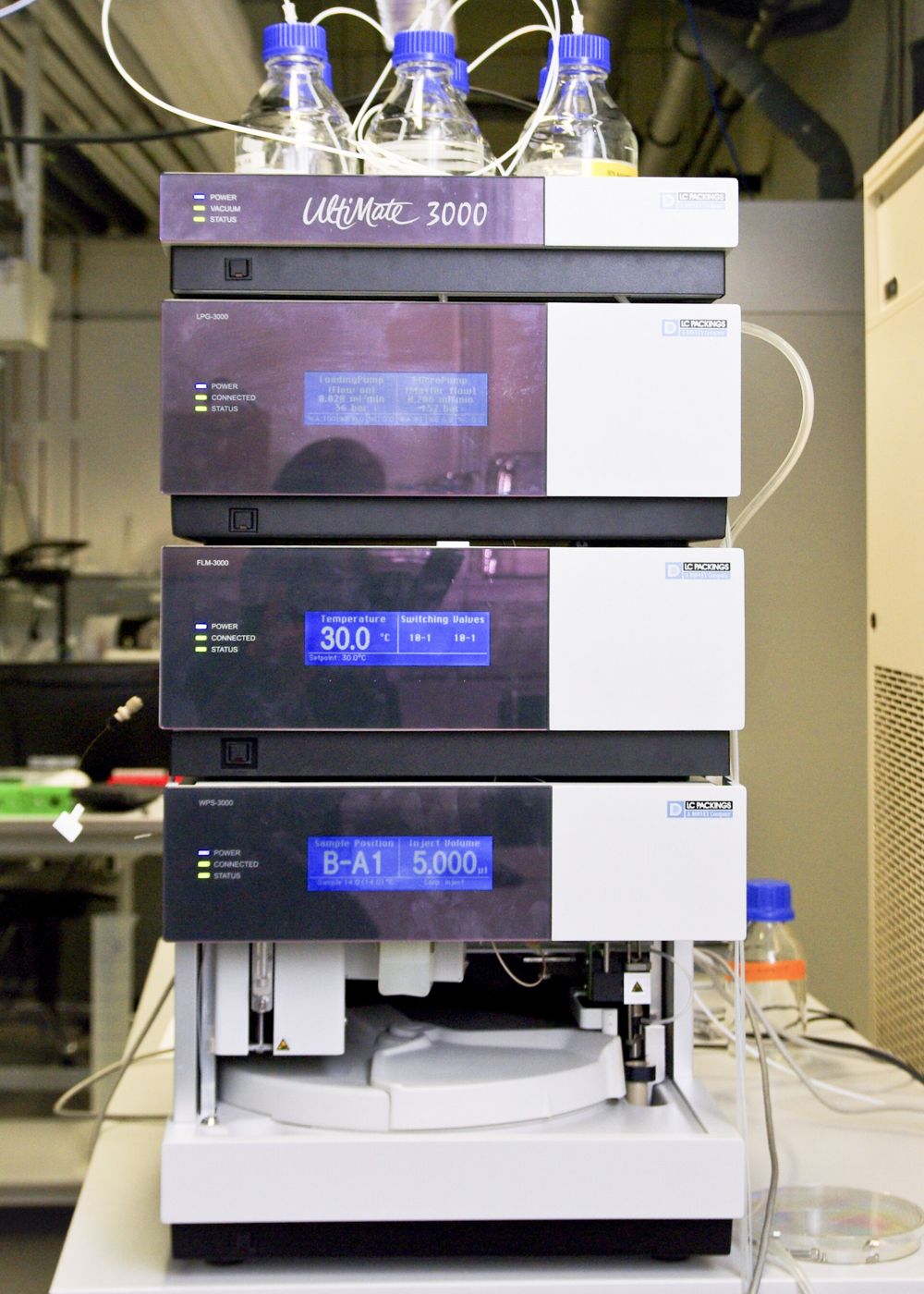
Preparative reversed-phase HPLC is the standard purification method for synthetic peptides. It uses the same separation principle as the analytical method, scaled up: wider columns, larger particles and higher flow rates. C18-bonded silica is the usual stationary phase, with C8 or C4 phases chosen for very hydrophobic or larger peptides that bind too strongly to C18. The mobile phase is water and acetonitrile, each with about 0.1 percent TFA. TFA acts as an ion-pairing agent, sharpening peaks by pairing with charged amine groups and shielding and residual silanols on the column.
The gradient is usually focused around the acetonitrile concentration at which the target elutes, rising slowly through that window to maximize resolution. Column loading is a balance: more crude material per run raises throughput but broadens peaks and erodes separation. Very crude or very large batches are sometimes pre-cleaned by flash reversed-phase chromatography or ion exchange before the final HPLC step.
Fraction analysis and pooling
The eluent is collected as a series of fractions across the main peak. Each fraction is analyzed by analytical HPLC, and the identity of the main component is confirmed by mass spectrometry. Fractions from the center of the peak usually meet specification; those on the leading and trailing edges contain more impurity. Pooling is a direct trade-off between yield and purity. Including edge fractions raises recovery but lowers the purity of the combined material, so the target specification decides where the cut is made. The HPLC purity reported for a lot reflects that pooling decision as much as the synthesis itself. Off-specification fractions can be re-purified rather than discarded.
TFA salt, acetate and counterion exchange
Because TFA is present throughout purification, a peptide is normally isolated as its trifluoroacetate salt. Each basic group, meaning the free N-terminus and every arginine, lysine and histidine side chain, can carry a trifluoroacetate counterion. In a peptide with several basic residues the counterion makes up a meaningful share of the powder’s mass, which is one reason net peptide content is lower than HPLC purity.
Counterion exchange replaces trifluoroacetate with acetate or chloride. Common approaches include passing the peptide over an ion-exchange resin, re-chromatographing it with an acetic acid or ammonium acetate mobile phase, or repeatedly lyophilizing it from dilute hydrochloric acid. Residual TFA has been reported to interfere with some cell-based assays, so the salt form is worth considering in experimental design. Counterion content can be measured by ion chromatography or fluorine NMR.
Lyophilization of the pure fraction
The pooled solution is frozen and freeze-dried. Sublimation removes water, acetonitrile and unbound TFA, leaving a light, porous solid that is far more stable than the peptide in solution. The resulting powder is often hygroscopic, so it is handled with attention to moisture and sealed promptly. The physics of the process are covered in peptide lyophilization.
Release testing
A purified lot is released against a specification. Analytical HPLC gives purity as the target’s share of total peak area, mass spectrometry confirms identity, and appearance is recorded. Depending on the material, net peptide content, water content and counterion content may also be determined. Each result is tied to the lot number so it can be traced back to the batch record, and researchers can match a vial to its results through the COA lookup tool. These materials are intended for laboratory research use only and not for human or veterinary use.
References
- King DS, Fields CG, Fields GB. A cleavage method which minimizes side reactions following Fmoc solid phase peptide synthesis. Int. J. Pept. Protein Res. 1990, 36, 255.
- Mant CT, Hodges RS (eds). High-Performance Liquid Chromatography of Peptides and Proteins: Separation, Analysis, and Conformation. CRC Press, 1991.
- Chan WC, White PD (eds). Fmoc Solid Phase Peptide Synthesis: A Practical Approach. Oxford University Press, 2000.
- Isidro-Llobet A, Álvarez M, Albericio F. Amino acid-protecting groups. Chem. Rev. 2009, 109, 2455.
- ICH Q6B. Specifications: Test Procedures and Acceptance Criteria for Biotechnological/Biological Products.
Educational content for research use only. Not for human consumption. Nothing here is medical advice or a claim about safety or efficacy.