Peptide Synthesis: How Research Peptides Are Made
A practical overview of how research peptides are made, from protecting groups and coupling chemistry to cleavage, purification and release testing.
 EMElena Marsh, PhDSenior Research Analyst, Analytical Chemistry~6 min read
 Synthesis
Peptide synthesis is the chemistry of joining amino acids, one residue at a time, into a defined sequence. Almost every compound in a modern catalog of research peptides, from a four-residue molecule such as Epitalon (Ala-Glu-Asp-Gly) to lipidated sequences of nearly forty residues such as tirzepatide, is made this way rather than extracted from biological material. On paper the process is simple: activate a carboxyl group, form an amide bond, repeat. In practice every step competes with side reactions, and small inefficiencies multiply across the length of the chain.
This overview explains how peptides are made in the laboratory: the main synthetic strategies, why protecting groups are needed, how coupling and cleavage work, and how the crude product is purified and tested before it reaches a researcher’s bench.
Why research peptides are made chemically
There are three broad routes to a peptide: isolation from a natural source, recombinant expression in engineered cells, and chemical synthesis. Isolation is rarely practical, because natural sources contain tiny amounts of any one peptide. Recombinant expression is efficient for proteins of a hundred residues or more, but it is poorly suited to short sequences and cannot easily introduce features that the genetic code does not encode.
Chemical synthesis handles those features with the same toolkit used for natural residues. D-amino acids, α-aminoisobutyric acid (Aib), C-terminal amides, N-terminal acetyl groups, lipid chains, fluorescent labels and isotopically labeled residues can all be built in during assembly. Choosing and specifying such changes is covered in our guide to custom peptide synthesis and common modifications. For sequences up to roughly fifty residues, chemical synthesis is the default; longer targets are usually assembled from synthetic fragments, for example by native chemical ligation, which joins an unprotected peptide thioester to a second peptide carrying an N-terminal cysteine.
The central difficulty is selectivity. Every amino acid carries at least two reactive groups, an amine and a carboxylic acid, and many also have reactive side chains. Mixing two unprotected amino acids with an activating agent gives a statistical mixture of dimers, oligomers and wrong-order products. Controlled synthesis therefore depends on blocking every functional group except the two that are meant to react.
Solution-phase and solid-phase strategies
Classical solution-phase (liquid-phase) synthesis builds the chain in solution and isolates each intermediate, typically by extraction or crystallization. It is still used for short sequences at large scale and for joining protected fragments, but it is labor intensive, and protected intermediates become unpredictably insoluble as chains grow.
In 1963 R. Bruce Merrifield described a different approach: anchor the first amino acid to an insoluble polymer bead and grow the chain while it remains attached. Because the peptide never leaves the solid support, large excesses of reagents can be used to push each reaction toward completion, and the excess is then removed simply by filtration and washing. Merrifield received the 1984 Nobel Prize in Chemistry for this work. Solid-phase peptide synthesis (SPPS) is now the standard method for short and medium-length sequences, and most lyophilized catalog peptides are products of it. The resins, linkers and cycle mechanics are explained in our article on solid-phase peptide synthesis.
Protecting groups and the synthesis cycle
SPPS proceeds from the C-terminus toward the N-terminus, the opposite direction to ribosomal translation. Each incoming amino acid carries a temporary protecting group on its alpha-amine, removed at the start of the next cycle, and permanent protecting groups on reactive side chains, which stay in place until the very end. The two schemes in wide use differ in how those groups are removed. In Boc/benzyl chemistry, the temporary tert-butyloxycarbonyl group is removed with trifluoroacetic acid (TFA) and the final cleavage uses anhydrous hydrogen fluoride. In Fmoc/tert-butyl chemistry, the base-labile fluorenylmethoxycarbonyl group is removed with piperidine and the final cleavage uses TFA. The comparison is set out in detail in Fmoc chemistry in peptide synthesis.
Coupling chemistry
A carboxylic acid does not react with an amine at a useful rate on its own, so it must first be converted into an activated ester or a related reactive species. Common activators include carbodiimides such as DIC used with additives like HOBt or Oxyma, and aminium or phosphonium salts such as HBTU, HATU and PyBOP. The choice balances speed against the risk of racemization, in which the alpha-carbon loses its stereochemical integrity and a diastereomer of the target forms. Cysteine and histidine are especially prone to this.
Why small inefficiencies add up
Each coupling and deprotection step falls slightly short of completion. If each of 29 couplings in a 30-residue sequence reached 99 percent, simple arithmetic puts the fraction of full-length chains near 75 percent before any other side reaction is counted; at 99.5 percent the figure is closer to 86 percent. The remainder consists of deletion sequences missing one residue, truncated chains and modified species, many differing from the target by a single amino acid. These impurities are structurally close to the product, and separating and detecting them is the main job of purification and of a supplier’s quality testing program.
Cleavage and global deprotection
Once assembly is complete, the peptide is released from the resin and its side-chain protecting groups are removed in a single acidic step. In Fmoc chemistry this is usually a TFA-based cocktail containing scavengers such as water, triisopropylsilane and ethanedithiol. As the protecting groups come off they generate reactive carbocations, and without scavengers these would alkylate tryptophan, methionine, cysteine and tyrosine side chains. The peptide is then precipitated in cold ether, washed and dried to give the crude product. Disulfide bonds, where the sequence requires them, are normally formed afterwards by controlled oxidation.
Purification and salt form
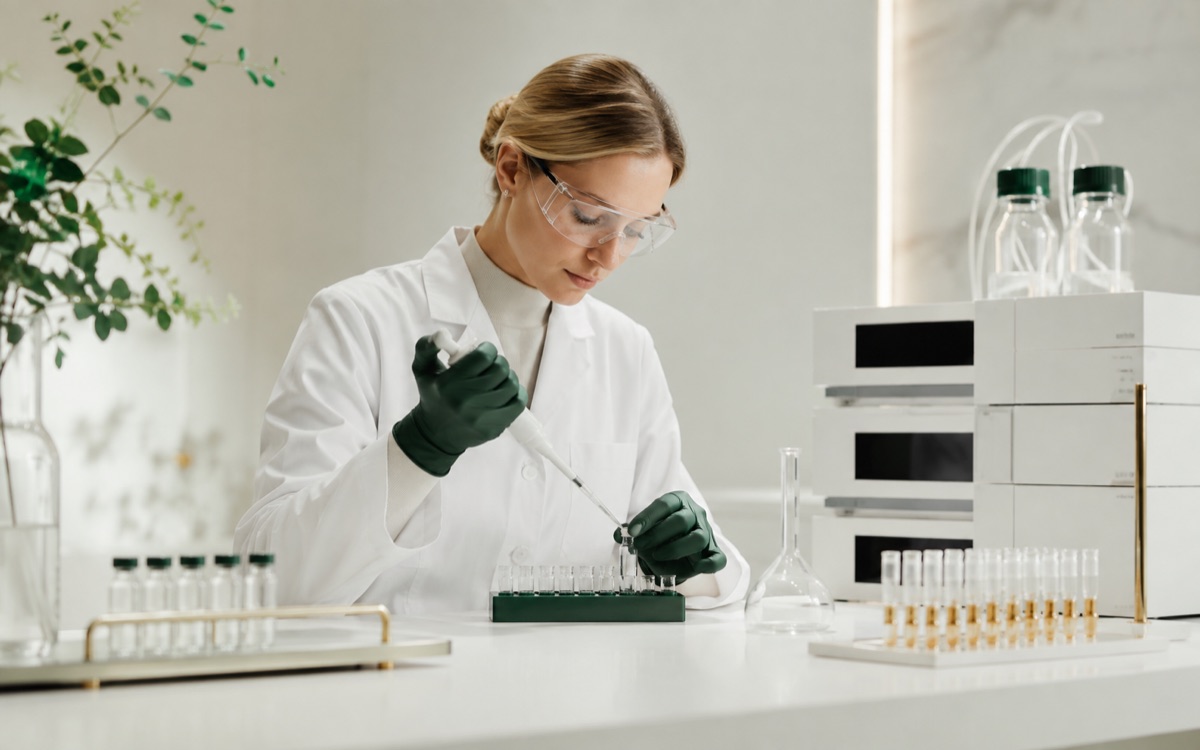
Crude peptide is purified by preparative reversed-phase HPLC, most often on C18 silica with a water and acetonitrile gradient containing a small amount of TFA. Fractions are collected across the main peak, each is checked by analytical HPLC and mass spectrometry, and those meeting specification are pooled and freeze-dried. Because TFA pairs with basic groups, the product is usually isolated as a TFA salt unless a counterion exchange to acetate or chloride is performed. The details, including scavenger cocktails and fraction pooling, are covered in peptide purification.
Confirming what was made
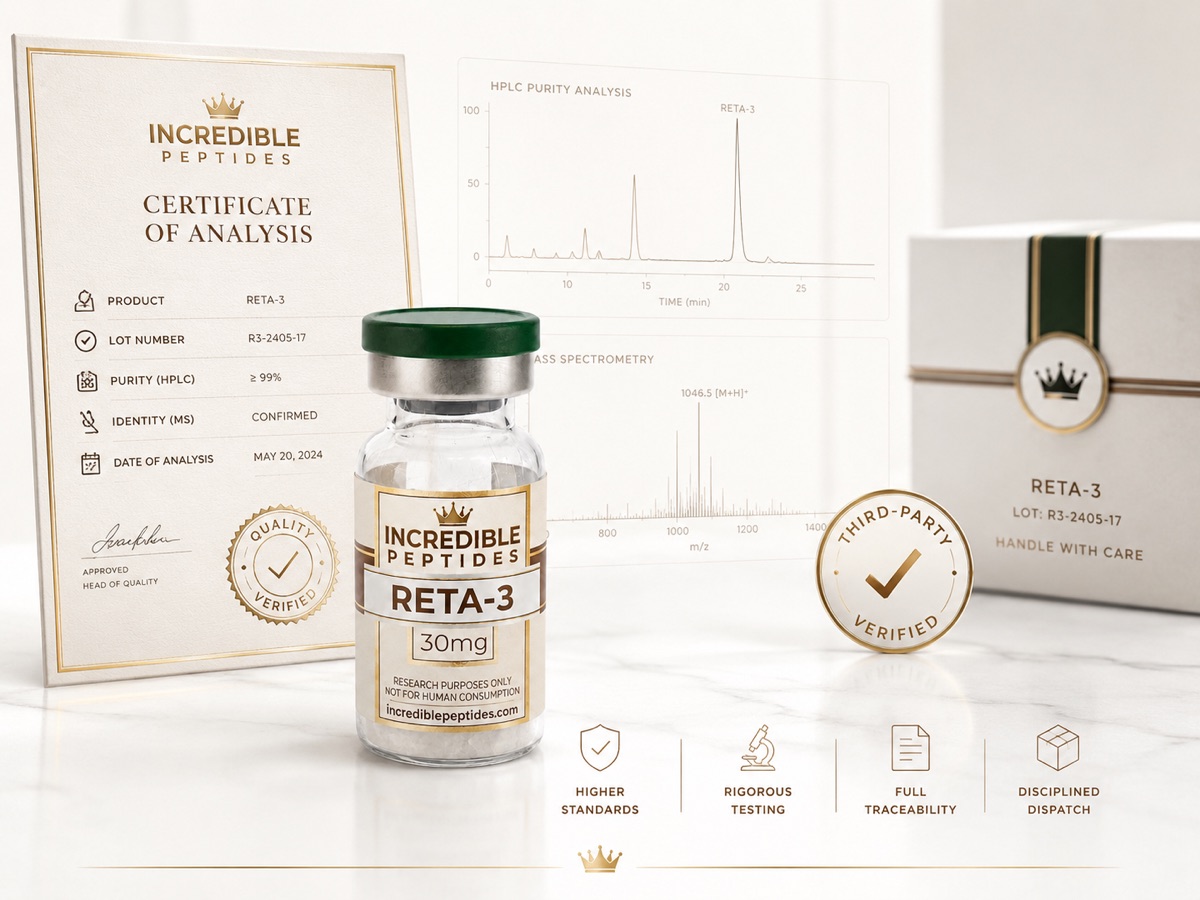
Release testing answers two separate questions. Purity is usually measured by analytical reversed-phase HPLC with UV detection near 214 to 220 nm, where the peptide bond absorbs, and is reported as the target peak’s share of total peak area. Identity is confirmed by mass spectrometry, which shows whether the observed mass matches the theoretical mass of the intended sequence. Neither test alone is sufficient: a sample can be pure but the wrong peptide, or the right peptide carrying a co-eluting impurity.
A purity figure also differs from peptide content. A lyophilized peptide contains counterions and residual water alongside the peptide itself, so net peptide content is commonly well below 100 percent even when HPLC purity is high. Amino acid analysis, Karl Fischer water determination and counterion assays address that question. How these methods are applied lot by lot is described on our peptide purity testing page.
Reading synthesis history in analytical data
Every peak in a chromatogram has a chemical origin. A shoulder just before the main peak may be a deletion sequence; a mass sixteen units above the target points to methionine oxidation; a diastereomer from racemization can share the target’s mass exactly and appear only as a closely eluting peak. Knowing how peptides are synthesized makes those signals interpretable and helps researchers judge whether a lot suits the assay they have in mind. All peptides discussed here are supplied for laboratory research use only and are not for human or veterinary use.
References
- Merrifield RB. Solid phase peptide synthesis. I. The synthesis of a tetrapeptide. J. Am. Chem. Soc. 1963, 85, 2149.
- Kent SBH. Chemical synthesis of peptides and proteins. Annu. Rev. Biochem. 1988, 57, 957.
- Dawson PE, Muir TW, Clark-Lewis I, Kent SBH. Synthesis of proteins by native chemical ligation. Science 1994, 266, 776.
- Chan WC, White PD (eds). Fmoc Solid Phase Peptide Synthesis: A Practical Approach. Oxford University Press, 2000.
- El-Faham A, Albericio F. Peptide coupling reagents, more than a letter soup. Chem. Rev. 2011, 111, 6557.
- ICH Q6B. Specifications: Test Procedures and Acceptance Criteria for Biotechnological/Biological Products.
Educational content for research use only. Not for human consumption. Nothing here is medical advice or a claim about safety or efficacy.