Solid-Phase Peptide Synthesis (SPPS) Explained
How SPPS works, from Merrifield's resin-bound chain to modern automated synthesizers, and why some peptide sequences remain difficult to assemble.
 EMElena Marsh, PhDSenior Research Analyst, Analytical Chemistry~5 min read
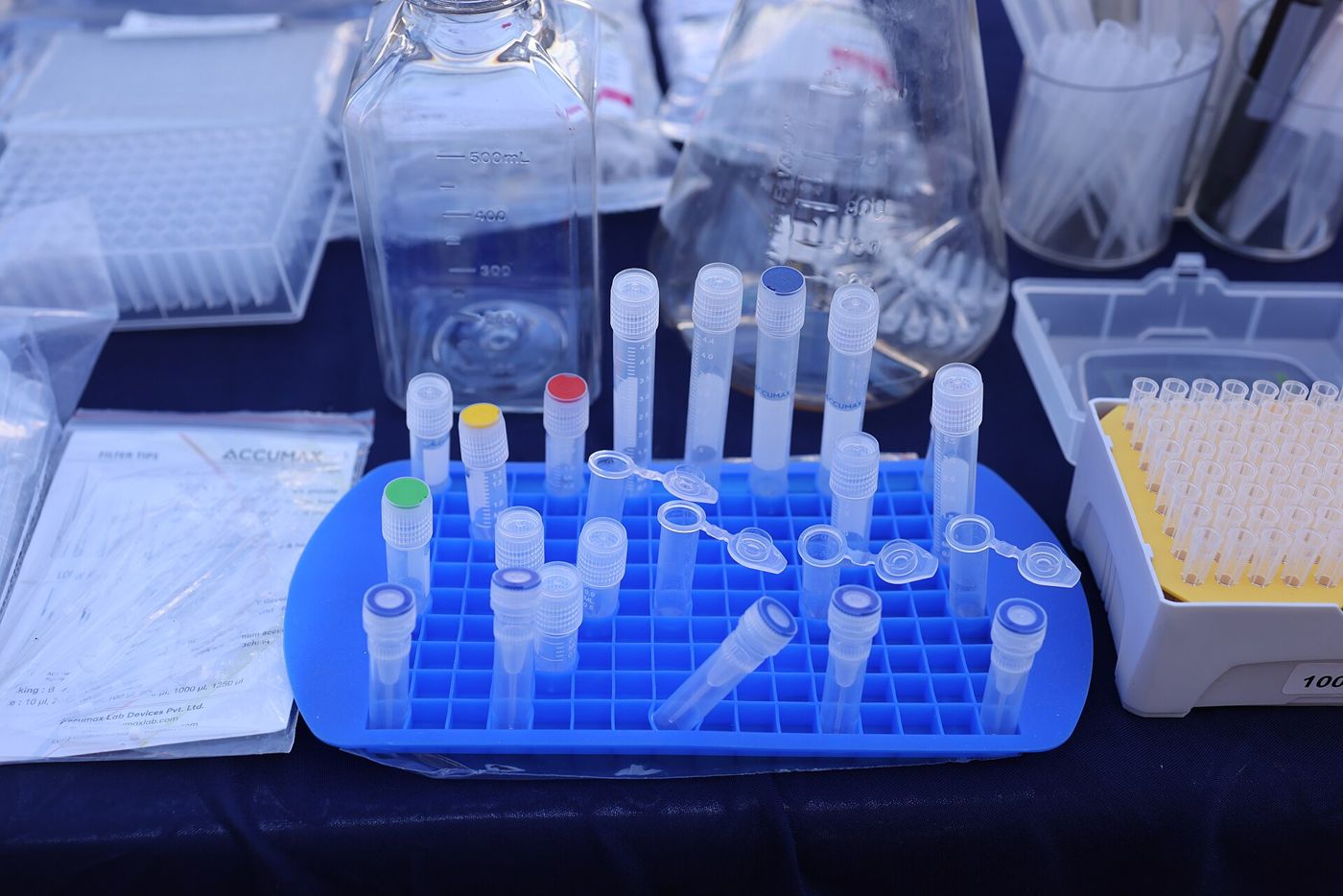 SynthesisPhoto: Gannu03 / Wikimedia Commons
Solid phase peptide synthesis (SPPS) builds a peptide while one end of the chain is tethered to an insoluble polymer bead. That single idea turned peptide chemistry from a slow, intermediate-by-intermediate craft into a repetitive cycle that can be run by hand in a fritted vessel or by an automated peptide synthesizer. It remains the method of choice for sequences from a few residues up to roughly fifty, and most longer synthetic proteins are assembled from fragments that were themselves made on a solid support.
This article explains the Merrifield principle, how resins and linkers are chosen, what happens in each synthesis cycle, how automation changed the field, and why some sequences remain stubbornly difficult to make. For the wider picture of how a finished research peptide is produced, see our overview of peptide synthesis.
The Merrifield principle
In 1963 R. Bruce Merrifield reported the synthesis of a tetrapeptide on chloromethylated polystyrene beads lightly crosslinked with divinylbenzene. The C-terminal amino acid was attached to the resin as a benzyl ester, and the chain was extended one protected residue at a time. The advantage was practical rather than chemical. Because the growing peptide is covalently bound to a solid, every reagent can be used in large excess to drive reactions close to completion, and all of the excess, along with by-products, is removed by filtration and washing. No intermediate ever needs to be isolated, crystallized or characterized.
The trade-off is that impurities formed on the resin also stay on the resin. An incomplete coupling or a side reaction cannot be purified away until the very end, so the quality of the final crude product depends on the efficiency of every individual step. Merrifield synthesis earned the 1984 Nobel Prize in Chemistry, and the same principle underlies the short and medium-length sequences found in a typical research peptides category, from tripeptides such as KPV (Lys-Pro-Val) to longer modified chains.
Resins, linkers and resin loading
The solid support has two parts: a polymer matrix and a linker that connects the first amino acid to it. Crosslinked polystyrene is still common, while PEG-grafted polystyrene and all-PEG resins swell better in polar solvents and are often preferred for long or aggregation-prone sequences. Good swelling matters because the chemistry happens inside the solvated bead, not just on its surface.
The linker determines what the C-terminus looks like after cleavage and how harsh that cleavage must be. A Wang linker releases a C-terminal carboxylic acid on exposure to concentrated trifluoroacetic acid (TFA). A Rink amide linker releases a C-terminal amide, the form found in many native peptide hormones. The 2-chlorotrityl chloride resin is extremely acid-sensitive, so protected fragments can be released with dilute acid, and its steric bulk also suppresses some side reactions at the first two residues.
Resin loading, expressed in millimoles of reactive sites per gram, is a key design choice. Values of roughly 0.2 to 1.0 mmol/g are typical. High loading gives more product per gram of resin, but chains packed closely together are more likely to interact and aggregate. Lower loading is usually chosen for long sequences, accepting a smaller batch in exchange for cleaner couplings.
The SPPS cycle step by step
Synthesis proceeds from the C-terminus toward the N-terminus. Each residue is added by the same short sequence of operations, shown below for the widely used Fmoc strategy.
| Step | Purpose | Typical reagents |
|---|---|---|
| Deprotection | Remove the temporary alpha-amine protecting group | 20% piperidine in DMF |
| Wash | Remove base and released by-products | DMF |
| Coupling | Form the new amide bond with an activated amino acid | Fmoc amino acid with DIC/Oxyma or HBTU/HATU and a base |
| Wash | Remove excess activated amino acid | DMF |
| Capping (optional) | Acetylate unreacted amines so they cannot grow further | Acetic anhydride with a base |
Monitoring tells the chemist whether a step worked. The Kaiser ninhydrin test turns deep blue in the presence of free primary amines, so a blue resin sample after coupling signals an incomplete reaction. In Fmoc chemistry, the dibenzofulvene adduct released during deprotection absorbs strongly in the UV, and instruments can track it to estimate how each cycle went. Capping converts would-be deletion sequences into shorter truncated chains, which are usually easier to separate later. These in-process checks complement, rather than replace, the analytical work described on our quality testing page, which is performed on the purified material.
Automation and the modern peptide synthesizer
Because the cycle is repetitive, it was automated early. Merrifield’s group built an automated instrument in the 1960s, and commercial peptide synthesizers followed. Modern instruments fall into a few groups: batch synthesizers that handle one sequence at a time, parallel synthesizers that run dozens of small-scale sequences side by side, flow-based systems that pump reagents through a packed resin bed, and microwave-assisted instruments that heat the reaction to speed up couplings and deprotections. Heating shortens cycle times considerably, although it can also accelerate side reactions such as racemization of cysteine and histidine.
Difficult sequences and aggregation
Some sequences assemble poorly no matter how carefully the chemistry is run. The usual culprit is on-resin aggregation: as the chain grows, neighboring chains form hydrogen-bonded beta-sheet-like structures that collapse the resin and bury the reactive N-terminus. Stretches rich in valine, isoleucine, alanine and other beta-branched or hydrophobic residues are notorious. Typical signs are slow or incomplete Fmoc removal, shrinking resin volume and failed couplings that repeat at the same position.
Several tools disrupt aggregation. Pseudoproline dipeptides introduce a temporary kink at serine or threonine positions; backbone protection with Hmb or Dmb groups removes a hydrogen-bond donor; elevated temperature, chaotropic salts and mixed solvents help resolvate the chains; and low-loading PEG-based resins keep chains apart. Repeated (double) couplings are a simple fallback.
Sequence-specific side reactions add another layer. Aspartic acid followed by glycine readily forms an aspartimide under the basic deprotection conditions, a known concern for motifs such as the Asp-Gly in the tetrapeptide Epitalon (Ala-Glu-Asp-Gly). Diketopiperazine formation can cleave a dipeptide off the resin, especially when proline or glycine sits near the C-terminus. The chemistry of these protecting-group strategies is covered in Fmoc vs Boc peptide synthesis.
From resin to verified research material
When the last residue is coupled, the peptide is cleaved from the resin and its side chains are deprotected, typically with a TFA cocktail containing scavengers. What comes off the resin is a crude mixture: the target sequence plus deletion, truncation and modified species, the proportions of which reflect everything that happened during assembly. That crude product then goes through preparative HPLC, as described in peptide purification, before analytical HPLC and mass spectrometry confirm purity and identity. Those release methods are summarized on the peptide purity testing overview for research lots. All materials discussed are for laboratory research use only and not for human or veterinary use.
References
- Merrifield RB. Solid phase peptide synthesis. I. The synthesis of a tetrapeptide. J. Am. Chem. Soc. 1963, 85, 2149.
- Wang SS. p-Alkoxybenzyl alcohol resin and p-alkoxybenzyloxycarbonylhydrazide resin for solid phase synthesis of protected peptide fragments. J. Am. Chem. Soc. 1973, 95, 1328.
- Rink H. Solid-phase synthesis of protected peptide fragments using a trialkoxy-diphenyl-methylester resin. Tetrahedron Lett. 1987, 28, 3787.
- Kaiser E, Colescott RL, Bossinger CD, Cook PI. Color test for detection of free terminal amino groups in the solid-phase synthesis of peptides. Anal. Biochem. 1970, 34, 595.
- Chan WC, White PD (eds). Fmoc Solid Phase Peptide Synthesis: A Practical Approach. Oxford University Press, 2000.
Educational content for research use only. Not for human consumption. Nothing here is medical advice or a claim about safety or efficacy.