
GHK-Cu: The Copper Tripeptide in Laboratory Research
A research-chemistry profile of GHK-Cu: the Gly-His-Lys sequence, how it binds copper(II), what in vitro studies report and how to test it.
 DODaniel Okafor, MSResearch Analyst, Molecular Biology~6 min read
 Compounds
The GHK-Cu peptide is the copper(II) complex of glycyl-L-histidyl-L-lysine, a tripeptide first described in the early 1970s and studied ever since as a model for how very small peptides bind transition metals. Its appeal to laboratory researchers is easy to understand: three residues, a well-defined metal-binding site and a sizeable in vitro literature on cell signaling and gene expression make it a convenient subject for coordination chemistry, analytical method development and cell-culture work.
This profile covers the structure and discovery of GHK-Cu, the chemistry of its copper complex, the main lines of in vitro research and the analytical questions a laboratory should consider. GHK-Cu is supplied for laboratory research use only and is not for human or veterinary use.
Identity: Sequence, Formula and Supplied Forms
GHK is the sequence Gly-His-Lys. The free tripeptide has the formula C14H24N6O4 and an average molar mass of about 340.4 g/mol. When it binds a single Cu(II) ion the resulting complex is written GHK-Cu, and research material is commonly supplied as a lyophilized blue to violet powder whose colour comes from the copper centre. A laboratory working with GHK-Cu research peptide should note exactly which form a label describes: the copper complex, the free peptide, or a salt such as the acetate of either. The distinction matters for molar calculations, because the copper ion and any counterions add mass that the sequence alone does not account for.
Each residue contributes something specific. Glycine supplies a flexible, unhindered N-terminal amine. Histidine carries the imidazole ring that is central to metal binding. Lysine provides a long side chain ending in a primary amine, which is protonated at neutral pH and gives the free peptide a net positive charge.
Discovery and Research History
GHK was isolated in 1973 by Loren Pickart and Marshall Thaler from human plasma. They reported that a plasma fraction altered the survival and growth of cultured liver cells, and the active factor was subsequently identified as the tripeptide Gly-His-Lys. Because it was found in plasma rather than designed, GHK is usually described as an endogenous peptide, although the biological route by which it is generated remains a matter of discussion.
A strong affinity for copper(II) emerged early as one of the molecule’s defining features, and much of the later literature focuses on the copper complex rather than the free peptide as the species of interest. Several authors have also pointed out that the Gly-His-Lys motif occurs within larger extracellular-matrix proteins, including the α2 chain of type I collagen and the glycoprotein SPARC, which led to the proposal that the tripeptide can be released by proteolysis. That idea is plausible on sequence grounds but remains a hypothesis.
Coordination Chemistry of the Copper Complex
In GHK-Cu the copper(II) ion is bound by three nitrogen atoms from the peptide: the free α-amino group of glycine, the deprotonated amide nitrogen of the Gly-His peptide bond and a nitrogen of the histidine imidazole ring. Together these donors form fused five- and six-membered chelate rings around the metal in an approximately square-planar arrangement. The fourth equatorial position is not filled by the peptide’s own donors. In the solid state it is occupied by a carboxylate oxygen from a neighbouring complex, while in solution it can be taken by water or by another ligand, such as a free amino acid or a second peptide, producing ternary complexes.
This binding mode resembles the N-terminal copper site of serum albumin, which likewise combines an N-terminal amine, backbone amide nitrogens and a histidine. Reports that GHK can exchange copper with albumin in vitro are frequently cited, but whether that exchange is significant depends heavily on pH, concentration and the competing ligands present.
pH Dependence and Redox Behaviour
Deprotonation of a backbone amide is only favourable when a metal ion stabilises the resulting negative charge, so the complex forms over a pH range around neutrality and dissociates as the solution becomes strongly acidic. That property has direct analytical consequences, discussed below. Binding to GHK also alters the redox behaviour of copper relative to the free aquo ion, so reported antioxidant or pro-oxidant effects in cell-free systems are strongly assay-dependent.
In Vitro Research: Fibroblasts and Gene Expression
The most frequently cited cell-based work on GHK-Cu uses fibroblast cultures, the standard in vitro model for studying extracellular-matrix production. In 1988 Maquart and colleagues, working with Pickart, reported that the tripeptide-copper complex increased collagen synthesis in fibroblast cultures, and later studies examined glycosaminoglycan production and matrix metalloproteinase expression. These are in vitro observations, made at specific concentrations in defined media, and they do not by themselves establish what happens in an intact organism.
For laboratories designing their own experiments with GHK-Cu, the copper tripeptide complex, several controls deserve attention. Free GHK and an equivalent concentration of a simple copper salt such as CuCl2 help separate effects of the complex from effects of copper alone. Culture media and serum supplements contain their own copper and competing ligands, so the actual speciation in a well may differ from what was weighed out.
A second line of work is computational. Pickart and co-workers used the Connectivity Map, a public database of gene-expression profiles recorded from cultured cell lines exposed to small molecules, to examine the transcriptional signature associated with GHK. They reported that the signature involved a broad set of genes, including genes connected with DNA repair, antioxidant responses and the ubiquitin-proteasome system. Because the Connectivity Map data come from a limited panel of transformed cell lines under single exposure conditions, those findings are best regarded as hypothesis-generating rather than mechanistic proof.
Analytical Considerations for GHK-Cu
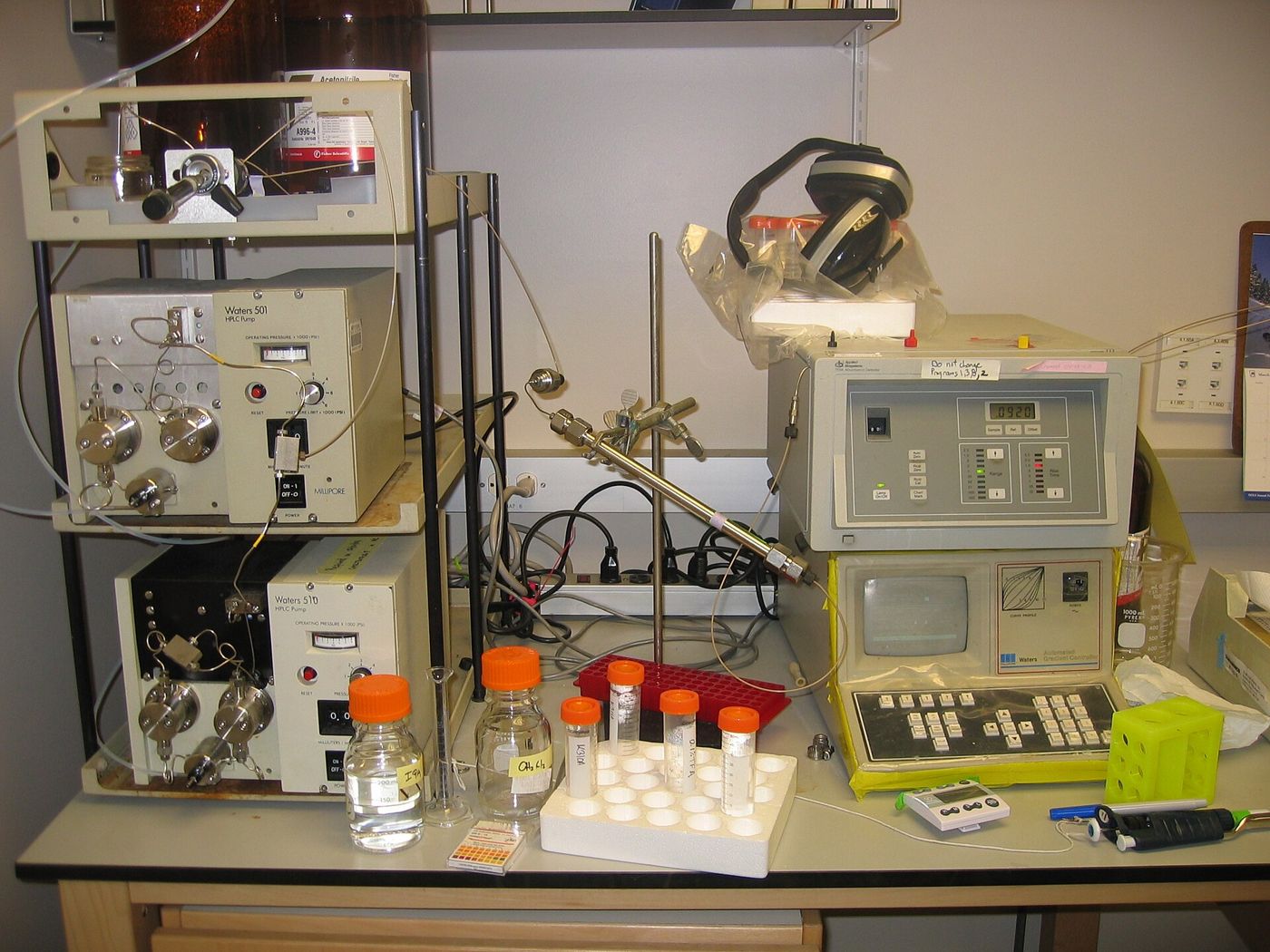
GHK-Cu presents a few analytical quirks. Reversed-phase HPLC mobile phases commonly contain trifluoroacetic acid, and at that acidity the copper complex dissociates. A chromatogram of GHK-Cu run under standard acidic conditions therefore usually reports the free tripeptide, with copper eluting separately or going undetected. HPLC purity remains meaningful for the peptide component, but it says little about copper stoichiometry. The short, polar sequence is also weakly retained on C18 columns.
Mass spectrometry confirms identity through the protonated free peptide near m/z 341.2 and, under gentle ionisation conditions, copper-containing ions with the characteristic 63Cu/65Cu isotope pattern. Copper content itself is better measured by elemental methods such as ICP-OES or ICP-MS, and UV-visible spectroscopy shows a broad visible absorption band from the copper centre that is useful as a quick qualitative check. Our guide to peptide mass spectrometry explains how such spectra are read. The lyophilized solid should be kept dry, cold and protected from light.
GHK-Cu as a Component of Peptide Blends
GHK-Cu also appears in multi-component research vials. Blends sold under the GLOW name are commonly described in the research-peptide market as combining GHK-Cu with BPC-157 and TB-500, although the composition and ratio should always be confirmed on the product listing and the lot certificate of analysis. A laboratory comparing the GLOW multi-peptide blend with single-compound GHK-Cu should expect the copper chemistry described above to complicate analysis, with copper content verified separately. The analytical side of such blends is covered in our GLOW peptide blend profile.
Where the Evidence Stands
The sequence, copper-binding geometry and solution chemistry of GHK-Cu are well established. Its cell biology rests mainly on in vitro studies, some preclinical animal work and gene-expression analyses that remain hypothesis-generating. Researchers should name the experimental system behind each finding, keep free peptide and copper complex distinct in their records, and verify identity and copper content for every lot. GHK-Cu is for laboratory research use only; it is not for human or veterinary use.
References
- Pickart L, Thaler MM. Tripeptide in human serum which prolongs survival of normal liver cells and stimulates growth in neoplastic liver. Nature New Biology, 1973.
- Lau SJ, Sarkar B. The interaction of copper(II) and glycyl-L-histidyl-L-lysine, a growth-modulating tripeptide from plasma. Biochemical Journal, 1981.
- Maquart FX, Pickart L, Laurent M, Gillery P, Monboisse JC, Borel JP. Stimulation of collagen synthesis in fibroblast cultures by the tripeptide-copper complex glycyl-L-histidyl-L-lysine-Cu2+. FEBS Letters, 1988.
- Lamb J, et al. The Connectivity Map: using gene-expression signatures to connect small molecules, genes, and disease. Science, 2006.
- Pickart L, Margolina A. Regenerative and protective actions of the GHK-Cu peptide in the light of the new gene data. International Journal of Molecular Sciences, 2018.
Research Products in This Article
Educational content for research use only. Not for human consumption. Nothing here is medical advice or a claim about safety or efficacy.
 EM