
Kisspeptin: KISS1-Derived Peptides and the KISS1R Receptor
The KISS1 gene products, their shared RF-amide decapeptide, KISS1R Gq signaling, and what animal studies show about hypothalamic GnRH neurons.
 DODaniel Okafor, MSResearch Analyst, Molecular Biology~5 min read
 CompoundsPhoto: kaibara87 / Wikimedia Commons, CC BY 2.0
Kisspeptin is the collective name for a family of peptides encoded by the KISS1 gene, all sharing an amidated C-terminal decapeptide that activates the G protein-coupled receptor KISS1R, also known as GPR54. Kisspeptin peptide research spans two quite different fields. It began in tumour cell biology, where KISS1 was identified as a gene that suppressed metastatic behaviour of melanoma cell lines, and moved into neuroendocrinology once animal studies showed that kisspeptin signaling acts upstream of gonadotropin-releasing hormone (GnRH) neurons in the hypothalamus.
This profile covers the KISS1 gene products and their structures, the identification of KISS1R, the receptor’s signaling pharmacology, and the preclinical research on hypothalamic GnRH neurons. It also explains why anyone working with kisspeptin-10 or a longer form needs to confirm which peptide a given lot actually contains.
From the KISS1 gene to the kisspeptin peptides
KISS1 was described in 1996 in melanoma cell line studies; the name nods to Hershey, Pennsylvania, where the work was done. The gene encodes a precursor of 145 amino acids that is cleaved into a 54-residue peptide, originally named metastin. Shorter fragments of 14, 13 and 10 residues have also been isolated or characterised. All of these share the same C-terminal sequence, ending in an arginine and an amidated phenylalanine. This Arg-Phe-NH2 ending places kisspeptins in the RF-amide peptide family, alongside neuropeptide FF and prolactin-releasing peptide.
| Form | Length | Notes |
|---|---|---|
| Kisspeptin-54 (metastin) | 54 residues | Major processed product of the precursor |
| Kisspeptin-14 | 14 residues | C-terminal fragment |
| Kisspeptin-13 | 13 residues | C-terminal fragment |
| Kisspeptin-10 | 10 residues | YNWNSFGLRF-NH2; minimal fully active sequence |
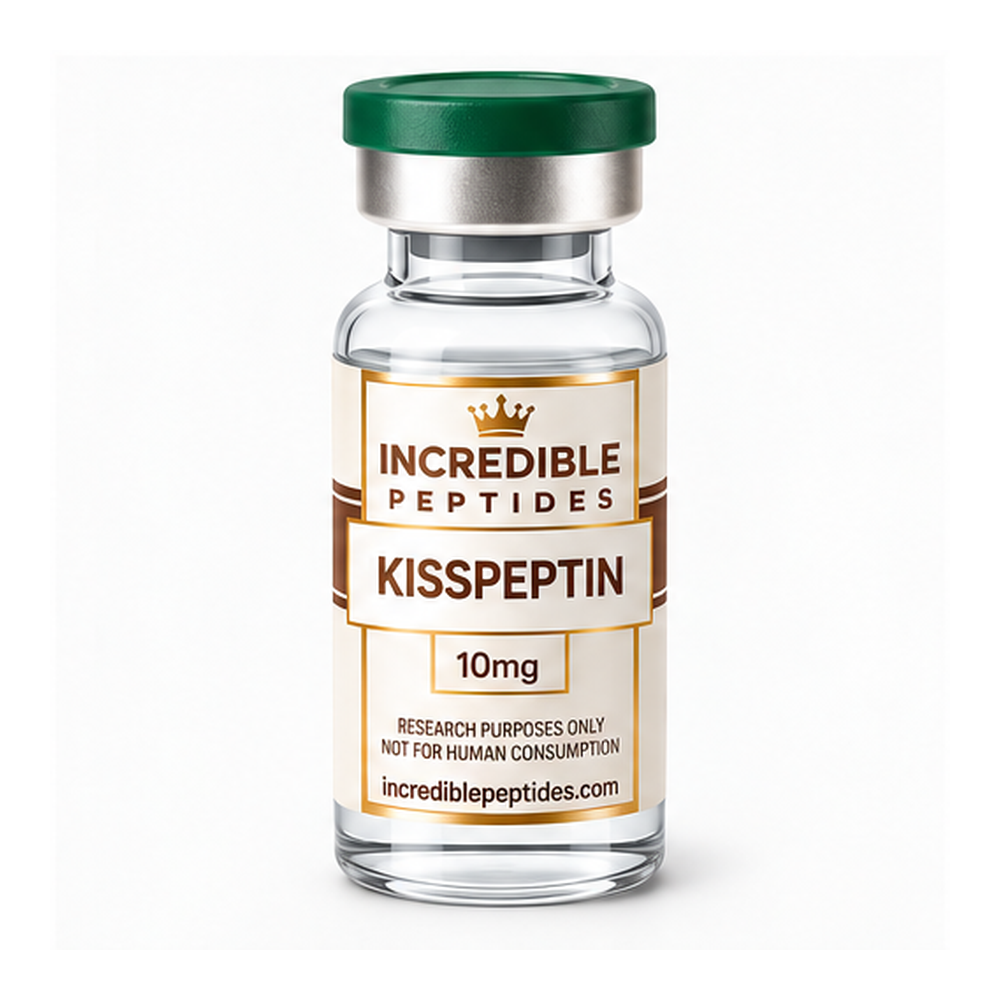
Kisspeptin-10, Tyr-Asn-Trp-Asn-Ser-Phe-Gly-Leu-Arg-Phe-NH2, has the formula C63H83N17O14 and an average molecular weight of about 1302.5 g/mol. Orthologous sequences from other species differ at some positions, so the species origin of a sequence matters when comparing studies. Incredible Peptides lists Kisspeptin 10mg as a research peptide; because the name alone does not specify the form, check the product listing and the lot certificate of analysis to confirm the sequence and length supplied.
Identifying the receptor: GPR54 becomes KISS1R
GPR54 was cloned in 1999 as an orphan receptor with homology to the galanin receptors. In 2001, three groups independently identified KISS1-derived peptides as its endogenous ligands, using reverse pharmacology: they expressed the orphan receptor in cell lines and screened tissue extracts and candidate peptides for activity. The receptor was subsequently renamed KISS1R. In 2003, studies of knockout mice lacking the receptor drew attention to its role in neuroendocrine signaling within the hypothalamic-pituitary-gonadal axis, which redirected much of the field toward the hypothalamus.
KISS1R signaling pharmacology
KISS1R is a class A (rhodopsin-like) GPCR that couples predominantly to Gq/11. Agonist binding activates phospholipase C beta, which hydrolyses phosphatidylinositol 4,5-bisphosphate into inositol trisphosphate and diacylglycerol. Inositol trisphosphate releases calcium from intracellular stores, while diacylglycerol activates protein kinase C. In recombinant cell lines, downstream readouts include ERK1/2 and p38 MAP kinase phosphorylation, and the receptor also recruits beta-arrestins. This contrasts with the luteinising hormone receptor further along the same axis, which couples mainly to Gs and cAMP and is also activated by hCG (human chorionic gonadotropin), a glycoprotein LH receptor agonist used as a reference ligand in cell-based assays. Common in vitro assays for KISS1R include calcium mobilisation, inositol phosphate accumulation and ERK phosphorylation, as described in the article on cell signaling assays.
Structure-activity work has shown that the C-terminal decapeptide carries the full receptor-activating information. Kisspeptin-10 and kisspeptin-54 show broadly similar potency at KISS1R in cell-based assays, and the C-terminal amide is essential: the free-acid analogue loses most of its activity. Short kisspeptins are rapidly degraded by proteases in biological matrices, which has motivated analogues with modified backbones or substitutions at cleavage-prone positions. Prolonged agonist exposure in cell and animal systems produces receptor desensitisation, an important consideration when designing time-course experiments.
Hypothalamic GnRH neuron research in animals
Most of what is known about kisspeptin’s physiological role comes from rodent, sheep and primate studies, and it should be read as preclinical. Kisspeptin-expressing neurons cluster in two hypothalamic regions in rodents: the arcuate nucleus and the rostral periventricular region of the third ventricle. Arcuate kisspeptin neurons co-express neurokinin B and dynorphin and are often called KNDy neurons. GnRH neurons express KISS1R, and electrophysiology in mouse brain slices showed that kisspeptin depolarises them with a long-lasting increase in firing. In whole-animal studies, central kisspeptin stimulated GnRH release and, as a consequence, pituitary gonadotropin secretion, an effect blocked by GnRH receptor antagonists.
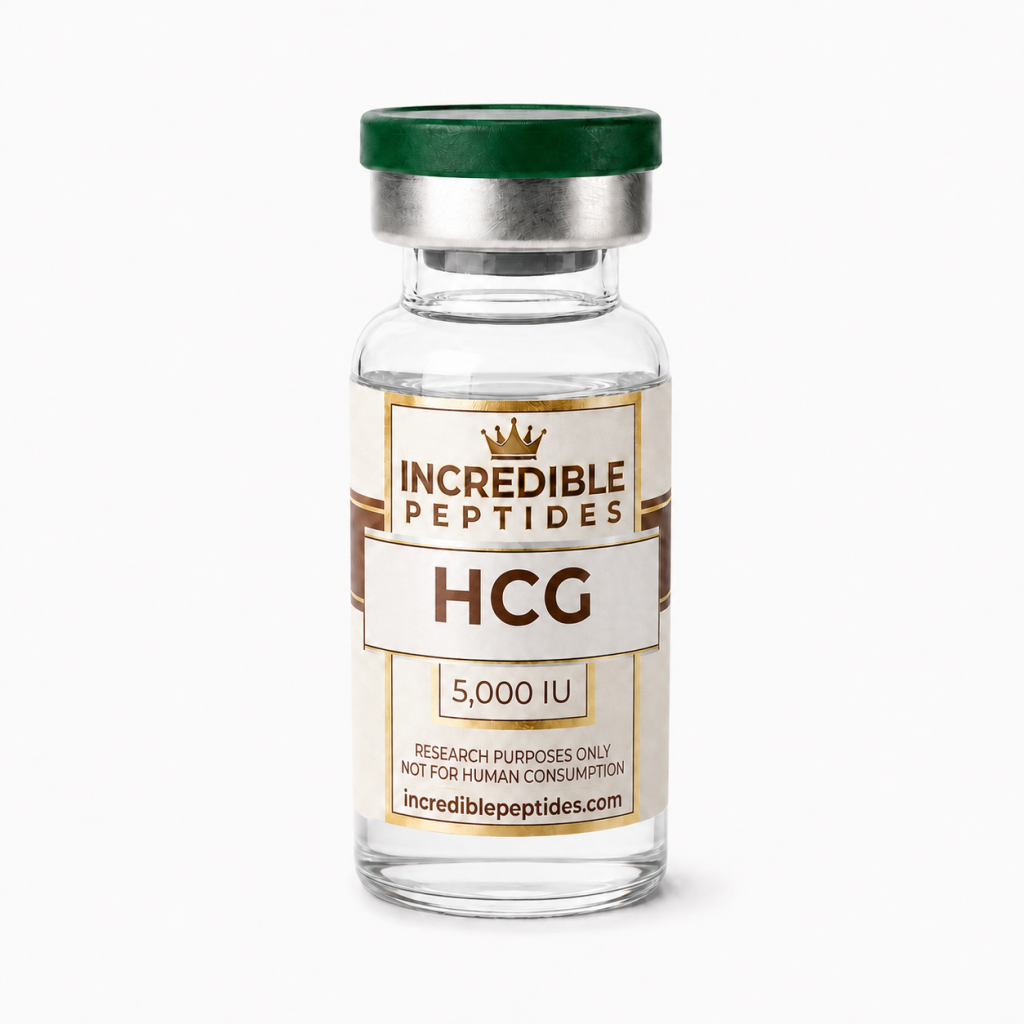
That cascade connects kisspeptin to a second class of research compound. The pituitary releases luteinising hormone (LH), which acts on the LH/choriogonadotropin receptor, a class A GPCR with a large leucine-rich extracellular domain that couples mainly to Gs and cAMP. The same receptor binds hCG, which is why that glycoprotein serves as a reference agonist in LH receptor assays. The structural contrast is stark: kisspeptin-10 is a ten-residue linear peptide acting at a Gq-coupled receptor, whereas hCG is a large heterodimeric glycoprotein, as explained in our profile of hCG as a glycoprotein hormone rather than a peptide.
Handling and analytical considerations
Kisspeptin-10 contains a tryptophan and a tyrosine, so it absorbs at 280 nm and is susceptible to oxidation at tryptophan; storage dry, cold, protected from light and sealed under low humidity is advisable. Three asparagines create deamidation risk in solution, and the C-terminal amide must be confirmed, because the free-acid form differs by only about 1 Da and has much lower activity. Reversed-phase HPLC and electrospray mass spectrometry (protonated mass near m/z 1302.6) are the core identity and purity tests. For longer forms, mass confirmation is the simplest way to verify length. When reviewing documentation for a kisspeptin research lot, confirm the sequence or form stated, the mass found against the expected value, and the lot number on the vial.
Why kisspeptin remains a key receptor model
Kisspeptin is a compact example of how a peptide family discovered in one context became central to another. Its biology rests on a well-defined receptor, a clear Gq signaling pathway and a minimal ten-residue pharmacophore, which make it a convenient tool for receptor pharmacology in vitro. Its physiological role has been mapped mostly in animal models, and those findings should be described as preclinical. Kisspeptin research peptides are for laboratory research use only; they are not for human or veterinary use.
References
- Ohtaki T, Shintani Y, Honda S, et al. Metastasis suppressor gene KiSS-1 encodes peptide ligand of a G-protein-coupled receptor. Nature. 2001.
- Kotani M, Detheux M, Vandenbogaerde A, et al. The metastasis suppressor gene KiSS-1 encodes kisspeptins, the natural ligands of the orphan G protein-coupled receptor GPR54. Journal of Biological Chemistry. 2001.
- Kenakin T. A Pharmacology Primer: Techniques for More Effective and Strategic Drug Discovery. Academic Press.
Research Products in This Article
Educational content for research use only. Not for human consumption. Nothing here is medical advice or a claim about safety or efficacy.