Oxytocin: Structure of a Cyclic Nonapeptide Hormone
How a nine-residue disulfide ring became the first synthetic peptide hormone, and what its chemistry and receptor pharmacology teach researchers.
 DODaniel Okafor, MSResearch Analyst, Molecular Biology~5 min read
 CompoundsPhoto: Gannu03 / Wikimedia Commons
Oxytocin is a peptide hormone made of nine amino acids. Two of them are joined by a sulfur bridge, called a disulfide bond, which closes part of the chain into a ring. Oxytocin also holds a special place in the history of chemistry. In 1953 it became the first peptide hormone to be made in the lab. For researchers, the oxytocin peptide is a small model of several themes that come up again and again in peptide science. It shows how one disulfide bond limits the shapes a chain can take. It shows how just two amino acid swaps set oxytocin apart from vasopressin at the receptor. It also shows how the chemistry of cysteine controls how well a small ring-shaped peptide holds up in solution.
This profile covers the structure of oxytocin and Vincent du Vigneaud’s synthesis. It then looks at how the oxytocin receptor (OXTR) works in cell-based systems. Next it compares oxytocin with vasopressin. Last, it gives practical points on handling and testing a molecule that holds a disulfide bond.
Sequence and structure
Oxytocin has the sequence Cys-Tyr-Ile-Gln-Asn-Cys-Pro-Leu-Gly-NH2. In one-letter code it is CYIQNCPLG-NH2. A disulfide bond joins Cys1 and Cys6. This forms a ring of 20 atoms that spans six residues. A three-residue tail, Pro-Leu-Gly-NH2, sticks out from the ring. The last glycine at the C-terminal end carries an amide group. So the molecule has no free acid group at that end. Older papers counted the two half-cystines as one cystine residue. For that reason, they describe oxytocin as an octapeptide amide.
| Property | Value |
|---|---|
| Sequence | CYIQNCPLG-NH2, disulfide Cys1-Cys6 |
| Molecular formula | C43H66N12O12S2 |
| Average molecular weight | approx. 1007.2 g/mol |
| Monoisotopic mass | approx. 1006.44 Da |
| Ring size | 20 atoms (six residues) |
| Chromophore | Tyr2 (absorbs near 275 to 280 nm) |
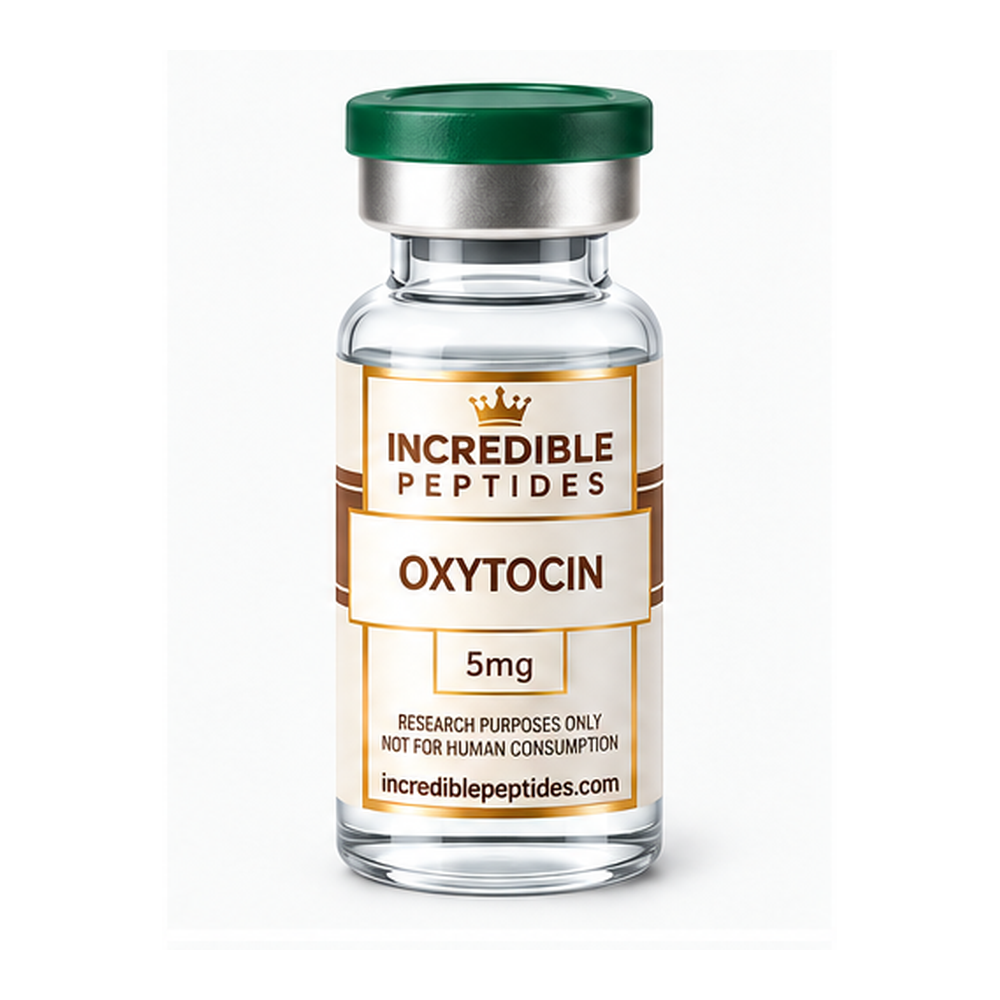
The ring is not stiff. NMR and crystal studies show that it can flex. The tyrosine side chain and the tail point in different ways, based on their surroundings. Even so, the disulfide bond limits the shapes the peptide can take. The open, linear form has far more freedom. If the disulfide is broken by reduction, the peptide loses most of its activity at the receptor. Incredible Peptides lists Oxytocin 5mg, the synthetic ring-shaped nonapeptide. The lot certificate of analysis is the reference for its identity, purity and salt form.
Du Vigneaud and the first synthetic peptide hormone
In the early 1950s, Vincent du Vigneaud’s group at Cornell University Medical College worked out the structure of oxytocin. They took it from extracts of the back lobe of the pituitary gland, called the posterior pituitary. Hans Tuppy found the sequence on his own at about the same time. In 1953 du Vigneaud and his team reported how they made it. They used classical chemistry in solution. They built the chain one step at a time, then formed the disulfide by oxidation. They showed that the man-made product matched the natural hormone. It had the same physical traits. It also gave the same results in classical tests on isolated animal tissue. Du Vigneaud won the 1955 Nobel Prize in Chemistry for this work. The prize honored his work on compounds that contain sulfur and the first synthesis of a polypeptide hormone.
This feat came a decade before Merrifield’s solid-phase method. Today oxytocin is made as a matter of routine by solid-phase synthesis. The disulfide is then formed and the product is purified. The article on peptide synthesis outlines these steps.
How the oxytocin receptor works
The oxytocin receptor is a class A GPCR, a type of receptor that sits in the cell membrane. Its main partner is the Gq/11 protein. This turns on an enzyme called phospholipase C beta. That enzyme makes inositol trisphosphate and diacylglycerol. These signals then free calcium from stores inside the cell. Some cell systems also show links to Gi/o. Binding studies have found two more points. First, strong binding of agonists, the compounds that turn the receptor on, needs metal ions with a double charge. Magnesium matters most. Second, cholesterol in the membrane helps keep the receptor in its strong-binding state. Both facts matter when you design membrane-binding assays. In these tests, the buffer and the way the membrane is prepared can shift the measured affinity.
Lab work in cells most often uses cell lines such as HEK293 or CHO. These cells are made to express recombinant OXTR. Common readouts are a rise in calcium, a build-up of inositol phosphate, or ERK phosphorylation. Labs use synthetic oxytocin as a reference agonist in these assays. They plot concentration-response curves. They can then compare analogues against those curves. The core ideas of affinity and potency are covered in binding affinity and EC50.
Oxytocin and vasopressin compared
Arginine vasopressin, CYFQNCPRG-NH2, has the same basic design. It has a Cys1-Cys6 disulfide ring, a three-residue tail and a glycinamide at the C-terminal end. It differs from oxytocin at only two places.
| Position | Oxytocin | Arginine vasopressin |
|---|---|---|
| 3 | Ile | Phe |
| 8 | Leu | Arg |
| Average molecular weight | approx. 1007.2 | approx. 1084.2 |
Those two swaps shift which receptor each peptide prefers. The choice is between OXTR and the vasopressin receptors V1a, V1b and V2. But this preference is not complete. Oxytocin has some activity at V1a receptors. Vasopressin also turns on OXTR. So tests with recombinant receptors should add the right controls. These include selective antagonists, or cells that lack the receptor. Use them where cross-reactivity could cloud the results. Both peptides belong to a very old family. Vertebrates that are not mammals use related peptides such as vasotocin. Vasotocin mixes features of both.
Disulfide handling and stability
The disulfide is the most important chemical feature of oxytocin. In solution, the peptide can break down in several ways. One is deamidation, the loss of an amide group. It can happen at Gln4, Asn5 and the glycinamide at the C-terminal end. Other reactions happen at the disulfide itself. These include beta-elimination and the forming of trisulfides and tetrasulfides. Disulfide exchange can also link chains into dimers and larger clumps. These reactions depend strongly on pH and heat. The peptide is most stable in mildly acidic conditions. It is much less stable at neutral and alkaline pH. Reducing agents such as DTT or TCEP will open the ring. Use them only on purpose.
Mass spectrometry can tell several of these forms apart directly. The reduced, linear peptide is 2 Da heavier than the ring form. A dimer bound by a covalent link shows up near twice the mass of one unit. Deamidation adds about 1 Da. Reversed-phase HPLC splits dimers and many breakdown products away from the main peak. Ellman’s reagent can test for free thiol. Good storage follows from this chemistry. Keep dry material cold, sealed and out of the light. Make solutions fresh in a suitable buffer. Split them into small portions to avoid repeated freeze-thaw cycles. Oxytocin is like other single-sequence compounds in the research peptides catalogue. Check it against its lot certificate for identity and purity before you use it in assays. More detail is given in the article on peptide stability and degradation.
A small ring with a long scientific history
Oxytocin brings together a rich history and lasting value as a model compound. It has a ring held in place by a disulfide, a tail with an amide end, and close ties to vasopressin. These traits make it ideal for studying how small changes in structure alter which receptor a peptide prefers. Its cysteine chemistry also shows stability problems that many ring-shaped peptides share. Oxytocin research peptide is supplied for laboratory research use only. It is not for human or veterinary use.
References
- du Vigneaud V, Ressler C, Swan JM, Roberts CW, Katsoyannis PG, Gordon S. The synthesis of an octapeptide amide with the hormonal activity of oxytocin. Journal of the American Chemical Society. 1953, 75, 4879.
- Gimpl G, Fahrenholz F. The oxytocin receptor system: structure, function, and regulation. Physiological Reviews. 2001.
- Hawe A, Poole R, Romeijn S, Kasper P, van der Heijden R, Jiskoot W. Towards heat-stable oxytocin formulations: analysis of degradation kinetics and identification of degradation products. Pharmaceutical Research. 2009.
- Merrifield RB. Solid phase peptide synthesis. I. The synthesis of a tetrapeptide. Journal of the American Chemical Society. 1963, 85, 2149.
- The Nobel Prize in Chemistry 1955: Vincent du Vigneaud. Nobel Foundation.
Research Product in This Article
Educational content for research use only. Not for human consumption. Nothing here is medical advice or a claim about safety or efficacy.