
CagriSema (G1-S/C Blend): Cagrilintide and Semaglutide in Research
The chemistry behind CagriSema: two lipidated peptides from different receptor families in one vial, and what that means for formulation and analytical testing.
 DODaniel Okafor, MSResearch Analyst, Molecular Biology~5 min read
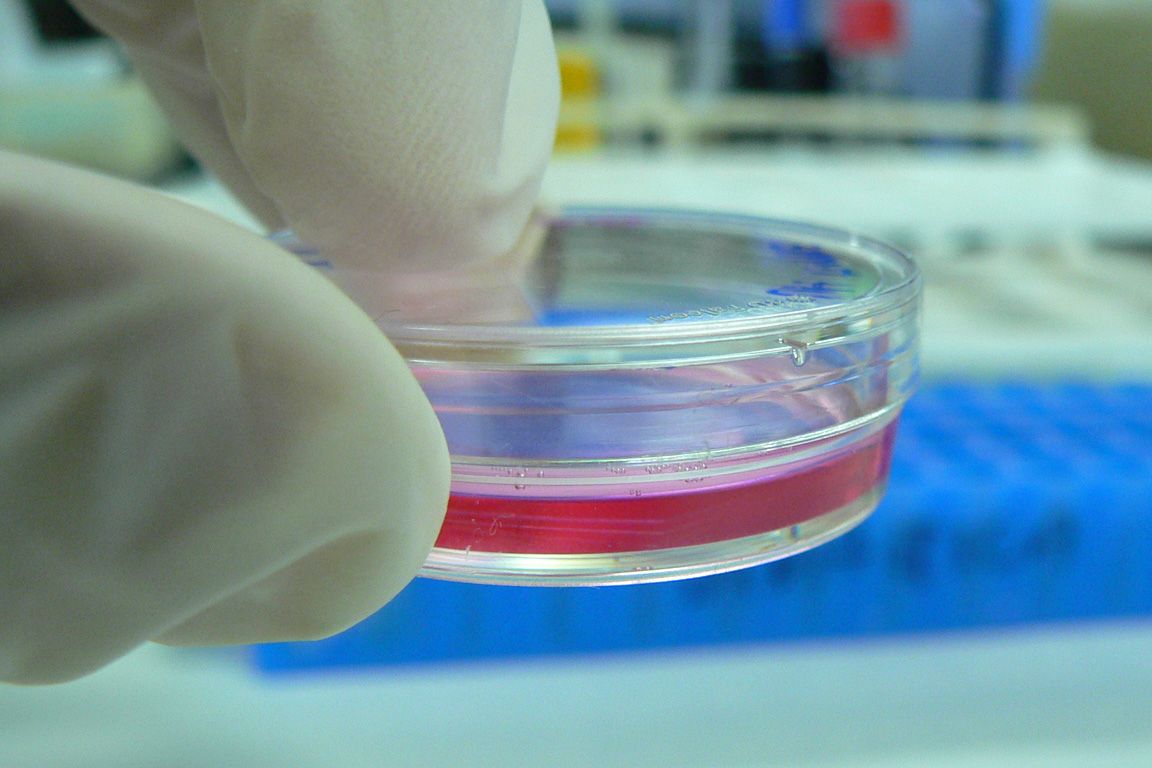
 CompoundsPhoto: Nadine90 / Wikimedia Commons, CC BY-SA 3.0
CagriSema is the name used in the scientific literature for a combination of two lipidated peptides: cagrilintide, a long-acting amylin analogue, and semaglutide, a long-acting GLP-1 analogue. For a research chemist the pairing is interesting less as a product than as a case study. It places two peptides from different receptor families, each carrying a long-chain acyl side chain, in the same vial, and that raises questions about receptor pharmacology, solution behaviour and analytical testing that do not arise with a single compound.
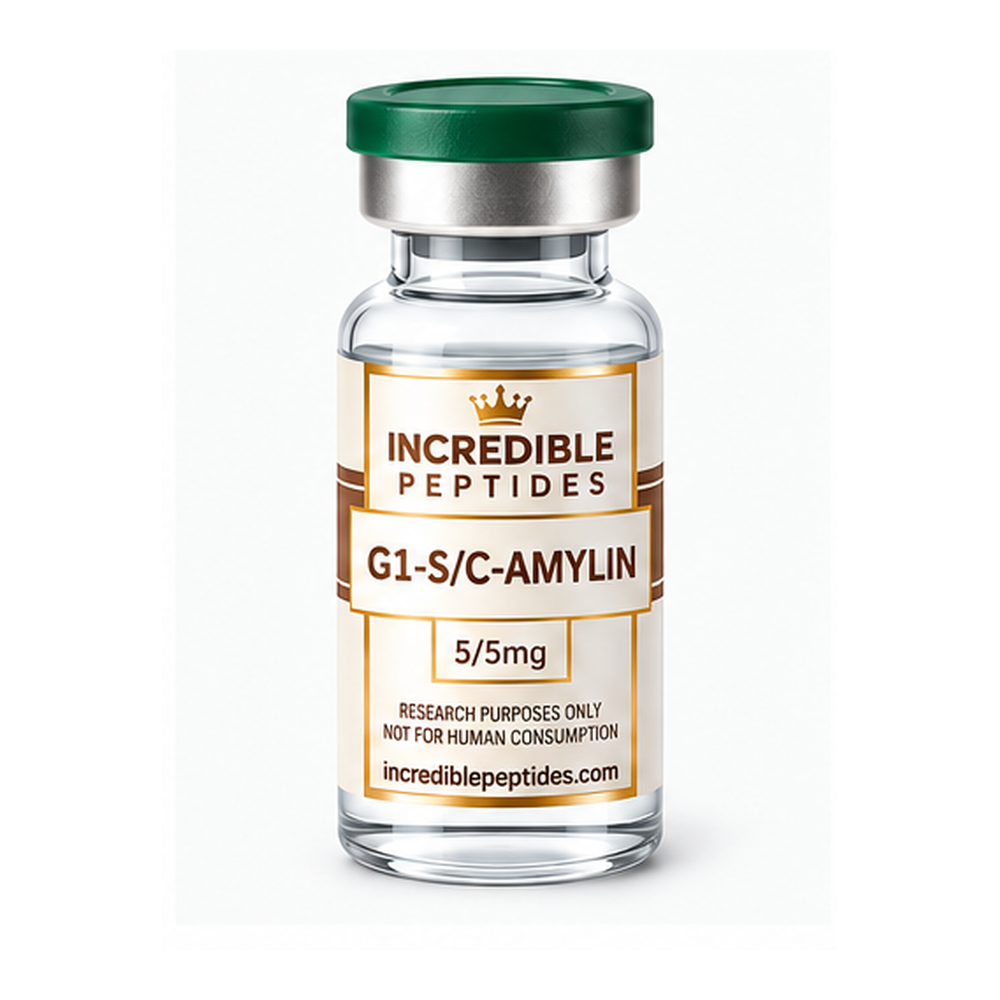
This article describes each component, the receptor-level rationale for studying them together, and the formulation and testing considerations for a two-peptide blend. Incredible Peptides supplies this combination as the G1-S/C-Amylin Blend 5/5mg, a semaglutide-cagrilintide research blend.
What the name refers to
The name is a contraction of the two components, “Cagri” for cagrilintide and “Sema” for semaglutide. Both molecules come from the same medicinal chemistry tradition, in which a peptide hormone is stabilized against proteolysis and then given a lipid side chain that binds reversibly to serum albumin, extending its exposure in animal pharmacokinetic studies. Because the two analogues share that design logic, they have similar physicochemical character, which is part of what makes co-formulation conceivable.
The research blend sold as G1-S/C-Amylin Blend 5/5mg is labelled as containing 5 mg of each peptide per vial. Composition, counter-ion and per-component content should always be confirmed against the product listing and the certificate of analysis for the specific lot, rather than inferred from the name.
The two components
Semaglutide
Semaglutide is an analogue of GLP-1(7-37), a 31-residue peptide. Three changes distinguish it from the native sequence. Alanine at position 8 is replaced by α-aminoisobutyric acid (Aib), a non-proteinogenic residue that protects the N-terminus from cleavage by dipeptidyl peptidase-4. Lysine 34 is replaced by arginine, leaving lysine 26 as the single attachment point for the side chain. That side chain consists of an octadecanedioic acid (C18 diacid) linked through a γ-glutamic acid spacer and two 8-amino-3,6-dioxaoctanoic acid units. The resulting molecule has an average molecular weight of roughly 4.11 kDa. Its design history is described by Lau and colleagues and summarized by Knudsen and Lau; our semaglutide peptide structure profile covers it in more depth.
Cagrilintide
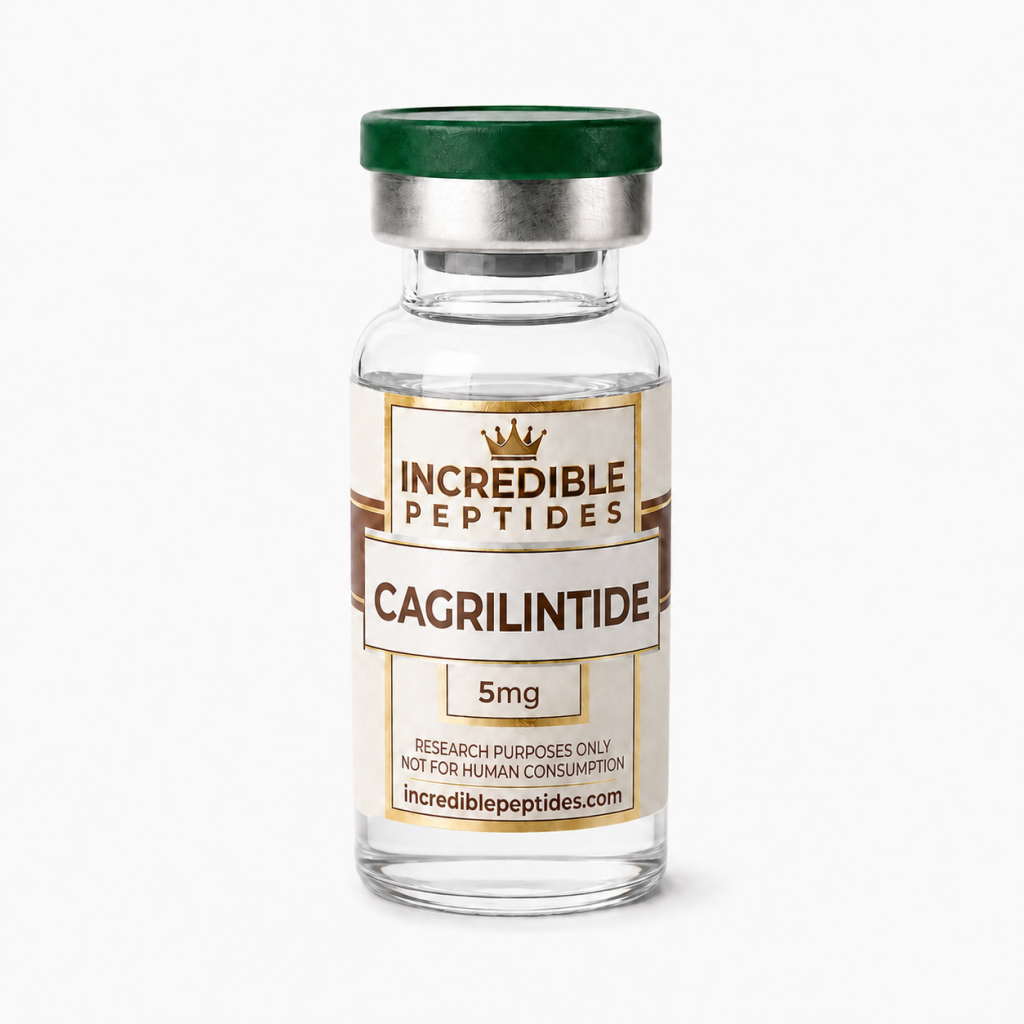
Cagrilintide is derived from amylin, a 37-residue peptide of the calcitonin family with a disulfide-bonded N-terminal ring and an amidated C-terminus. The parent sequence aggregates into amyloid fibrils, so the analogue carries substitutions that suppress fibrillation and improve chemical stability, plus an N-terminal acylation with a long-chain diacid. The details are set out by Kruse and colleagues and in our cagrilintide profile.
Receptor rationale: two complementary families
Both targets are class B G protein-coupled receptors that signal predominantly through Gs and cAMP, but they are pharmacologically distinct. Semaglutide acts at the GLP-1 receptor, a single gene product. Cagrilintide acts at the amylin receptors, which are complexes of the calcitonin receptor (CTR) with receptor activity-modifying proteins RAMP1, RAMP2 or RAMP3, and it has also been described as activating CTR itself. Neither component is expected to engage the other’s receptor to a meaningful degree, so the pairing is a way to activate two separate receptor systems with one material rather than to strengthen activity at a single target.
Preclinical interest in the combination draws on receptor anatomy. GLP-1 receptors and amylin receptors are both expressed in brainstem regions such as the area postrema and the nucleus of the solitary tract, so animal-model studies can ask whether co-activation of the two pathways produces interactions that neither produces alone. Answering that question requires the right design: each component on its own, the combination, and a vehicle control, ideally across several concentration ratios. Single-component material such as standalone cagrilintide is therefore needed alongside the blend, because a blend alone cannot separate the contribution of each peptide. Selective antagonists, for example exendin(9-39) at the GLP-1 receptor, can help confirm which receptor mediates a response in a cell-based or tissue assay.
Formulation challenges of a two-peptide blend
Putting two peptides in one container is not simply a matter of mixing powders. In solution, each peptide has its own pH-solubility profile, isoelectric point and aggregation tendency. Amylin analogues have historically been handled at acidic pH, where the native peptide is less prone to fibrillation, whereas semaglutide is commonly characterized near neutral pH. The cagrilintide design work reportedly emphasized solubility and physical stability across a broader pH range, a property that matters whenever an amylin analogue must share a solution with another peptide. Both molecules are amphiphilic, and lipidated peptides can self-associate into oligomers or micelle-like assemblies whose behaviour may change when a second amphiphile is present.
A lyophilized blend shifts most of those questions to the moment the material is dissolved for analysis or an assay. A laboratory using such a blend should record the solvent, pH and concentration, and regard solution stability as something to measure rather than assume, for instance by repeating HPLC analysis at set intervals. Our guide to peptide blends and multi-peptide vials discusses these issues more generally.
Stoichiometry is a second point. An equal-mass blend is not an equimolar blend, because the two peptides have different molecular weights, and the actual peptide content of each component also depends on counter-ions and residual water. Molar amounts should be calculated from each component’s molecular weight and, where reported, its net peptide content.
Analytical testing of a semaglutide and cagrilintide blend
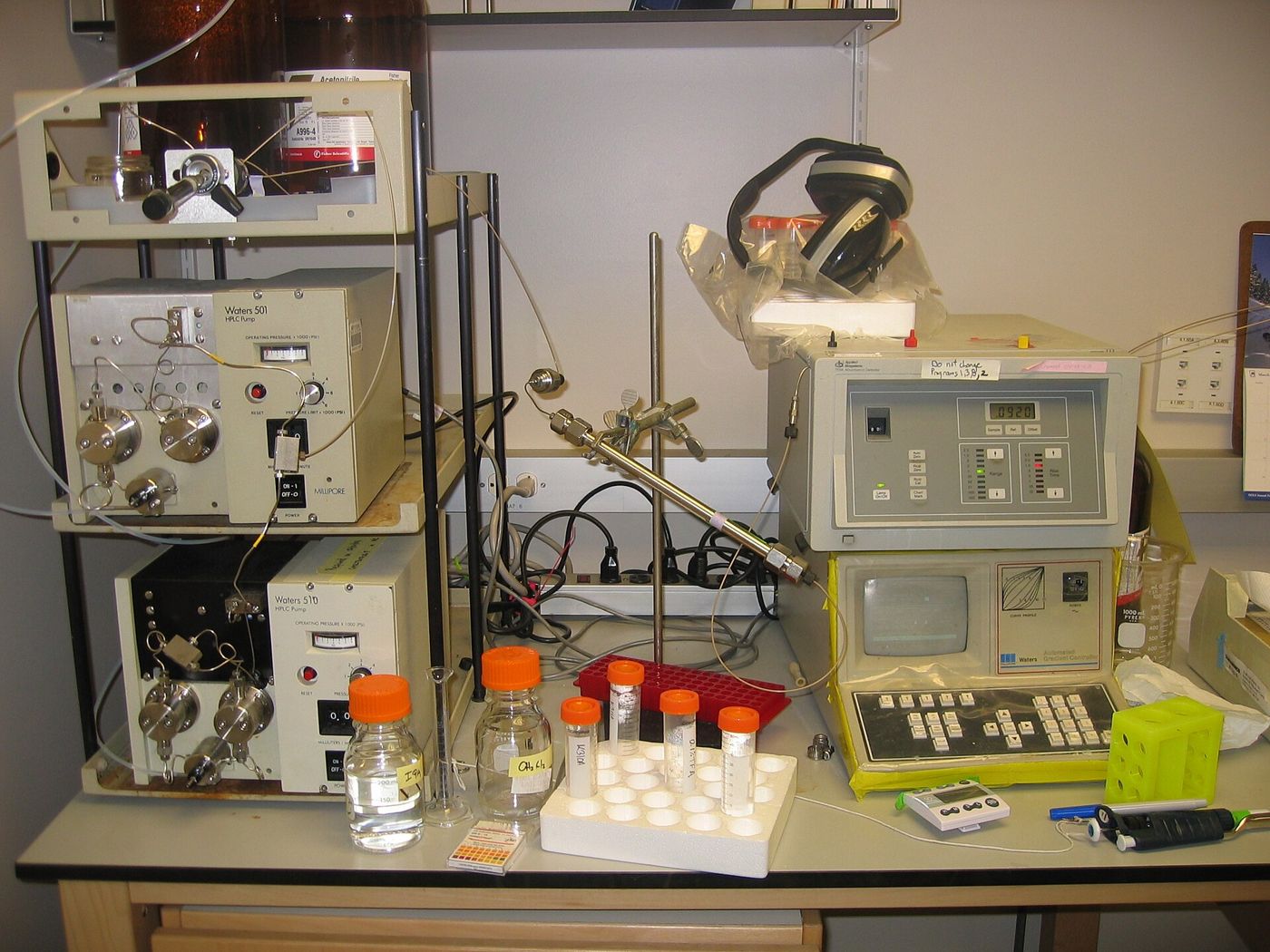
A single area-percent purity figure is ambiguous for a blend: it can describe the total of two main peaks, or one peak relative to everything else. Meaningful testing reports each component separately. A reversed-phase HPLC method has to resolve two strongly retained, lipidated peptides from each other and from their related impurities, such as variants missing the acyl side chain, deamidated forms or deletion sequences, and the method should be shown to do so. Identity is confirmed by mass spectrometry, where the two components give distinct deconvoluted masses from their multiply charged ion series, and per-component assay or content figures indicate whether the labelled ratio is actually present.
When reviewing documentation for the semaglutide-cagrilintide blend, look for an observed mass for each peptide, a chromatogram showing both peaks with their retention times, and a statement of how purity and content were calculated.
A two-receptor research tool
CagriSema is best understood as an exercise in compatible design: two lipidated analogues, each stabilized against its own weaknesses, combined to engage the GLP-1 receptor and the CTR-RAMP receptor family at once. For the laboratory, the useful questions are the ones about chemistry and evidence quality: whether each component’s identity and content are documented, whether solution behaviour has been measured, and whether experiments include single-component controls. The blend is supplied for laboratory research use only; not for human or veterinary use.
References
- Kruse T, Hansen JL, Dahl K, et al. Development of cagrilintide, a long-acting amylin analogue. J Med Chem. 2021.
- Lau J, Bloch P, Schäffer L, et al. J Med Chem. 2015 (discovery of semaglutide).
- Knudsen LB, Lau J. The discovery and development of liraglutide and semaglutide. Front Endocrinol. 2019.
- Poyner DR, Sexton PM, Marshall I, et al. International Union of Pharmacology. XXXII. The mammalian calcitonin gene-related peptides, adrenomedullin, amylin, and calcitonin receptors. Pharmacol Rev. 2002.
- ICH Q2(R2). Validation of Analytical Procedures. International Council for Harmonisation.
Research Products in This Article
Educational content for research use only. Not for human consumption. Nothing here is medical advice or a claim about safety or efficacy.
 EM