Peptide Light and Moisture Sensitivity
Why some residues are light-sensitive, how moisture accelerates degradation in lyophilized peptides, and which packaging and handling steps help.
 EMElena Marsh, PhDSenior Research Analyst, Analytical Chemistry~5 min read
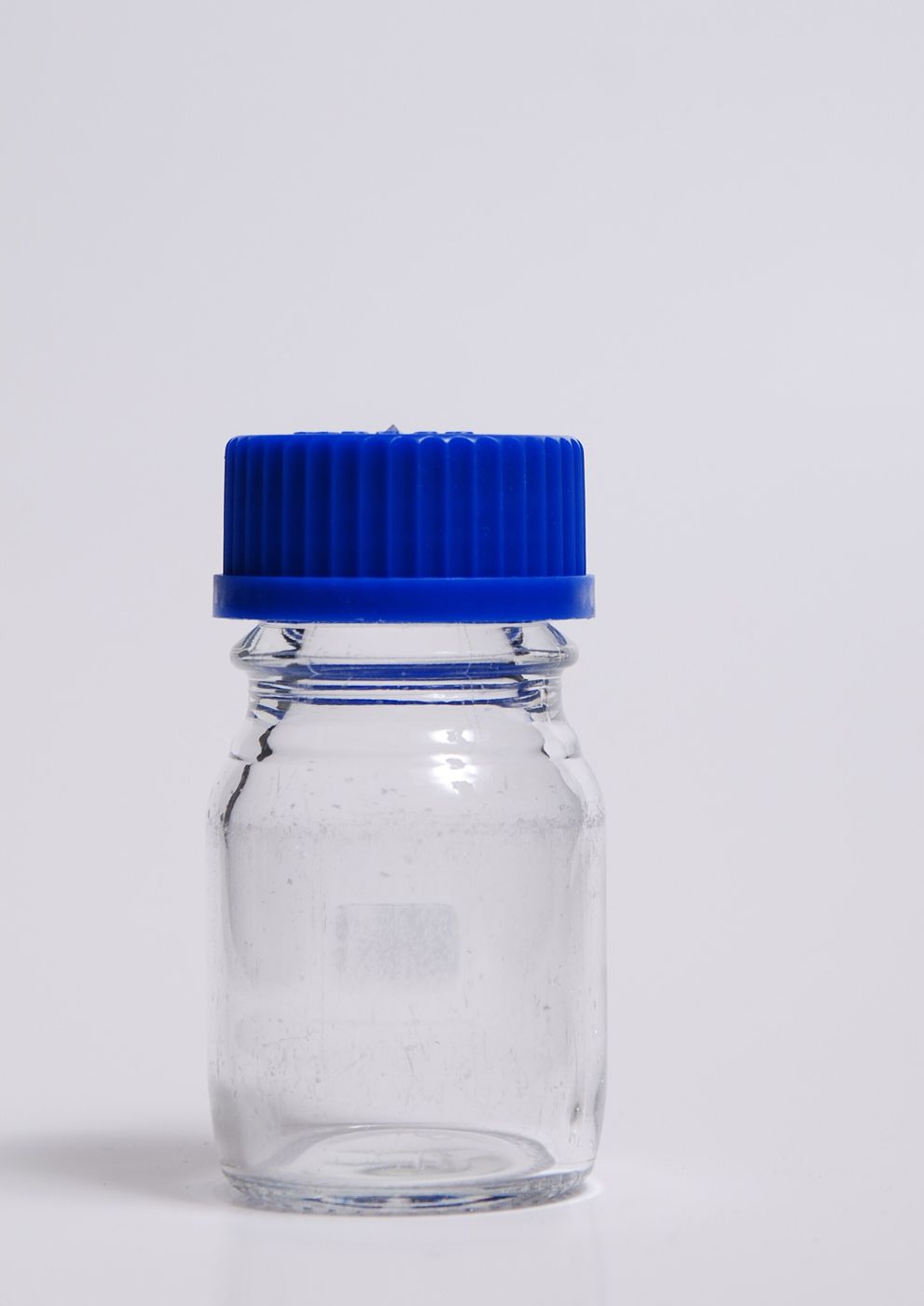 StabilityPhoto: Lilly_M / Wikimedia Commons, CC BY-SA 3.0
Lyophilized peptides look inert: a small white cake or powder at the bottom of a sealed vial. In practice they respond to two everyday environmental factors that are easy to underestimate. Certain amino acid side chains absorb ultraviolet and short-wavelength visible light and can undergo photochemical damage, and most freeze-dried peptides are hygroscopic, readily taking up water from the air the moment a vial is opened. Hygroscopic peptides that absorb moisture become more chemically reactive and harder to weigh accurately.
This article explains the chemistry behind photodegradation and moisture uptake, how standard photostability testing is structured, which packaging features reduce exposure, and which handling habits in the laboratory make the biggest difference. It is written for laboratory staff who receive, weigh and prepare peptide materials.
Photodegradation
Light only causes chemical change if it is absorbed. Among the standard amino acids, the main chromophores are the aromatic side chains of tryptophan, tyrosine and, more weakly, phenylalanine, which absorb in the ultraviolet region, together with disulfide bonds, which absorb weakly at short UV wavelengths. Sequences containing tryptophan, tyrosine, methionine, histidine or cysteine are common across lyophilized research peptides, so light sensitivity is a general consideration rather than a niche one.
Photodegradation proceeds by two broad routes. In direct photolysis, an absorbing residue is excited and reacts itself; disulfide bonds can be cleaved this way, and excited tryptophan can transfer energy or electrons to neighboring groups. In photosensitized reactions, another molecule absorbs light and generates reactive oxygen species, most notably singlet oxygen, which then attack electron-rich residues. Tryptophan, methionine, histidine, tyrosine and cysteine are the usual targets. Tryptophan oxidation yields products such as N-formylkynurenine and kynurenine, some of which are colored, which is one reason a degraded sample may develop a faint yellow tint. Photosensitizers are not always obvious: riboflavin in cell culture media, for example, is known to generate reactive oxygen species under ordinary laboratory lighting.
How Photostability Is Tested
ICH Q1B sets out the standard approach to photostability testing in pharmaceutical development, and its design is a useful reference for research materials. Samples are exposed to a defined light source providing an overall illumination of not less than 1.2 million lux hours and an integrated near-ultraviolet energy of not less than 200 watt hours per square meter. A dark control, protected with aluminum foil and held alongside, separates light effects from thermal ones. The guideline distinguishes forced-degradation testing, which aims to reveal pathways, from confirmatory testing, which evaluates whether a given packaging configuration provides adequate protection.
Moisture and Hygroscopic Powders
Freeze-drying produces an amorphous solid with a very large internal surface area and little residual water. Both properties make the material eager to absorb moisture. The degree of hygroscopicity varies with sequence and salt form: peptides with many charged residues such as arginine, lysine, histidine, aspartate and glutamate tend to take up more water, and counterions left from purification, commonly trifluoroacetate or acetate, also contribute.
Absorbed water has several consequences. It acts as a plasticizer, lowering the glass transition temperature of the amorphous solid and increasing molecular mobility, which allows hydrolysis, deamidation and oxidation to proceed faster than in a dry cake. Sufficient moisture can cause the cake to shrink, collapse or become sticky. There is also a purely quantitative problem: if a powder has gained water, a weighed portion contains less peptide than its mass suggests, and every concentration calculated from it will be biased low. This is why net peptide content and residual water are worth checking in a supplier’s quality testing documentation before preparing stock solutions. Water content in solids is usually measured by Karl Fischer titration, described in USP general chapter <921> Water Determination.
Moisture and light interact with the chemistry covered in our overview of peptide stability and degradation pathways. A moist, light-exposed sample containing methionine or tryptophan is exposed to several reinforcing routes at once.
Packaging Choices
Packaging is the first line of defense, and each element addresses a particular risk.
| Packaging element | Main protection | Limitation |
|---|---|---|
| Amber glass vial | Absorbs much UV and short-wavelength visible light | Does not block all wavelengths; offers no moisture protection on its own |
| Opaque carton or foil overwrap | Near-complete light exclusion during storage | Protection ends once the vial is removed |
| Butyl rubber stopper with crimp seal | Low moisture and oxygen permeability | Puncturing or repeated opening compromises the seal |
| Inert gas headspace (nitrogen or argon) | Reduces oxygen available for oxidation | Lost when the vial is opened in air |
| Desiccant in secondary packaging | Absorbs moisture in the outer container | Capacity is finite and must be refreshed |
Clear glass vials are common for lyophilized peptides and are acceptable when the vial is kept in a closed carton or a dark freezer. Plastic tubes are more permeable to water vapor and oxygen than sealed glass, which makes them less suitable for long-term storage of solids. For laboratory aliquots, amber or foil-wrapped tubes held inside a sealed container with desiccant give reasonable protection.
Handling in the Lab
The most important single habit is to let a cold vial warm to room temperature before opening it, ideally inside a desiccator. Opening a vial straight from the freezer exposes the cold solid to room air, and moisture condenses directly onto the powder. Weigh quickly, in a low-humidity environment where possible, and reseal promptly. If the laboratory has a supply of dry nitrogen or argon, a gentle purge of the headspace before resealing helps limit both moisture and oxygen.
Light exposure in the laboratory is often cumulative rather than dramatic. Fluorescent lighting emits some ultraviolet, and windows admit daylight. Keep solids and solutions covered when they are not being handled, wrap clear tubes in foil, and avoid leaving samples on a bench or autosampler tray longer than necessary. Dividing material into single-use aliquots reduces the number of times the main stock is opened. Our guide to peptide storage covers aliquoting and labeling in more detail.
Visual inspection is a useful first check: clumping, a glassy or shrunken cake, or yellow discoloration all suggest moisture or light damage. Appearance cannot confirm integrity, however. Only analytical methods such as reversed-phase HPLC and mass spectrometry can show whether oxidation or hydrolysis products are present, which is why lot-level peptide purity testing carries more weight than how a powder looks.
Keeping Light and Water Out
Light and moisture damage are among the most preventable forms of peptide degradation. Knowing which residues in a sequence absorb light or oxidize readily, recognizing that lyophilized powders are hygroscopic, choosing packaging that excludes both, and building simple handling routines around warming, weighing and resealing go a long way toward preserving material quality between receipt and use.
References
- ICH Q1B. Stability Testing: Photostability Testing of New Drug Substances and Products. International Council for Harmonisation.
- ICH Q1A(R2). Stability Testing of New Drug Substances and Products. International Council for Harmonisation.
- United States Pharmacopeia. General Chapter <921> Water Determination.
- Manning MC, Chou DK, Murphy BM, Payne RW, Katayama DS. Stability of protein pharmaceuticals: an update. Pharmaceutical Research, 2010.
- Wang W. Lyophilization and development of solid protein pharmaceuticals. International Journal of Pharmaceutics, 2000.
Educational content for research use only. Not for human consumption. Nothing here is medical advice or a claim about safety or efficacy.