
Thymosin Alpha-1: A 28-Residue Thymic Peptide
The acetylated 28-residue peptide from thymosin fraction 5: its sequence, its precursor, in vitro signaling studies, and how it differs from thymosin beta-4 and thymalin.
 DODaniel Okafor, MSResearch Analyst, Molecular Biology~5 min read
 Compounds
Thymosin alpha-1 is a 28-residue peptide, N-terminally acetylated, that was first purified from a crude calf thymus preparation in the 1970s. Despite the shared name, it is structurally unrelated to thymosin beta-4 and quite different from thymus extract preparations such as thymalin. For researchers, thymosin alpha 1 is interesting on several levels: as a product of a larger nuclear precursor protein, as an intrinsically disordered acidic peptide, and as a ligand whose cellular targets are still only partly defined.
This profile covers the discovery of thymosin alpha-1 in thymosin fraction 5, its sequence and physicochemical properties, its relationship to prothymosin alpha, the in vitro studies that have examined Toll-like receptor signaling, and practical points on handling and analysis. It deliberately stays at the level of chemistry and cell biology.
Discovery in thymosin fraction 5
In the 1960s Allan Goldstein and Abraham White prepared partially purified extracts of calf thymus, and one of these, known as thymosin fraction 5, became a standard starting material. Fraction 5 is a mixture of many small acidic polypeptides. Goldstein’s group named its components by their behaviour on isoelectric focusing: alpha thymosins have isoelectric points below about 5, beta thymosins between about 5 and 7, and gamma thymosins above 7. The name therefore describes a fractionation scheme rather than a structural family, which is why thymosin alpha-1 and thymosin beta-4 share a label but little else.
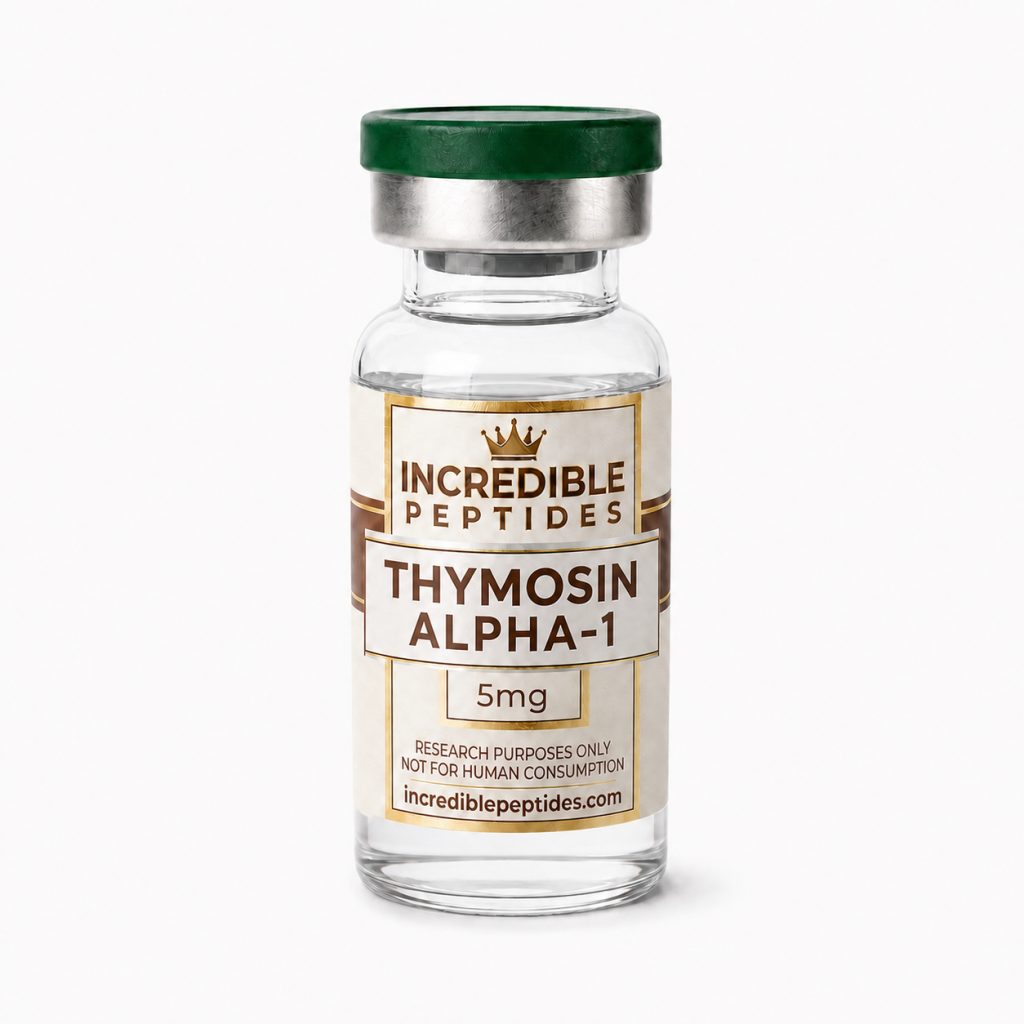
Thymosin alpha-1 was isolated from fraction 5 and sequenced in 1977. It was later prepared by chemical synthesis, and today research material is produced synthetically, typically by solid-phase methods. Incredible Peptides lists a synthetic thymosin alpha-1 research peptide; as with any lot, the certificate of analysis defines its identity and purity.
Sequence and physicochemical properties
The sequence of thymosin alpha-1 is Ac-Ser-Asp-Ala-Ala-Val-Asp-Thr-Ser-Ser-Glu-Ile-Thr-Thr-Lys-Asp-Leu-Lys-Glu-Lys-Lys-Glu-Val-Val-Glu-Glu-Ala-Glu-Asn-OH, or in one-letter code Ac-SDAAVDTSSEITTKDLKEKKEVVEEAEN. The N-terminal serine is acetylated and the C-terminus is a free acid.
| Property | Value |
|---|---|
| Length | 28 residues |
| N-terminus | Acetylated serine |
| Molecular formula | C129H215N33O55 |
| Average molecular weight | approx. 3108.3 g/mol |
| Acidic groups | 3 Asp, 6 Glu, C-terminal carboxylate |
| Basic groups | 4 Lys (N-terminus blocked) |
| Approximate net charge at pH 7 | -6 |
| Cys, Met, Trp, Tyr | None |
The composition explains much of its behaviour. With ten acidic groups against four lysines and a blocked N-terminus, the peptide is strongly anionic at neutral pH. It contains no cysteine, so there are no disulfides to manage, and no methionine or tryptophan, so oxidation is a minor concern. It also lacks aromatic residues, which means quantification by absorbance at 280 nm is not possible. In aqueous buffer the peptide is largely unstructured; spectroscopic and NMR studies have reported that it adopts partly helical conformations in membrane-mimetic solvents such as trifluoroethanol or detergent micelles.
Prothymosin alpha and the origin of the peptide
Thymosin alpha-1 corresponds to the N-terminal segment of prothymosin alpha, a larger, highly acidic, intrinsically disordered protein found in the nucleus of many cell types, not only in thymus. Later work raised the possibility that at least some of the thymosin alpha-1 recovered from tissue extracts arose from proteolysis of the precursor during isolation, and processing by a lysosomal asparaginyl endopeptidase, cleaving after the asparagine at position 28, has been described in cell studies. The biology of the precursor and that of the free peptide are therefore distinct questions, and results for one should not be assigned to the other.
Thymosin alpha-1, thymosin beta-4 and thymalin
Three materials are often confused. Thymosin beta-4 is a 43-residue actin-sequestering peptide with an entirely different sequence and function in cell biology; it is discussed in the profile of TB-500 and thymosin beta-4. Thymosin alpha-1 is the defined 28-residue acetylated peptide described here.
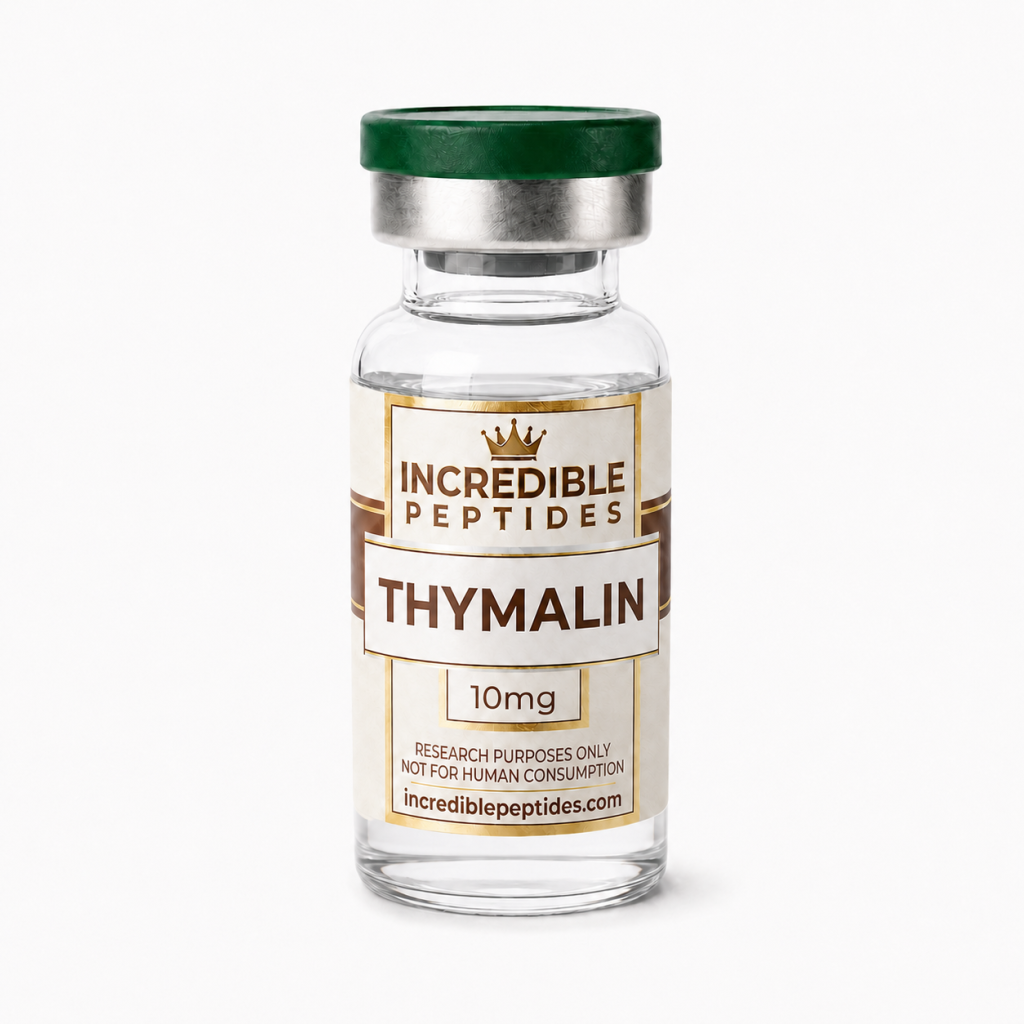
Thymalin, a thymus-derived peptide preparation, is a third category. It was developed by Vladimir Khavinson and Vyacheslav Morozov as a polypeptide extract of calf thymus rather than a single defined sequence, and it belongs to the bioregulator tradition rather than to the Goldstein fraction 5 work. Because the composition of materials sold under this name is not standardised in the same way as a synthetic sequence, researchers should confirm what a given lot contains on the product listing and its certificate of analysis before comparing it with defined peptides.
Toll-like receptor signaling studies in vitro
Unlike many peptide hormones, thymosin alpha-1 has no classical high-affinity receptor that has been cloned and characterised. Most mechanistic work has instead examined its effects on intracellular signaling in cultured cells. A frequently cited 2004 study by Romani and colleagues reported that thymosin alpha-1 activated murine dendritic cells through Toll-like receptor 9 and the adaptor MyD88, with downstream activation of p38 MAP kinase and NF-kappaB. Other in vitro studies have described involvement of TLR2 and changes in cytokine gene expression in cultured cell systems.
Interpreting these findings requires care. Toll-like receptors respond to microbial products, so peptide preparations must be tested for endotoxin and other contaminants, because trace lipopolysaccharide can produce TLR signaling on its own. Effects should be concentration-dependent, reproducible across cell sources, and absent with appropriate negative controls, including a scrambled or unrelated acidic peptide. Whether thymosin alpha-1 binds TLRs directly, acts on a co-receptor, or influences signaling indirectly has not been firmly established. The design principles are discussed in the article on cell signaling assays.
Handling and analytical characterisation
As a 28-residue acidic peptide, thymosin alpha-1 is well suited to reversed-phase HPLC with UV detection near 214 nm. Electrospray mass spectrometry gives a series of multiply charged ions that deconvolute to the intact mass, around 3108 Da on an average-mass basis. Analytical points worth checking include the presence of the N-terminal acetyl group (a missing acetyl gives a species 42 Da lighter), deamidation of the C-terminal asparagine (plus 1 Da), aspartate isomerisation, and deletion sequences from synthesis. When reviewing documents for a lot of the acetylated 28-residue thymosin alpha-1 peptide, confirm the identity method, chromatographic purity and lot number. Store dry material cold and sealed, and prepare solutions shortly before use in assays.
A defined peptide with open mechanistic questions
Thymosin alpha-1 is chemically well defined: an acetylated, acidic, disordered 28-mer derived from prothymosin alpha. Its cellular mechanism is less settled, with Toll-like receptor signaling in cultured cells the best-studied lead and contaminant controls essential to any such work. Keeping it distinct from thymosin beta-4 and from thymalin avoids most of the confusion in the literature. Thymosin alpha-1 is supplied for laboratory research use only; it is not for human or veterinary use.
References
- Goldstein AL, Low TLK, McAdoo M, et al. Thymosin alpha1: isolation and sequence analysis of an immunologically active thymic polypeptide. Proceedings of the National Academy of Sciences USA. 1977.
- Romani L, Bistoni F, Gaziano R, et al. Thymosin alpha 1 activates dendritic cells for antifungal Th1 resistance through toll-like receptor signaling. Blood. 2004.
- ICH Q6B. Specifications: Test Procedures and Acceptance Criteria for Biotechnological/Biological Products. International Council for Harmonisation.
Research Products in This Article
Educational content for research use only. Not for human consumption. Nothing here is medical advice or a claim about safety or efficacy.
 EM