TB-500 and Thymosin Beta-4: Structure and Research Background
What thymosin beta-4 is, how it binds actin, and why the market name TB-500 can describe two very different molecules that only a COA can tell apart.
 DODaniel Okafor, MSResearch Analyst, Molecular Biology~5 min read
 Compounds
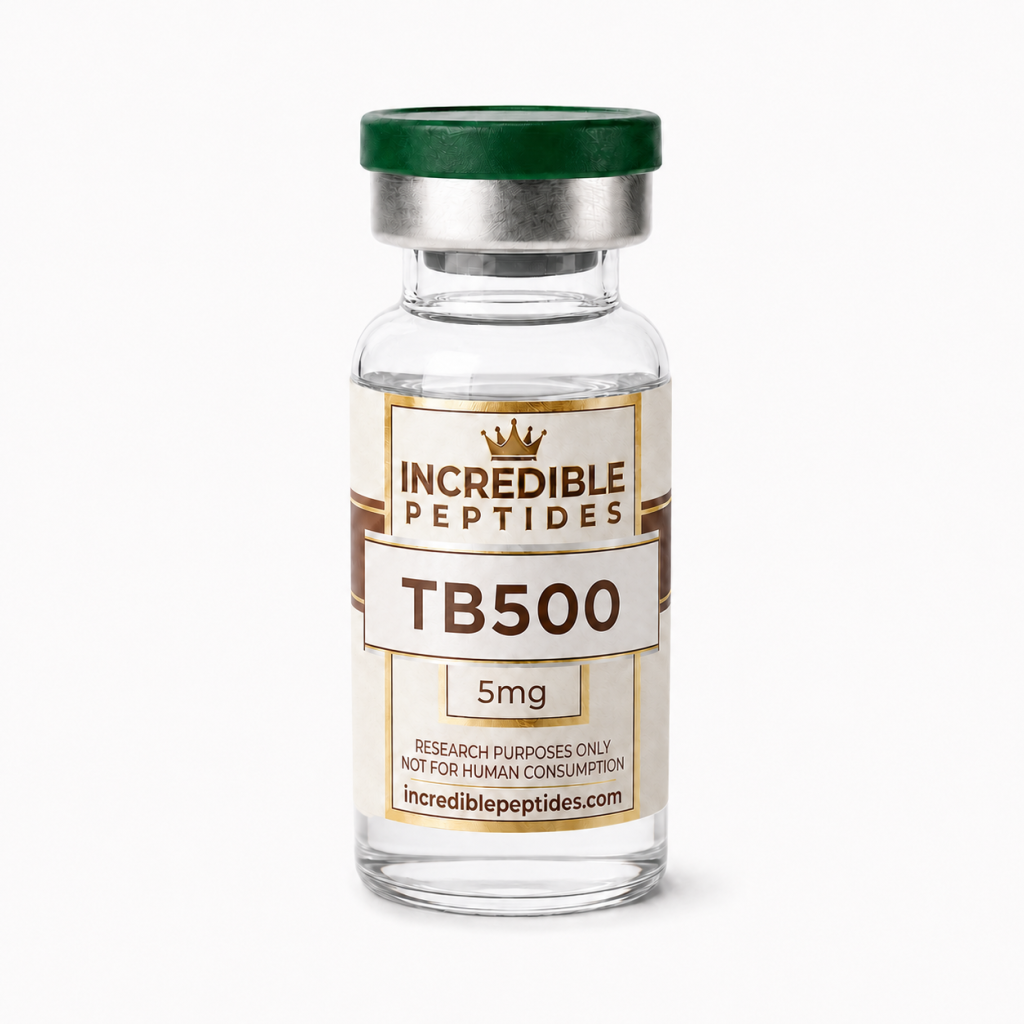
The TB500 peptide is sold under a market name rather than a scientific one, and that alone causes confusion. The name points to thymosin beta-4 (Tβ4), a small, highly conserved protein that is one of the main actin-binding molecules in many cell types. Depending on the supplier, however, “TB-500” may refer to synthetic full-length thymosin beta-4 or to a short fragment derived from its actin-binding region. The two differ by several kilodaltons and are not interchangeable.
This profile describes the structure and actin biology of thymosin beta-4, explains what the TB-500 label can mean, summarizes the main in vitro research themes, and sets out how to confirm what a vial of the TB500 research peptide actually contains.
Thymosin beta-4: structure
Thymosin beta-4 is a 43-residue peptide with an acetylated N-terminal serine. Its sequence is Ac-SDKPDMAEIEKFDKSKLKKTETQEKNPLPSKETIEQEKQAGES, and its average molecular weight is close to 4.96 kDa. It was first isolated from calf thymus in the course of work on thymic peptide fractions, and its complete sequence was reported in 1981 by Low, Hu and Goldstein. The thymic origin explains the name, but Tβ4 is in fact expressed in most tissues and is especially abundant in platelets and white blood cells.
The sequence is rich in charged residues, with many glutamates and lysines, and it is acidic overall. In free solution thymosin beta-4 is largely unstructured, behaving as an intrinsically disordered peptide; it adopts helical structure on binding to actin. Methionine 6 is the only sulfur-containing residue and can be oxidized to the sulfoxide, a modification that has been observed in biological samples and that also appears as a +16 Da species in mass spectra of synthetic material.
Actin sequestration and the LKKTETQ motif
Thymosin beta-4’s best-characterized function is binding monomeric actin (G-actin) in a 1:1 complex, which prevents those monomers from adding to actin filaments. Safer and colleagues showed in 1991 that Tβ4 is identical to an actin-sequestering factor previously described from platelets, linking the thymic peptide to a core cytoskeletal role. Because cells contain large pools of unpolymerized actin, sequestering proteins such as Tβ4 act as a buffer that the cell can draw on when filament assembly is needed.
Structural and mutational studies indicate that binding involves the N-terminal region and a central segment containing the motif LKKTETQ, residues 17 to 23. This motif is conserved across the β-thymosin family and is shared, in related forms, with other actin-binding domains. It is the region most often cited when synthetic fragments are designed to retain part of thymosin beta-4’s actin-related activity in vitro.
The N-terminus has a separate story. Cleavage releases the tetrapeptide Ac-SDKP (acetyl-Ser-Asp-Lys-Pro), which has its own research literature as a regulator of cell proliferation in hematopoietic systems. This is a reminder that Tβ4 can serve as a precursor for smaller bioactive fragments, and that activities reported for the full-length peptide may partly reflect its fragments.
What “TB-500” means in the research market
“TB-500” is not a name used in the primary scientific literature, and vendors apply it inconsistently. Some use it for synthetic, full-length, N-acetylated thymosin beta-4. Others use it for a short peptide based on the actin-binding region, frequently described as acetylated LKKTETQ, which has a molecular weight of roughly 0.89 kDa. Findings obtained with the full-length protein cannot be assumed to apply to the fragment, or the reverse.
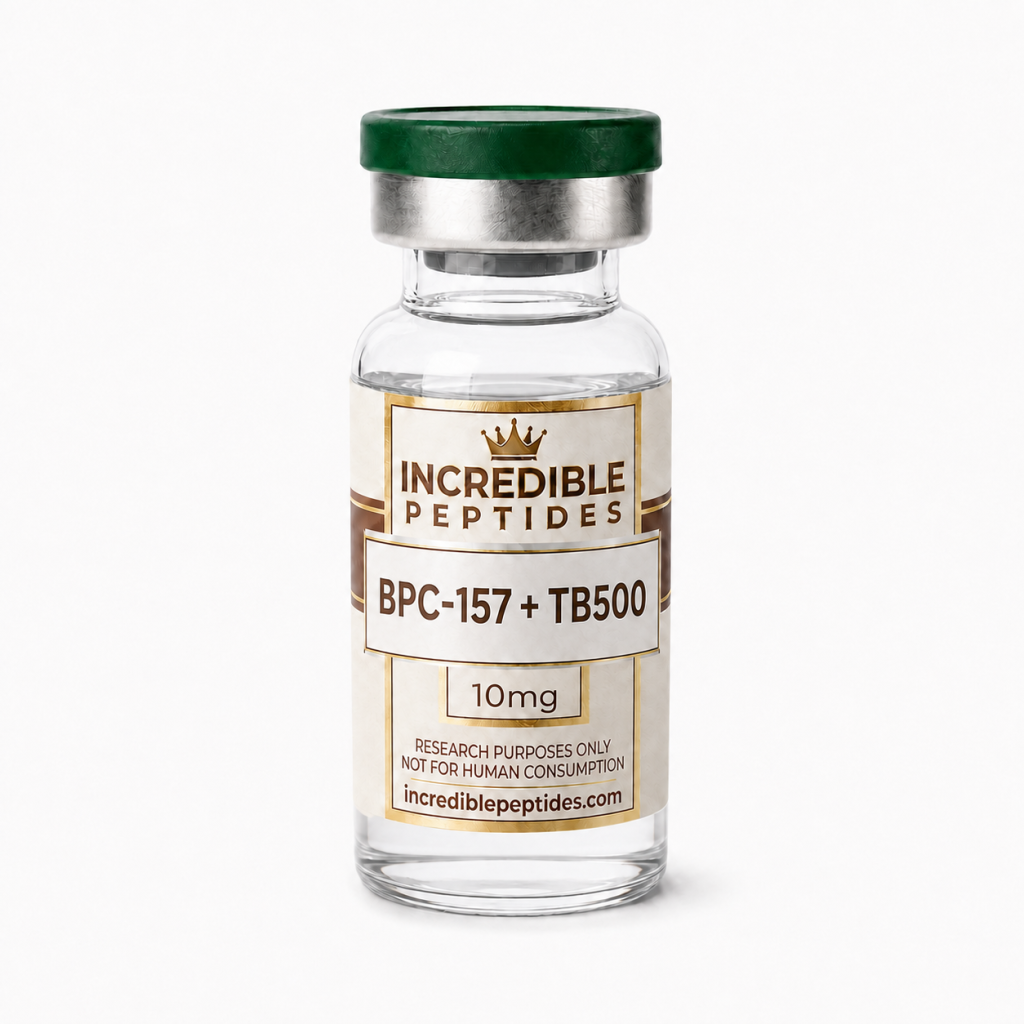
The difference is easy to detect analytically: an observed mass near 4.96 kDa and one near 0.89 kDa are not going to be confused by any competent mass spectrometry method. The practical point is that a researcher needs to know which molecule is in the vial before designing experiments, and the sequence and observed mass on the certificate of analysis are the place to find out. The same applies to combined products: a BPC-157 + TB500 blend is commonly described as containing both peptides, but which form of the thymosin component it contains should be confirmed on the listing and lot certificate. The chemistry of that combination is discussed in our article on the Wolverine peptide stack pairing BPC-157 and TB-500.
In vitro research themes
Most mechanistic work on thymosin beta-4 has been done in cell culture. Because it regulates actin availability, a natural line of investigation has been cell motility, using gap-closure (scratch) assays and transwell or Boyden chamber migration assays with endothelial cells, fibroblasts and other lines. Several groups have reported that exogenous Tβ4 increases migration in such assays, and that peptides containing the LKKTETQ region reproduce part of that activity in vitro. How an intracellular actin-sequestering protein acts when added to the outside of cells is still discussed; proposed explanations include uptake into cells and interactions with cell-surface proteins.
Preclinical animal studies of Tβ4 exist across several organ systems, mostly in rodents. As with any animal-model literature, results depend on the model, the material used and the study design, and they do not translate automatically to other species. For researchers, the useful conclusion is narrower: Tβ4 is a well-characterized actin-binding peptide with a reproducible effect on cytoskeletal biology in vitro, and its fragments are distinct molecules that need their own characterization.
Analytical considerations
Full-length thymosin beta-4 is a demanding target for solid-phase synthesis. A 43-residue chain gives many opportunities for incomplete couplings, so deletion sequences close in mass and retention time to the target are the main impurity class, and the N-terminal acetyl group (+42 Da) must be confirmed. Mass spectra of the full-length peptide show a series of multiply charged ions that are deconvoluted to the intact mass; satellites at +16 Da indicate methionine oxidation. A short fragment such as Ac-LKKTETQ is far simpler to make and to analyse, but it still needs identity confirmation, because a fragment and the full-length peptide can carry the same market name.
When reviewing the certificate for a TB500 lot, look first for a stated sequence and an observed mass that matches it, then for the HPLC purity and the counter-ion. Our article on peptide mass spectrometry explains how observed and theoretical masses are compared.
Key points on TB-500 and thymosin beta-4
Thymosin beta-4 is a conserved, acetylated 43-residue peptide whose principal established role is sequestering G-actin, with the LKKTETQ segment central to that interaction. “TB-500” is a commercial label that can describe either the full-length peptide or a short fragment, and the certificate of analysis is the only reliable way to tell which. Research material is supplied for laboratory research use only; not for human or veterinary use.
References
- Low TL, Hu SK, Goldstein AL. Proc Natl Acad Sci USA. 1981 (complete amino acid sequence of bovine thymosin β4).
- Safer D, Elzinga M, Nachmias VT. Thymosin beta 4 and Fx, an actin-sequestering peptide, are indistinguishable. J Biol Chem. 1991.
- Huff T, Müller CSG, Otto AM, Netzker R, Hannappel E. β-Thymosins, small acidic peptides with multiple functions. Int J Biochem Cell Biol. 2001.
- Sewald N, Jakubke H-D. Peptides: Chemistry and Biology. Wiley-VCH.
Research Products in This Article
Educational content for research use only. Not for human consumption. Nothing here is medical advice or a claim about safety or efficacy.