
SS-31 (Elamipretide): A Cardiolipin-Targeting Tetrapeptide
SS-31 is a four-residue aromatic-cationic peptide studied for its association with cardiolipin at the inner mitochondrial membrane in in vitro systems.
 DODaniel Okafor, MSResearch Analyst, Molecular Biology~5 min read
 Compounds
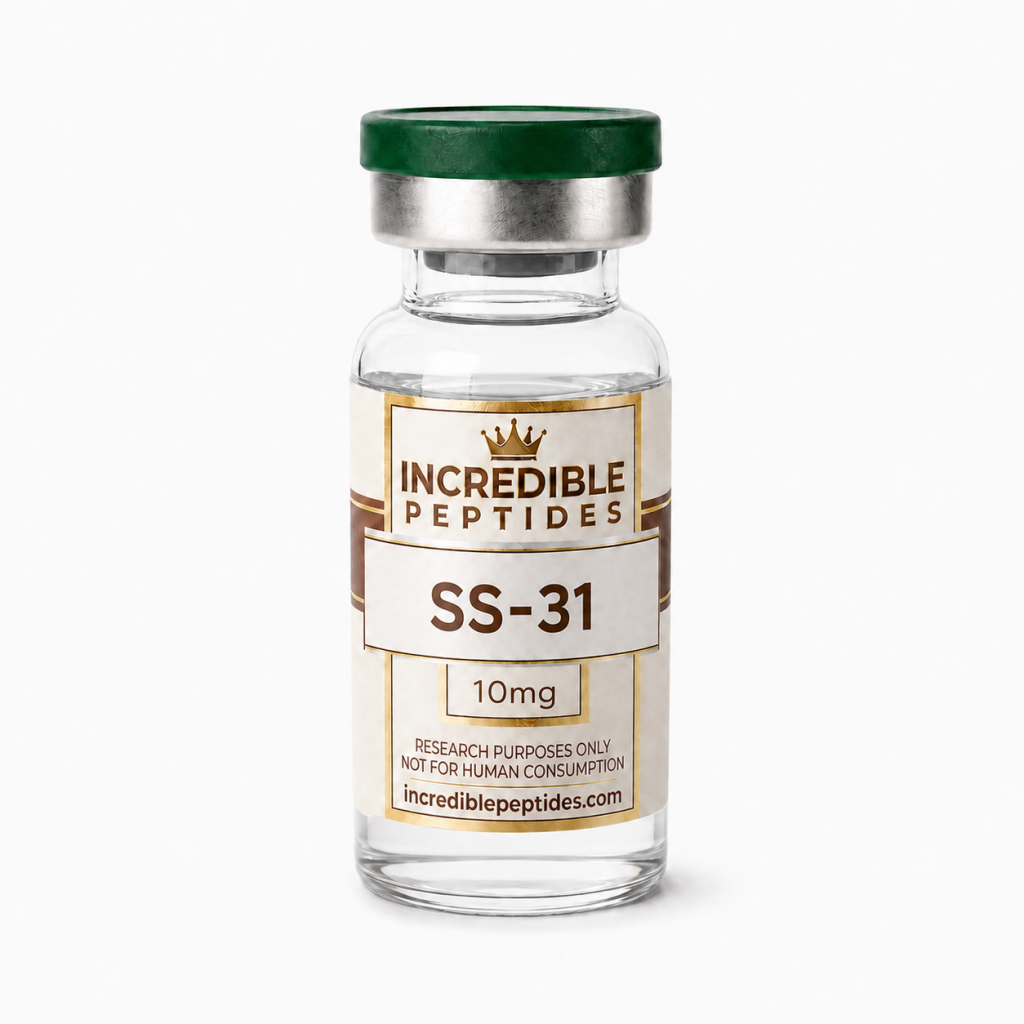
The ss31 peptide, catalogued as SS-31 and also known by the nonproprietary name elamipretide, is one of the most studied synthetic tetrapeptides in mitochondrial biochemistry. It belongs to the Szeto-Schiller (SS) family of aromatic-cationic peptides, a short series of four-residue sequences designed with alternating positively charged and aromatic residues. What makes SS-31 interesting to researchers is not its size but its destination: in cell and isolated-organelle experiments it is reported to concentrate at the inner mitochondrial membrane, where it associates with the phospholipid cardiolipin.
This profile covers the origins of the SS peptide series, the sequence and chemistry of SS-31, the proposed basis of its interaction with cardiolipin, the in vitro systems in which it is typically studied, and the analytical points that matter when the material arrives in a laboratory. SS-31 is supplied for laboratory research use only and is not for human or veterinary use.
Origins of the Szeto-Schiller Peptides
The SS peptides grew out of opioid peptide chemistry. Peter Schiller and colleagues had developed dermorphin-derived tetrapeptide amides in which the N-terminal tyrosine was replaced by 2′,6′-dimethyltyrosine (Dmt), a substitution that increases opioid receptor affinity. Hazel Szeto’s group, working with these compounds, noticed that some members of the series were unexpectedly cell-permeable despite carrying a net positive charge of three, and that they accumulated in mitochondria.
SS-31 rearranges the residues of that earlier scaffold so that D-arginine, rather than Dmt, occupies the N-terminus. Because an N-terminal phenolic residue is central to opioid receptor recognition, this reordering is generally described as removing meaningful opioid activity while preserving the aromatic-cationic pattern linked to mitochondrial targeting. The result, the SS-31 research tetrapeptide, is a compound studied for its membrane behaviour rather than for any receptor-mediated pharmacology.
Sequence and Chemical Structure
The sequence of SS-31 is D-Arg-Dmt-Lys-Phe-NH2. Each design element has a structural rationale. The D-configured arginine at position 1 resists aminopeptidase cleavage, and the C-terminal amide removes the free carboxylate, protecting against carboxypeptidases and eliminating a negative charge. At neutral pH the N-terminal amine, the arginine guanidinium group and the lysine side-chain amine are all protonated, giving a net charge of +3.
| Position | Residue | Character | Design role |
|---|---|---|---|
| 1 | D-Arginine | Cationic | Positive charge; D-configuration resists aminopeptidases |
| 2 | 2′,6′-Dimethyltyrosine (Dmt) | Aromatic, phenolic | Hydrophobic contact; phenol is a candidate radical scavenger |
| 3 | L-Lysine | Cationic | Second side-chain positive charge |
| 4 | L-Phenylalanine amide | Aromatic | Hydrophobic contact; amide caps the C-terminus |
The free base has the molecular formula C32H49N9O5 and an average molecular mass of roughly 640 Da. Because it is a polycation, the material is isolated as a salt, commonly an acetate or trifluoroacetate, and the counterion contributes to the mass of powder in the vial. For research use, each lot should be characterised by identity and purity data from its lot certificate rather than by assumptions about salt form.
Common In Vitro Research Systems
Most of the mechanistic literature on SS-31, including the membrane models described in the next section, comes from a small set of experimental systems. Isolated mitochondria are used to measure oxygen consumption, membrane potential, swelling and reactive oxygen species production under defined substrate conditions. Cultured cell lines are exposed to oxidative challenges such as tert-butyl hydroperoxide, with readouts including mitochondrial superoxide probes, lipid peroxidation markers and cell viability. Model membranes, from liposomes to supported bilayers, are used for binding, fluorescence and calorimetry studies, and purified cytochrome c with cardiolipin vesicles provides a reconstituted peroxidase assay.
A sizeable body of preclinical work in rodent models of mitochondrial dysfunction also exists. SS-31 is often studied alongside other mitochondria-associated peptides. The MOTS-c research peptide is a useful contrast: it is a 16-residue peptide encoded within the mitochondrial 12S rRNA gene, so it originates in the organelle rather than being designed to reach it. Our profile of MOTS-c as a mitochondrial-derived peptide covers that molecule in detail.
Interaction with the Inner Mitochondrial Membrane
Cardiolipin as the Proposed Binding Partner
Cardiolipin is a dimeric phospholipid with two phosphate groups and four acyl chains. In mammalian cells it is found almost exclusively in the inner mitochondrial membrane, where it helps shape cristae, supports the assembly of respiratory chain supercomplexes and interacts with cytochrome c. Its two anionic phosphates make it an obvious electrostatic partner for a trication.
Liposome and isolated-mitochondria studies from the Szeto laboratory reported that SS-31 binds cardiolipin-containing membranes selectively over membranes made from zwitterionic phospholipids, and that the aromatic residues insert into the hydrophobic region of the bilayer while the cationic residues engage the headgroups. The same work proposed that SS-31 limits the peroxidase activity that cytochrome c acquires when it is bound to cardiolipin, an activity that oxidises cardiolipin itself. Later biophysical studies broadened the picture, suggesting that SS-31 also alters the surface electrostatics of cardiolipin-rich bilayers. These are mechanistic models built mainly on in vitro data, and they are not fully settled.
Cell Uptake
Many mitochondria-targeted molecules, such as triphenylphosphonium conjugates, rely on the membrane potential to drive accumulation in the matrix. SS-31 has been described as entering cells and associating with mitochondria in a manner that depends far less on membrane potential, consistent with binding at the inner membrane rather than accumulation in the matrix. Fluorescently labelled and radiolabelled analogues were used to make these observations, and the extent to which tags alter behaviour is a reasonable point of caution when reading that literature. For a broader discussion of how residue order shapes behaviour, see our article on peptide structure-activity relationships.
Analytical Identity and Laboratory Handling
Small, highly charged peptides present specific analytical behaviour. In reversed-phase HPLC, SS-31 is quite polar and elutes early under typical acetonitrile gradients with trifluoroacetic acid; ion-pairing conditions and column choice affect retention and peak shape more than they would for a larger, more hydrophobic sequence. Because Dmt and the D-arginine are non-standard building blocks, diastereomeric impurities arising from racemisation during synthesis are worth considering, and they may not be resolved by every method. Mass spectrometry should show a protonated molecular ion near m/z 640 together with multiply charged species, and the observed mass should match the free peptide rather than the salt. Our guide to peptide mass spectrometry explains how to read those spectra.
As a lyophilised salt, SS-31 is generally hygroscopic. Standard practice applies: store sealed and cold, protect from light, allow vials to reach room temperature before opening, and prepare aqueous stock solutions in volumes that can be aliquoted to avoid repeated freeze-thaw cycles. Recording the counterion and net peptide content from the certificate helps when converting between powder mass and molar concentration in assays.
Where SS-31 Fits in Mitochondrial Peptide Research
SS-31 is best understood as a chemical tool: a stable, cell-permeable trication whose alternating aromatic and cationic residues give it an affinity for cardiolipin-rich membranes. Its value to researchers lies in probing how membrane lipid environment influences electron transport, cytochrome c behaviour and oxidative processes in isolated systems. Anyone designing work around it should verify identity and salt form on the lot certificate, choose analytical conditions suited to a small polycation, and read the mechanistic literature with its in vitro origins in mind. Researchers comparing designed and naturally encoded mitochondrial peptides can find the SS-31 research peptide listing alongside related compounds in the catalog.
References
- Szeto HH. Cell-permeable, mitochondrial-targeted, peptide antioxidants. AAPS Journal, 2006.
- Zhao K, Zhao GM, Wu D, et al. Cell-permeable peptide antioxidants targeted to inner mitochondrial membrane… Journal of Biological Chemistry, 2004.
- Birk AV, Liu S, Soong Y, et al. The mitochondrial-targeted compound SS-31 re-energizes … mitochondria by interacting with cardiolipin. Journal of the American Society of Nephrology, 2013.
- Lee C, Zeng J, Drew BG, et al. The mitochondrial-derived peptide MOTS-c promotes metabolic homeostasis… Cell Metabolism, 2015.
- Nelson DL, Cox MM. Lehninger Principles of Biochemistry. W.H. Freeman.
Research Products in This Article
Educational content for research use only. Not for human consumption. Nothing here is medical advice or a claim about safety or efficacy.