
Epitalon (Epithalon): A Synthetic Tetrapeptide Bioregulator
The chemistry of the Ala-Glu-Asp-Gly tetrapeptide, where it came from, and why its cell-culture literature still needs independent replication.
 DODaniel Okafor, MSResearch Analyst, Molecular Biology~6 min read
 Compounds
Epitalon, also spelled epithalon, is a synthetic tetrapeptide with the sequence Ala-Glu-Asp-Gly. It is one of a small set of short peptides designed by a St. Petersburg research group led by Vladimir Khavinson, who based them on amino acid analyses of crude animal tissue extracts. For an analytical chemist, the epitalon peptide is an instructive molecule: it is tiny, highly polar and acidic, and it carries an Asp-Gly motif that is notorious for chemical instability. For anyone reading the literature, it is a case study in how far evidence can be trusted when most of it comes from one research school.
This profile covers the structure and physicochemical properties of epitalon, its origin in the pineal extract epithalamin, the cell-culture reports on telomerase activity, and the practical points that matter when the compound is synthesised, stored and characterised in a laboratory.
Sequence and physicochemical properties
Written in one-letter code, epitalon is AEDG. The N-terminal alanine carries a free amine, and the C-terminal glycine ends in a free carboxylic acid, so the molecule is a simple linear peptide without amidation, acetylation or cyclisation. Two of its four side chains are carboxylic acids, which makes it strongly acidic overall. At neutral pH the protonated N-terminus contributes one positive charge, while the glutamate side chain, the aspartate side chain and the C-terminal carboxylate each contribute a negative charge, giving a net charge of roughly minus two.
| Property | Value |
|---|---|
| Sequence | H-Ala-Glu-Asp-Gly-OH (AEDG) |
| Molecular formula | C14H22N4O9 |
| Average molecular weight | approx. 390.35 g/mol |
| Monoisotopic mass | approx. 390.139 Da ([M+H]+ approx. 391.146) |
| Approximate net charge at pH 7 | -2 |
| Aromatic residues | None |
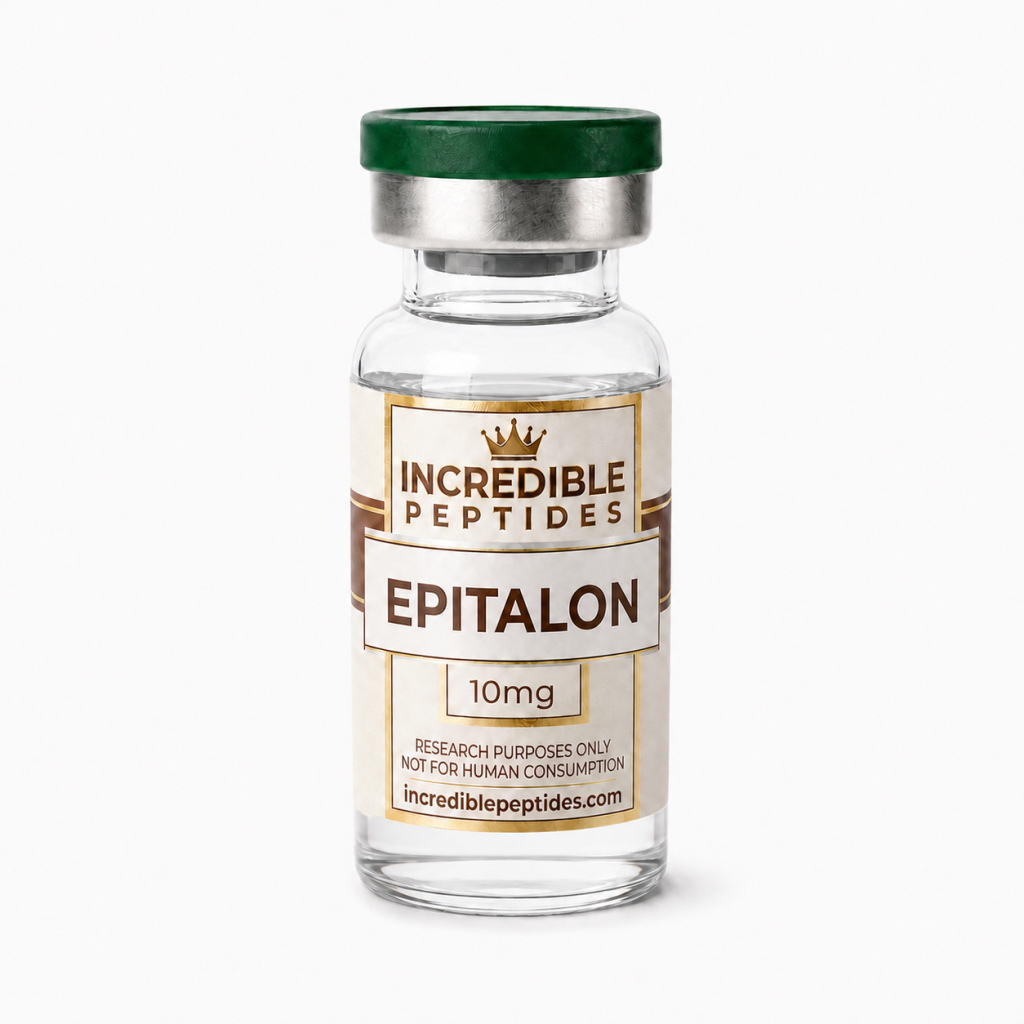
The absence of tryptophan or tyrosine has a practical consequence: epitalon has essentially no absorbance at 280 nm, so concentration cannot be estimated by the usual aromatic extinction-coefficient method. Detection relies on the peptide bond region around 210 to 220 nm, which is less selective. Incredible Peptides lists the compound as Epitalon 10mg, a synthetic AEDG research peptide; the salt form and counterion of any given lot are defined by its certificate of analysis rather than by the sequence alone.
From epithalamin to a defined tetrapeptide
Epitalon traces back to epithalamin, a polypeptide preparation extracted from bovine pineal gland. The Khavinson group analysed the amino acid composition of the extract and then synthesised a short peptide intended to represent its activity, a strategy the group applied to several tissue preparations. The broader idea, which they called peptide bioregulation, is covered in more detail in the overview of bioregulator peptides in research.
From a chemistry standpoint, the move from extract to defined sequence matters a great deal. A crude extract cannot be fully characterised, and its composition varies from batch to batch. A defined tetrapeptide, by contrast, can be made by standard synthesis, purified, and verified by HPLC and mass spectrometry against a known structure. That is why the defined short peptides grouped in our bioregulators category can be specified and tested in ways that the original tissue preparations could not. It also means that results obtained with epithalamin should not be assumed to transfer to epitalon, or the reverse; they are different materials.
Telomerase reports in cell culture
Much of the interest in epitalon stems from a 2003 report by Khavinson and colleagues describing increased telomerase activity and telomere elongation in cultured fibroblasts exposed to the peptide. Telomerase is the ribonucleoprotein reverse transcriptase that adds telomeric repeats to chromosome ends, and its catalytic subunit is normally expressed at low levels in most differentiated somatic cell types grown in culture.
What the measurements can and cannot show
Telomerase activity in such studies is usually measured with the telomeric repeat amplification protocol (TRAP), a PCR-based assay. TRAP is sensitive but semi-quantitative, and it is vulnerable to PCR inhibitors, primer-dimer artefacts and variation in extract preparation. Telomere length is measured separately, by terminal restriction fragment Southern blotting, quantitative PCR or fluorescence in situ hybridisation, each with its own error profile. A convincing result would ideally show agreement across orthogonal methods, concentration dependence, appropriate positive and negative controls, and a scrambled-sequence peptide control to show that the effect depends on the AEDG sequence rather than on any small acidic peptide.
Why replication is the central issue
Most published work on epitalon, including cell-culture and rodent studies, originates from the Khavinson group and its collaborators. Independent replication by unaffiliated laboratories using fully characterised material is sparse. Rodent studies from the same group exist, but they are preclinical, they share the same replication gap, and their endpoints lie outside the scope of a research-chemistry profile. None of this shows the original findings are wrong. It does mean they should be regarded as hypotheses awaiting confirmation rather than established pharmacology. The general framework for weighing evidence of this kind is set out in the guide on how to read a research paper.
Chemical stability: the Asp-Gly problem
The most important chemical feature of epitalon is its Asp-Gly junction. Aspartate followed by glycine is the sequence most prone to succinimide formation. The backbone amide nitrogen of the glycine attacks the side-chain carbonyl of the aspartate, closing a five-membered ring and releasing water. The succinimide intermediate then hydrolyses on either side, regenerating normal aspartate or producing isoaspartate, in which the peptide backbone runs through the side-chain carboxyl. The intermediate can also racemise, giving D-aspartyl products. Glycine’s lack of a side chain removes the steric hindrance that slows this reaction at other Asp-X sites.
This has two consequences for researchers. First, isoaspartate is isobaric with aspartate, so an isomerised impurity has exactly the same mass as the intact peptide. Mass spectrometry alone will not reveal it; separation by HPLC, tandem MS fragmentation patterns, or enzymatic methods are needed. Second, the same chemistry complicates synthesis. In Fmoc solid-phase synthesis, repeated piperidine treatment can drive aspartimide formation at Asp-Gly, producing a species 18 Da lighter than the target and piperidide adducts. Backbone protection of the glycine and modified deprotection conditions are standard countermeasures. Storage practice follows from the same chemistry: dry, cold, sealed material degrades far more slowly than peptide held in solution, and solutions near neutral pH should be prepared fresh rather than kept, as outlined in the article on peptide stability and degradation.
Analytical characterisation
Epitalon is a difficult molecule for routine reversed-phase HPLC because it is so polar. On a standard C18 column it may elute close to the void volume, where it is poorly resolved from salts and other polar species. Highly aqueous starting conditions, ion-pairing agents such as trifluoroacetic acid, or hydrophilic interaction chromatography (HILIC) can improve retention.
Electrospray mass spectrometry should show a protonated molecule near m/z 391.15. Useful additional checks include the absence of a signal 18 Da lower (aspartimide), chromatographic resolution of any isoaspartate isomer, and counterion content where the certificate reports it. When evaluating a lot of the Epitalon tetrapeptide supplied for laboratory work, compare the reported identity method, chromatographic purity and test date against these expectations, and confirm that the lot number on the vial matches the document.
Reading the epitalon literature with appropriate caution
Epitalon is chemically simple and easy to verify. Its biological literature is a different matter: the reports of telomerase activity in cultured cells are intriguing but concentrated in one research school, measured with assays that need orthogonal confirmation, and not yet widely reproduced. Researchers working with the compound are best served by rigorous material characterisation, attention to Asp-Gly isomerisation, sequence-scrambled controls and independent replication. Epitalon is supplied for laboratory research use only; it is not for human or veterinary use.
References
- Khavinson VKh, Bondarev IE, Butyugov AA. Report on telomerase activity and telomere length in cultured fibroblasts exposed to epithalon. Bulletin of Experimental Biology and Medicine. 2003.
- Geiger T, Clarke S. Deamidation, isomerization, and racemization at asparaginyl and aspartyl residues in peptides. Journal of Biological Chemistry. 1987.
- Chan WC, White PD (eds). Fmoc Solid Phase Peptide Synthesis: A Practical Approach. Oxford University Press; 2000.
- ICH Q1A(R2). Stability Testing of New Drug Substances and Products. International Council for Harmonisation.
Research Product in This Article
Educational content for research use only. Not for human consumption. Nothing here is medical advice or a claim about safety or efficacy.