Sermorelin: GHRH(1-29) and the Minimal Active Fragment
Why the 29-residue N-terminal fragment of GHRH keeps the full hormone's activity, why it is short-lived, and how it became the template for later GHRH analogues.
 DODaniel Okafor, MSResearch Analyst, Molecular Biology~5 min read
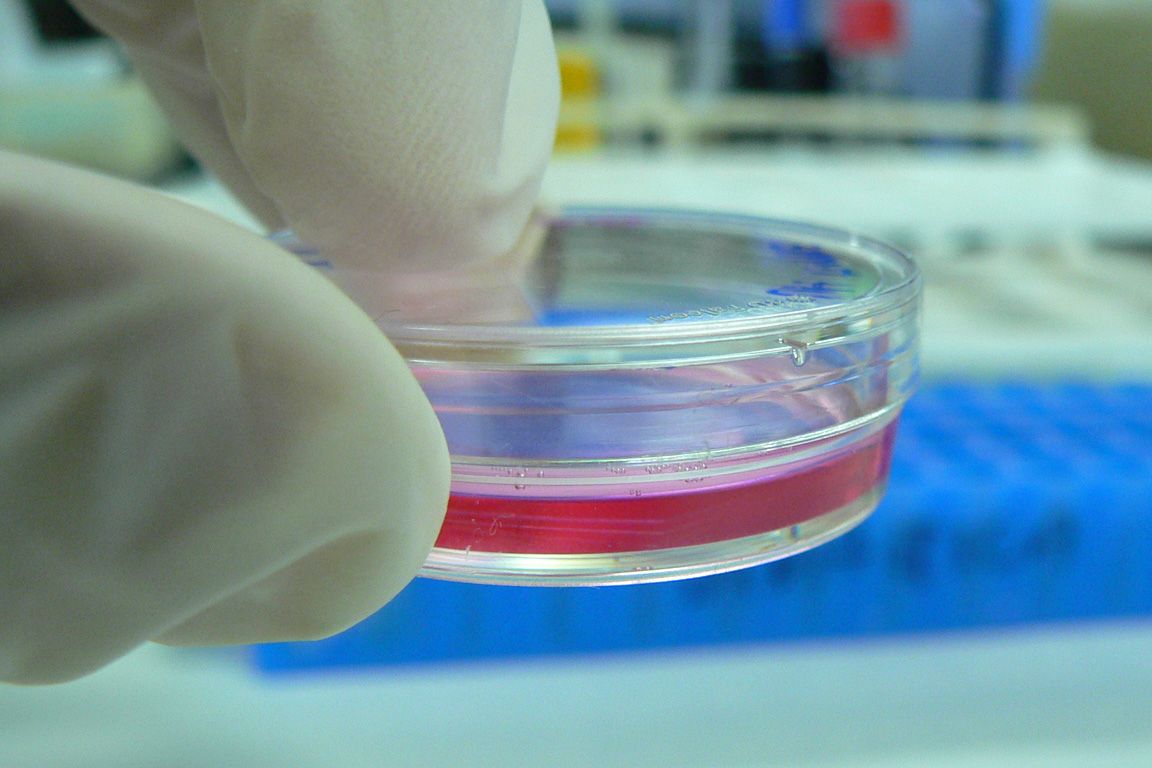 CompoundsPhoto: kaibara87 / Wikimedia Commons, CC BY 2.0
The sermorelin peptide is the 29-residue N-terminal fragment of growth hormone-releasing hormone, GHRH(1-29)-NH2. It matters to peptide chemists for a simple reason: soon after the full 44-residue hormone was sequenced, truncation studies showed that this shorter amidated fragment retained essentially all of the parent’s activity in pituitary cell assays. Sermorelin is therefore the minimal fully active unit of GHRH and the template from which most later GHRH analogues were built.
This profile covers how the fragment was identified, its sequence and physicochemical properties, its pharmacology at the GHRH receptor, the degradation routes that limit its lifetime, and how those liabilities shaped successors such as CJC-1295 and tesamorelin. The sermorelin research peptide (GHRH 1-29 amide) is used here as a laboratory reference compound; the article stays at the level of chemistry and receptor biology.
Finding the minimal active fragment
GHRH was isolated and sequenced in 1982 by the groups of Roger Guillemin and of Wylie Vale and Jean Rivier, working from pancreatic tumour extracts that produced the hormone in unusual abundance. With the 44-residue sequence in hand, the next question was which parts were necessary. Synthetic C-terminally truncated analogues were tested for their ability to release growth hormone from cultured rat anterior pituitary cells, and activity held up remarkably well as residues were removed from the C-terminus, down to position 29. Shorter fragments lost potency progressively, and the 1-29 amide became the accepted minimal sequence with full intrinsic activity in vitro.
That result fits what is now understood about class B GPCR ligands. The N-terminal residues drive receptor activation, the central and C-terminal helical region provides affinity through contacts with the receptor’s extracellular domain, and the extreme C-terminus of the native hormone contributes relatively little. Retaining the C-terminal amide, as in the native peptide, was part of the design.
Sequence and physicochemical properties
Sermorelin has the sequence YADAIFTNSYRKVLGQLSARKLLQDIMSR-NH2. The table summarises properties that are relevant at the bench.
| Property | Sermorelin |
|---|---|
| Residues | 29, C-terminal amide |
| Molecular formula (free base) | C149H246N44O42S |
| Average mass | approximately 3,358 Da |
| Ionisable side chains | Arg11, Lys12, Arg20, Lys21, Arg29; Asp3, Asp25 |
| Net charge near neutral pH | Positive (about +4, including the free N-terminus) |
| Chemically labile sites | Ala2-Asp3 (DPP-4), Asn8 (deamidation), Met27 (oxidation) |
Structural studies of GHRH fragments in membrane-mimetic solvents such as trifluoroethanol show a largely α-helical conformation across much of the sequence, with a flexible N-terminus. In aqueous buffer the peptide is much less ordered, which is typical of class B ligands that fold on contact with their receptor. Its basic character means it binds readily to glass and some plastics at low concentrations, so carrier protein or low-binding consumables are worth considering in dilute assay solutions.
Pharmacology at the GHRH receptor
Sermorelin acts at the GHRH receptor (GHRHR), a class B1 G protein-coupled receptor expressed on anterior pituitary somatotrophs. Binding follows the two-domain model shared with the glucagon, GLP-1 and secretin receptors: the peptide’s helical C-terminal region engages the N-terminal extracellular domain, and the N-terminus then enters the transmembrane bundle to stabilise the active state. Tyr1, Ala2 and Asp3 are critical for that step, which is why changes at the N-terminus have such large effects on efficacy. It is also why tesamorelin, an N-acylated full-length GHRH analogue, protects the N-terminal amine with a small acyl group rather than replacing any of these residues.
The receptor couples principally to Gs, raising cAMP and activating protein kinase A. In somatotrophs this promotes growth hormone gene transcription through CREB and the pituitary factor Pit-1 and supports calcium-dependent hormone secretion. Somatostatin counteracts it through Gi-coupled receptors. Typical laboratory readouts are cAMP accumulation in recombinant GHRHR cell lines and hormone release from primary rat pituitary cultures; the second captures the native system but adds variability. Our overview of growth hormone secretagogues places this pathway alongside the ghrelin receptor route.
Why sermorelin is short-lived
The fragment that retained full activity also retained every weakness of the native N-terminus. Its free Tyr-Ala N-terminus is a substrate for dipeptidyl peptidase-4, which removes the first two residues to leave GHRH(3-29), a product with greatly reduced receptor activity. Plasma also contains trypsin-like activity that can cut after the basic residues at positions 11, 12, 20 and 21. In incubation studies with plasma, native GHRH and its 1-29 fragment are degraded within minutes, so the half-life of sermorelin in any protease-containing system is short.
Two further liabilities are chemical rather than enzymatic. Asn8, followed by Ser9, can deamidate through a succinimide intermediate to aspartate and isoaspartate, and Met27 oxidises to the sulfoxide. Both reduce activity and both appear as impurities during storage, particularly in solution.
How later analogues addressed these weaknesses
Each liability became a design target. Modified GRF(1-29), sold as CJC-1295 without DAC, swaps four residues: D-Ala2 against DPP-4, Gln8 against deamidation, Ala15 to strengthen helicity, and Leu27 against oxidation. CJC-1295 with DAC adds an albumin-reactive lysine at position 30. Tesamorelin took a different route, restoring residues 30 to 44 and protecting the N-terminal amine with a trans-3-hexenoyl group. Our profiles of CJC-1295 and tesamorelin cover those designs in detail.
Analytical and handling notes
For a peptide of this size, reversed-phase HPLC with UV detection near 214 nm gives a purity profile, and electrospray mass spectrometry confirms identity through a series of multiply charged ions that should deconvolute to about 3,358 Da. Specific impurities to look for include the +16 Da Met27 sulfoxide, which typically elutes earlier than the parent; the +1 Da deamidation product, which may co-elute and needs careful integration; and deletion sequences from solid-phase synthesis. A certificate for sermorelin supplied as a lyophilised research material should report both chromatographic purity and mass confirmation, along with the counter-ion, since acetate or trifluoroacetate content affects how much peptide a weighed sample actually contains.
Lyophilised material is best stored frozen, dry and away from light. Once in solution, oxidation and deamidation accelerate, so freshly prepared solutions, degassed buffers for long incubations and minimal freeze-thaw cycling help keep the material close to its certified composition.
Sermorelin’s place in GHRH research
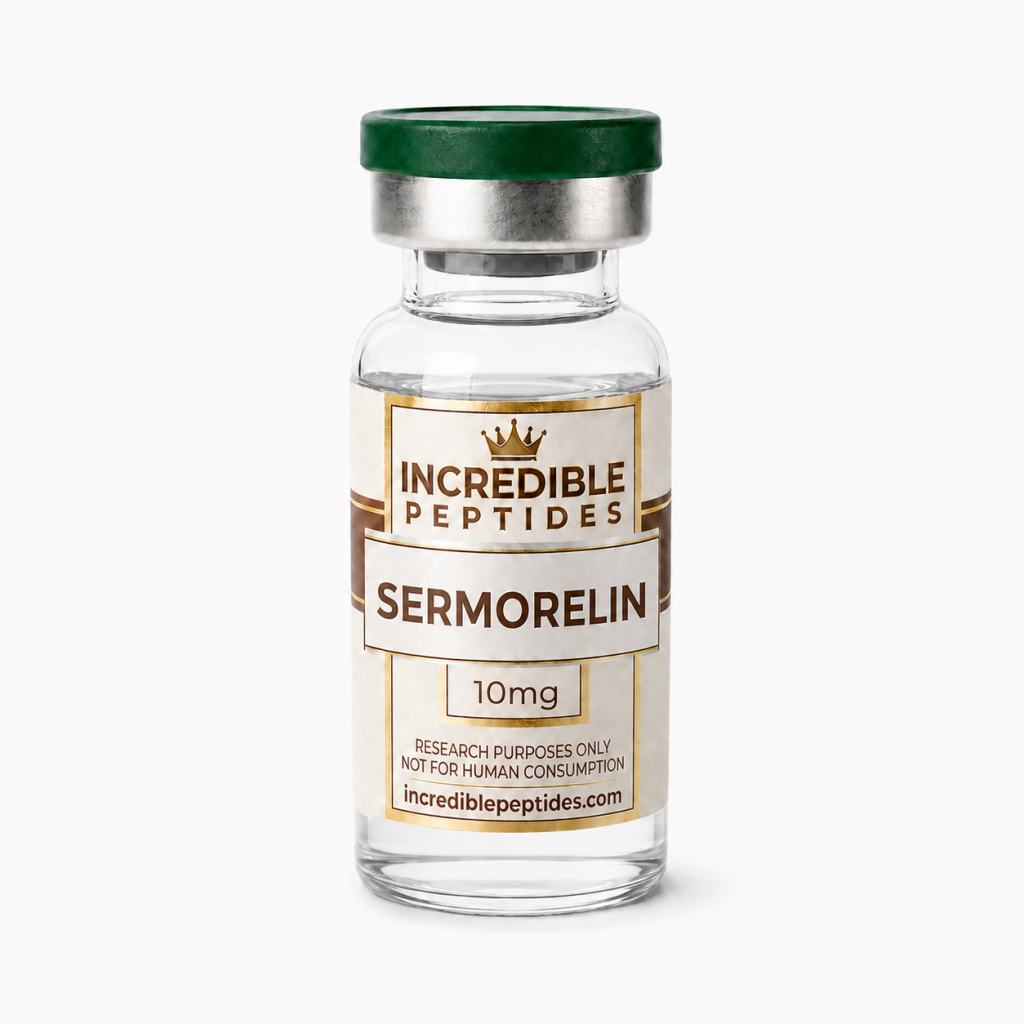
Sermorelin is less a finished design than a foundation. It defined the shortest sequence that fully activates the GHRH receptor, and every major analogue since has started from it, either by substituting residues within it or by rebuilding the native C-terminus and protecting the N-terminus. For researchers it remains the natural unmodified comparator in any study of GHRH analogues. Sermorelin from Incredible Peptides is for laboratory research use only; not for human or veterinary use.
References
- Guillemin R, Brazeau P, Böhlen P, Esch F, Ling N, Wehrenberg WB. Science, 1982 (isolation and sequence of growth hormone-releasing factor).
- Rivier J, Spiess J, Thorner M, Vale W. Nature, 1982 (characterisation of growth hormone-releasing factor).
- Frohman LA, et al. J Clin Invest, 1986 (enzymatic degradation of GHRH in plasma to an N-terminally cleaved, inactive product).
- Mayo KE. Molecular cloning and expression of a pituitary-specific receptor for growth hormone-releasing hormone. Molecular Endocrinology, 1992.
- Mentlein R. Dipeptidyl-peptidase IV (CD26): role in the inactivation of regulatory peptides. Regulatory Peptides, 1999.
Research Products in This Article
Educational content for research use only. Not for human consumption. Nothing here is medical advice or a claim about safety or efficacy.