CJC-1295 With and Without DAC: What the Difference Is
Both CJC-1295 forms share four substitutions on GHRH(1-29); only one carries the albumin-binding DAC. Here is the chemistry and how to tell them apart.
 DODaniel Okafor, MSResearch Analyst, Molecular Biology~4 min read
 CompoundsPhoto: Lilly_M / Wikimedia Commons, CC BY-SA 3.0
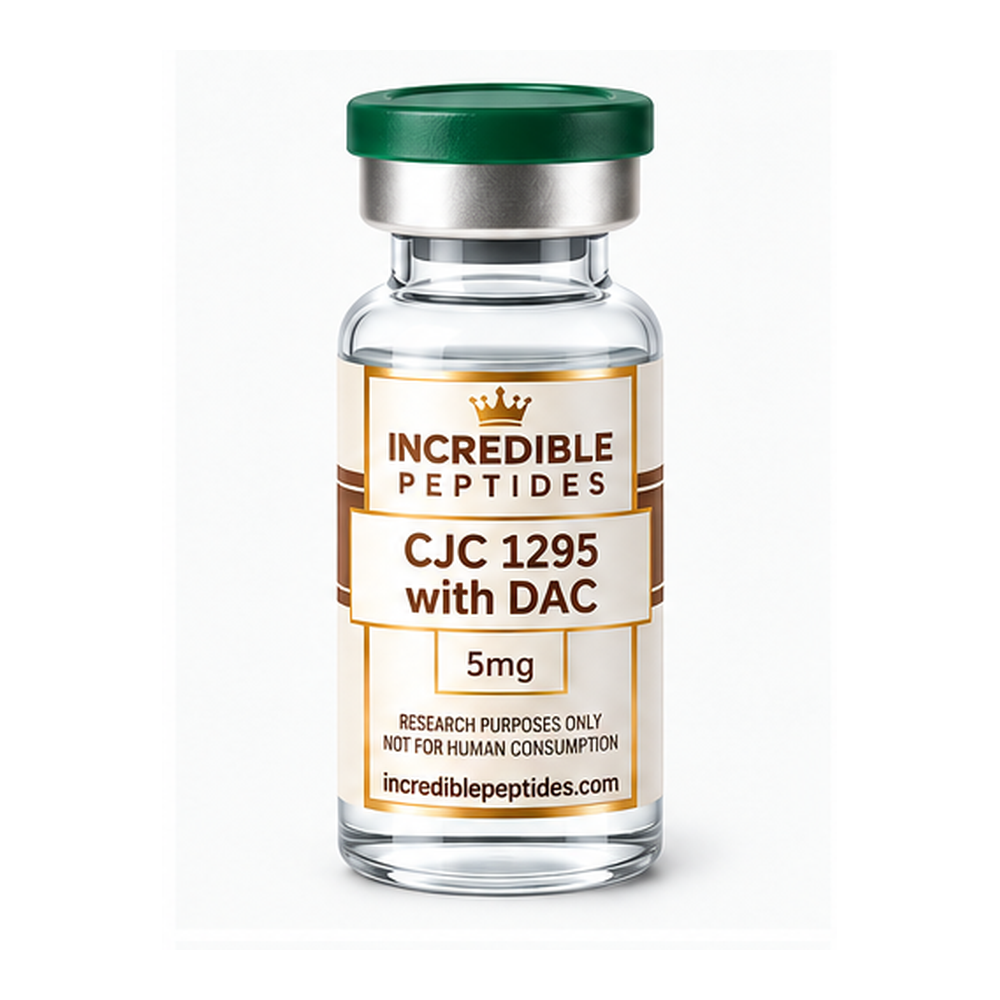
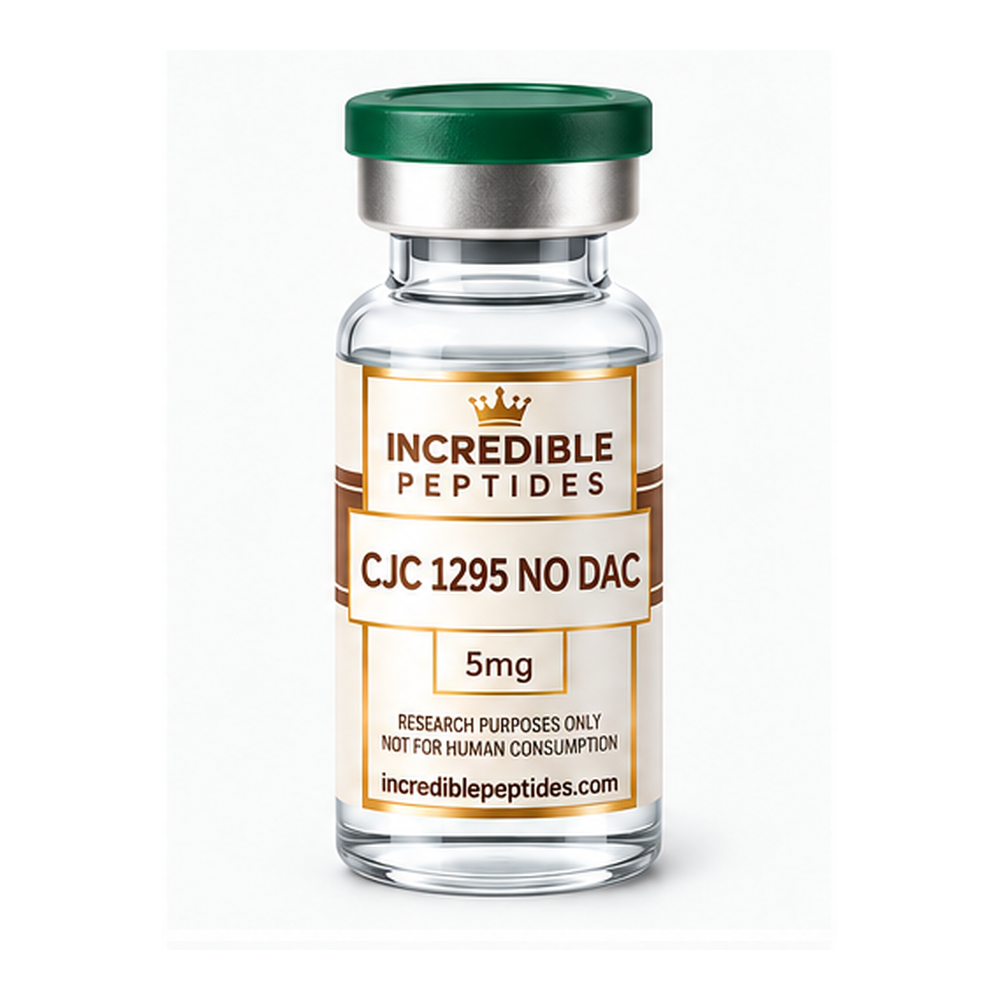
CJC-1295 is the name given to two related research peptides, and the difference between them is a common source of confusion. Both are built on the same tetrasubstituted analogue of GHRH(1-29), the minimal active fragment of growth hormone-releasing hormone. One form carries an extra lysine bearing a maleimide group, the Drug Affinity Complex or DAC, designed to bond covalently to albumin. The other, sold as CJC-1295 no DAC, also called modified GRF(1-29), lacks that group entirely.
This article explains the four amino acid substitutions the two forms share, the chemistry of the DAC modification, why the naming is muddled, and what the difference means for receptor assays and analytical testing. It stays at the level of structure and laboratory pharmacology.
The starting point: GHRH(1-29)
Native GHRH has 44 residues, but its first 29, amidated at the C-terminus, carry essentially all of its activity at the GHRH receptor. That fragment, known as sermorelin, has a weakness at almost every point of interest. Its free Tyr-Ala N-terminus is cleaved by dipeptidyl peptidase-4 within minutes in plasma. Asn8 deamidates. Met27 oxidises. Gly15 lowers the helical propensity of the region that the receptor’s extracellular domain recognises. Each of these became a target for substitution, an approach explained more generally in our article on peptide structure-activity relationships.
Four substitutions: modified GRF(1-29)
Modified GRF(1-29), often abbreviated Mod GRF 1-29, combines four changes on the GHRH(1-29)-NH2 backbone. Each comes from earlier SAR work on GHRH analogues.
| Position | Native residue | Substitution | Purpose |
|---|---|---|---|
| 2 | L-Ala | D-Ala | Resists DPP-4 cleavage of the Tyr-Ala dipeptide |
| 8 | Asn | Gln | Removes a fast deamidation site |
| 15 | Gly | Ala | Raises helical propensity and receptor potency |
| 27 | Met | Leu | Removes oxidation-prone sulfur, keeps hydrophobic packing |
The resulting sequence is Tyr-D-Ala-Asp-Ala-Ile-Phe-Thr-Gln-Ser-Tyr-Arg-Lys-Val-Leu-Ala-Gln-Leu-Ser-Ala-Arg-Lys-Leu-Leu-Gln-Asp-Ile-Leu-Ser-Arg-NH2, with an average mass of about 3.37 kDa. The substitutions extend its life in protease-containing systems compared with sermorelin, but it remains a small, unconjugated peptide with no built-in mechanism for prolonged persistence.
None of these changes alters the residues most directly responsible for receptor activation, Tyr1 and Asp3, and none changes the overall charge pattern of the helix. That is deliberate. Each substitution was first explored on its own in GHRH analogue series, and combining them assumes their effects are largely independent, which is a reasonable but testable assumption. In receptor assays, modified GRF(1-29) is therefore best compared directly with sermorelin under identical conditions, so that any difference in potency can be separated from differences in stability during the incubation.
The Drug Affinity Complex
The DAC version adds a lysine at position 30 whose ε-amine is acylated with 3-maleimidopropionic acid. The maleimide is an electrophile that reacts selectively with thiols by Michael addition to form a stable thiosuccinimide thioether. In blood the most abundant free thiol is Cys34 of serum albumin, the only cysteine in albumin not tied up in a disulfide bond. The design intent is that the peptide bonds to albumin after it enters circulation and then shares albumin’s long lifetime.
Jetté and colleagues described this approach in rats in 2005, showing that albumin conjugates of GRF(1-29) analogues still activated the GHRH receptor on anterior pituitary cells and identifying the compound later called CJC-1295 as a long-acting analogue in that species. The CJC prefix reflects ConjuChem, the company that developed the DAC technology. The modification adds a lysine and a maleimidopropionyl group, bringing the average mass to about 3.65 kDa.
Consequences in the laboratory
The maleimide is reactive outside the bloodstream too. In assay media containing serum, CJC-1295 with DAC, the albumin-reactive GRF(1-29) analogue, will conjugate to bovine or other albumin present, so the species acting on cells may be a roughly 67 kDa protein conjugate rather than free peptide. Any free thiol in a buffer, including cysteine, glutathione, dithiothreitol or 2-mercaptoethanol, will also consume the maleimide. At mildly alkaline pH the maleimide ring hydrolyses slowly to a maleamic acid that no longer reacts with thiols, and thiosuccinimide adducts can undergo slow retro-Michael exchange. Buffers should therefore be thiol-free, near neutral or slightly acidic, and freshly prepared. In serum-free receptor assays the DAC peptide behaves like a GRF(1-29) analogue with a C-terminal extension, and the GHRH receptor pharmacology is broadly the same: Gs coupling, cAMP accumulation and protein kinase A signalling.
Why the naming is confusing
In the original literature, CJC-1295 referred to the DAC-bearing construct. The tetrasubstituted peptide without the lysine-maleimide extension is properly modified GRF(1-29), and “CJC-1295 without DAC” is a commercial name that grew up later. The two products share a name but differ in mass, reactivity and behaviour in any albumin-containing system, so a vial label alone is not sufficient evidence of which molecule it holds.
Mass spectrometry resolves the question immediately. A deconvoluted average mass near 3.37 kDa indicates modified GRF(1-29); a mass near 3.65 kDa indicates the DAC form. Hydrolysis of the maleimide adds 18 Da, and a thiol adduct adds the mass of the thiol, so a DAC sample should also be checked for those species. Reversed-phase HPLC separates the two forms, since the maleimidopropionyl lysine changes retention. Our article on peptide mass spectrometry covers deconvolution of multiply charged spectra. Before using the non-DAC tetrasubstituted GRF(1-29) peptide (CJC-1295 no DAC) or its DAC counterpart, check that the certificate’s mass matches the intended form.
Choosing between the two forms
The two CJC-1295 forms answer different experimental questions. Modified GRF(1-29) is a stabilised but conventional GHRH receptor agonist suited to receptor pharmacology, pituitary cell work and combination studies such as the CJC-1295 ipamorelin pairing. The DAC form is a tool for studying albumin-mediated half-life extension and carries handling requirements that follow directly from its maleimide chemistry. Both are for laboratory research use only; not for human or veterinary use.
References
- Jetté L, et al. hGRF1-29-albumin bioconjugates activate the GRF receptor on the anterior pituitary in rats: identification of CJC-1295 as a long-lasting GRF analog. Endocrinology, 2005.
- Guillemin R, Brazeau P, Böhlen P, Esch F, Ling N, Wehrenberg WB. Science, 1982 (isolation and sequence of growth hormone-releasing factor).
- Mentlein R. Dipeptidyl-peptidase IV (CD26): role in the inactivation of regulatory peptides. Regulatory Peptides, 1999.
- Hermanson GT. Bioconjugate Techniques, 3rd edition. Academic Press, 2013.
Research Products in This Article
Educational content for research use only. Not for human consumption. Nothing here is medical advice or a claim about safety or efficacy.