Tesamorelin: A Stabilized GHRH(1-44) Analogue
How an N-terminal hexenoyl cap turns full-length GHRH(1-44) into a DPP-4 resistant analogue, and how tesamorelin compares structurally with sermorelin.
 DODaniel Okafor, MSResearch Analyst, Molecular Biology~6 min read
 CompoundsPhoto: kaibara87 / Wikimedia Commons, CC BY 2.0
The tesamorelin peptide is a synthetic analogue of growth hormone-releasing hormone (GHRH) that keeps the complete 44-residue native sequence and adds one chemical change at the N-terminus: a trans-3-hexenoyl group acylating the amine of Tyr1. That small cap alters how the molecule behaves toward dipeptidyl peptidase-4 (DPP-4) while leaving the receptor-binding sequence untouched, which makes tesamorelin a clean example of protecting a class B GPCR ligand without truncating or rewriting it.
This profile covers the sequence and its modification, GHRH receptor pharmacology, how tesamorelin compares structurally with the shorter sermorelin research peptide, GHRH(1-29) amide, and the analytical points that matter for a laboratory reference material. Much of the published literature on tesamorelin falls outside the scope of a research-chemistry article, so the discussion stays at the level of structure and receptor biology.
From native GHRH to tesamorelin
GHRH was isolated and sequenced in 1982 by two groups working in parallel, those of Roger Guillemin and of Wylie Vale and Jean Rivier, using extracts of pancreatic tumour tissue that happened to produce the hormone in quantity. The mature peptide has 44 residues and an amidated C-terminus: YADAIFTNSYRKVLGQLSARKLLQDIMSRQQGESNQERGARARL-NH2. It is a hypothalamic releasing hormone, and its principal target is the somatotroph of the anterior pituitary.
Tesamorelin, also known by the development code TH9507, is [trans-3-hexenoyl-Tyr1]GHRH(1-44)-NH2. Every residue matches the native hormone; the only difference is the six-carbon unsaturated acyl group on the N-terminal amine. That adds roughly 96 Da, giving an average mass of about 5.1 kDa for the free base. Like most synthetic peptides of this size it is supplied as a salt, and the counter-ion should be identified on the certificate of analysis because it affects the net peptide content of any weighed sample.
Why the N-terminus needs protecting
Native GHRH is short-lived in plasma. Incubation studies in the 1980s showed that its main route of inactivation is removal of the N-terminal Tyr-Ala dipeptide by DPP-4, a serine peptidase that cleaves after proline or alanine at position 2. The product, GHRH(3-44), has greatly reduced activity at the receptor, because residues 1 to 3 are essential for receptor activation rather than simply for binding.
Peptide chemists have used two broad strategies against this cleavage. One is to change the stereochemistry or identity of residue 2, as in the D-Ala2 substitution used in modified GRF(1-29) and CJC-1295. The other, used in tesamorelin, is to block the free N-terminal amine. DPP-4 recognises a protonated N-terminus in its active site, so acylation removes the substrate feature the enzyme needs while leaving Ala2 in its native L-configuration. The design question is whether an N-terminal acyl group can be tolerated by the receptor, since Tyr1 sits deep in the activation pocket. Published in vitro and animal characterisations describe the hexenoyl analogue as retaining GHRH-like receptor activity, which suggests the short, flexible acyl chain is accommodated.
| Peptide | Length | Key change versus native GHRH | DPP-4 liability |
|---|---|---|---|
| GHRH(1-44)-NH2 | 44 | None (reference sequence) | Cleaved at Ala2-Asp3 |
| Sermorelin, GHRH(1-29)-NH2 | 29 | C-terminal truncation | Cleaved at Ala2-Asp3 |
| Modified GRF(1-29) | 29 | D-Ala2, Gln8, Ala15, Leu27 | Reduced (D-Ala2) |
| Tesamorelin | 44 | N-terminal trans-3-hexenoyl group | Reduced (blocked amine) |
GHRH receptor pharmacology
The GHRH receptor (GHRHR) is a class B1, or secretin-family, G protein-coupled receptor, cloned from pituitary tissue in the early 1990s. Like the receptors for glucagon, GLP-1 and secretin, it binds its ligand in two steps. The C-terminal helical region of the peptide docks onto the large N-terminal extracellular domain, and the N-terminal residues then insert into the transmembrane core, where they stabilise the active conformation. Cryo-electron microscopy structures of the receptor bound to GHRH and Gs are consistent with this arrangement.
Activated GHRHR couples mainly to Gs. Adenylyl cyclase raises intracellular cAMP, protein kinase A phosphorylates targets including CREB, and in somatotrophs this drives transcription of the growth hormone gene through the pituitary transcription factor Pit-1, alongside calcium-dependent exocytosis of stored hormone. Somatostatin opposes these effects through Gi-coupled receptors, so the somatotroph integrates a stimulatory and an inhibitory signal.
Assay systems
Three experimental formats dominate. Radioligand or fluorescent-ligand binding in membranes from GHRHR-expressing cells measures affinity. cAMP accumulation in recombinant cell lines, read by HTRF or luminescent biosensors, measures functional potency at the receptor itself. Primary anterior pituitary cell cultures, usually from rats, measure the downstream release of growth hormone into the medium and capture the native cellular context. Because the tesamorelin peptide is cleaved more slowly by DPP-4, assays run in serum-containing media or tissue extracts can show differences from native GHRH that reflect stability rather than receptor potency, and good designs separate the two with protease inhibitors or short incubation times.
Tesamorelin and sermorelin compared
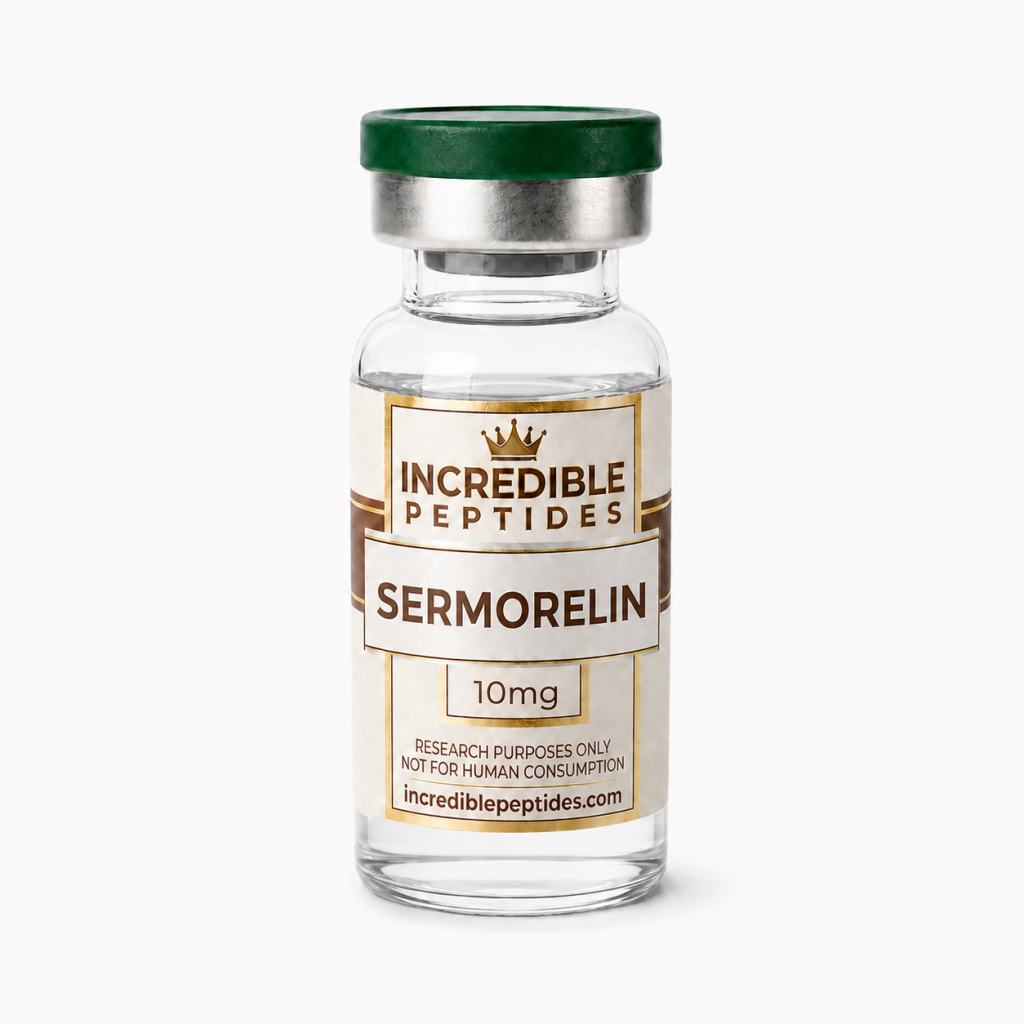
Sermorelin and tesamorelin, the acylated GHRH(1-44) analogue, represent two different answers to the same question. Sermorelin answers it by subtraction: truncation studies showed that the first 29 residues, amidated at the C-terminus, carry essentially the full in vitro activity of the parent hormone, so residues 30 to 44 can be omitted. Tesamorelin answers it by addition: it keeps every native residue and protects the vulnerable end.
The structural consequences are predictable. Sermorelin has a free N-terminal amine and is a DPP-4 substrate, whereas tesamorelin is not readily cleaved by that route. Both share the native Asn8 and Met27, so both carry the same deamidation and oxidation liabilities that later analogues such as modified GRF(1-29) were designed to remove. At about 5.1 kDa, tesamorelin is roughly 50 percent larger than sermorelin at about 3.36 kDa, which affects its retention on reversed-phase columns, its charge-state distribution in electrospray mass spectrometry, and the mass of material needed to reach a given molar concentration in an assay.
Analytical and handling considerations
Identity is best confirmed by mass spectrometry. In electrospray ionisation a 44-residue peptide appears as a series of multiply charged ions, and deconvolution should return the expected average mass. Several impurities are worth looking for specifically: a +16 Da species from oxidation of Met27, a +1 Da shift from deamidation of Asn8, a des-acyl species lacking the hexenoyl group, and truncated or deletion sequences from synthesis. Because the acyl group contains a trans double bond, a geometric isomer is a possible process impurity that would share the same mass and need chromatographic resolution to detect.
Purity is normally reported from reversed-phase HPLC with UV detection at 214 to 220 nm. A single high-purity figure does not by itself prove identity, which is why a complete record pairs chromatographic purity with mass confirmation; our articles on HPLC purity testing explain how to read those results. For storage, lyophilised GHRH analogues are typically kept frozen, dry and protected from light, with the methionine residue making exposure to air and oxidising conditions in solution a particular concern. Researchers sourcing tesamorelin as a lyophilised research reference material should check the lot certificate for mass confirmation, HPLC purity and counter-ion.
Where tesamorelin sits among GHRH analogues
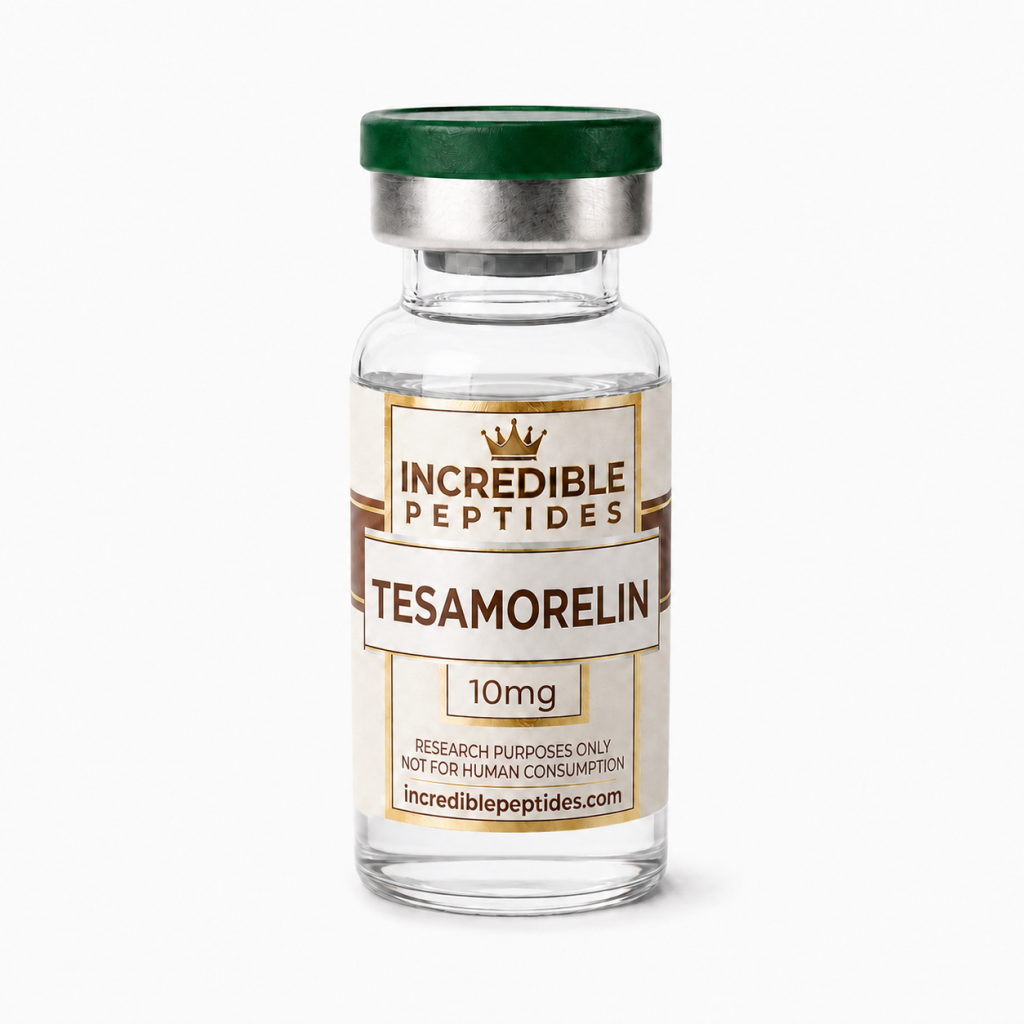
Tesamorelin illustrates a design choice that recurs across peptide chemistry: rather than trimming or substituting a native sequence, protect the single site that limits its lifetime and leave the rest alone. For receptor pharmacologists it offers a full-length GHRH sequence that persists longer in protease-containing assay systems. Its closest comparators are sermorelin, which keeps the native N-terminus, and CJC-1295, which adds amino acid substitutions and, in one form, an albumin-reactive group; our profile of CJC-1295 with and without DAC covers that branch of the family. Tesamorelin offered by Incredible Peptides is for laboratory research use only; not for human or veterinary use.
References
- Guillemin R, Brazeau P, Böhlen P, Esch F, Ling N, Wehrenberg WB. Science, 1982 (isolation and sequence of growth hormone-releasing factor).
- Rivier J, Spiess J, Thorner M, Vale W. Nature, 1982 (characterisation of growth hormone-releasing factor).
- Frohman LA, et al. J Clin Invest, 1986 (enzymatic degradation of GHRH in plasma to an N-terminally cleaved, inactive product).
- Mayo KE. Molecular cloning and expression of a pituitary-specific receptor for growth hormone-releasing hormone. Molecular Endocrinology, 1992.
- Mentlein R. Dipeptidyl-peptidase IV (CD26): role in the inactivation of regulatory peptides. Regulatory Peptides, 1999.
Research Products in This Article
Educational content for research use only. Not for human consumption. Nothing here is medical advice or a claim about safety or efficacy.