NAD+ in Research: Is NAD+ a Peptide?
NAD+ is sold beside peptides but is a dinucleotide coenzyme. Its structure, redox chemistry, consuming enzymes, salvage pathway and handling explained.
 EMElena Marsh, PhDSenior Research Analyst, Analytical Chemistry~6 min read
 Compounds
Search for an NAD+ peptide and you will find the compound listed beside peptides in many research catalogs, including ours. The short answer to the question in the title is no: nicotinamide adenine dinucleotide is not a peptide. It contains no amino acids and no peptide bonds. It is a dinucleotide coenzyme, built from two nucleotides joined through a pyrophosphate bridge, and it sits at the centre of cellular redox chemistry and of several families of signalling enzymes.
This article explains why NAD+ is grouped with peptides commercially but differs chemically, then walks through its structure, its redox behaviour, the enzymes that consume it, the salvage pathway that regenerates it (including the link to nicotinamide N-methyltransferase), and the practical points of handling NAD+ as a laboratory reagent. NAD+ sold as a research material is for laboratory research use only and is not for human or veterinary use.
Why NAD+ Is Not a Peptide
A peptide is a chain of amino acids linked by amide bonds formed between the carboxyl group of one residue and the amino group of the next. NAD+ has neither component. Its building blocks are a nitrogenous base, a ribose sugar and phosphate, repeated twice: one nucleotide carries nicotinamide as its base, the other carries adenine. The two are linked through their 5′-phosphate groups, giving a phosphoanhydride (pyrophosphate) bond rather than any amide linkage.
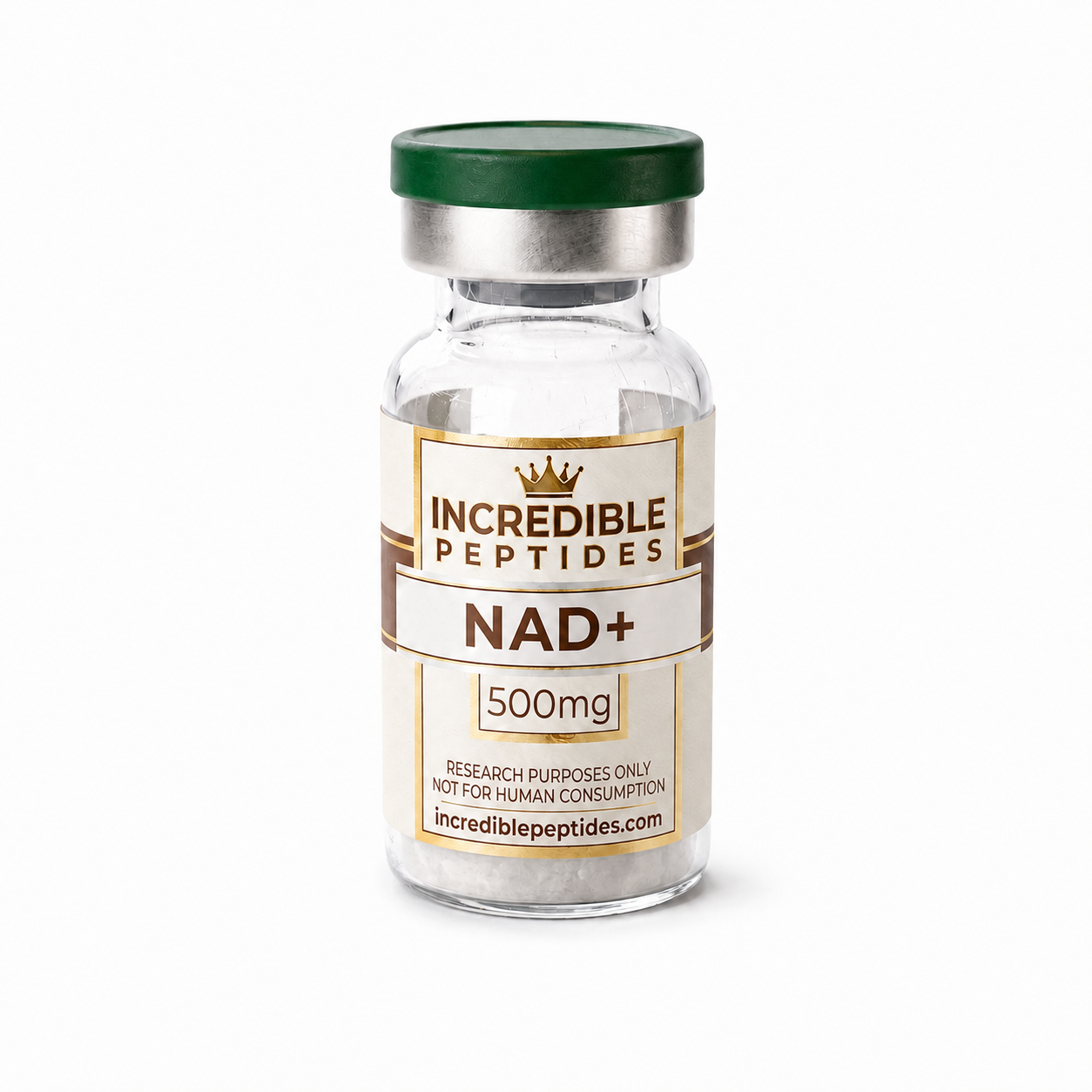
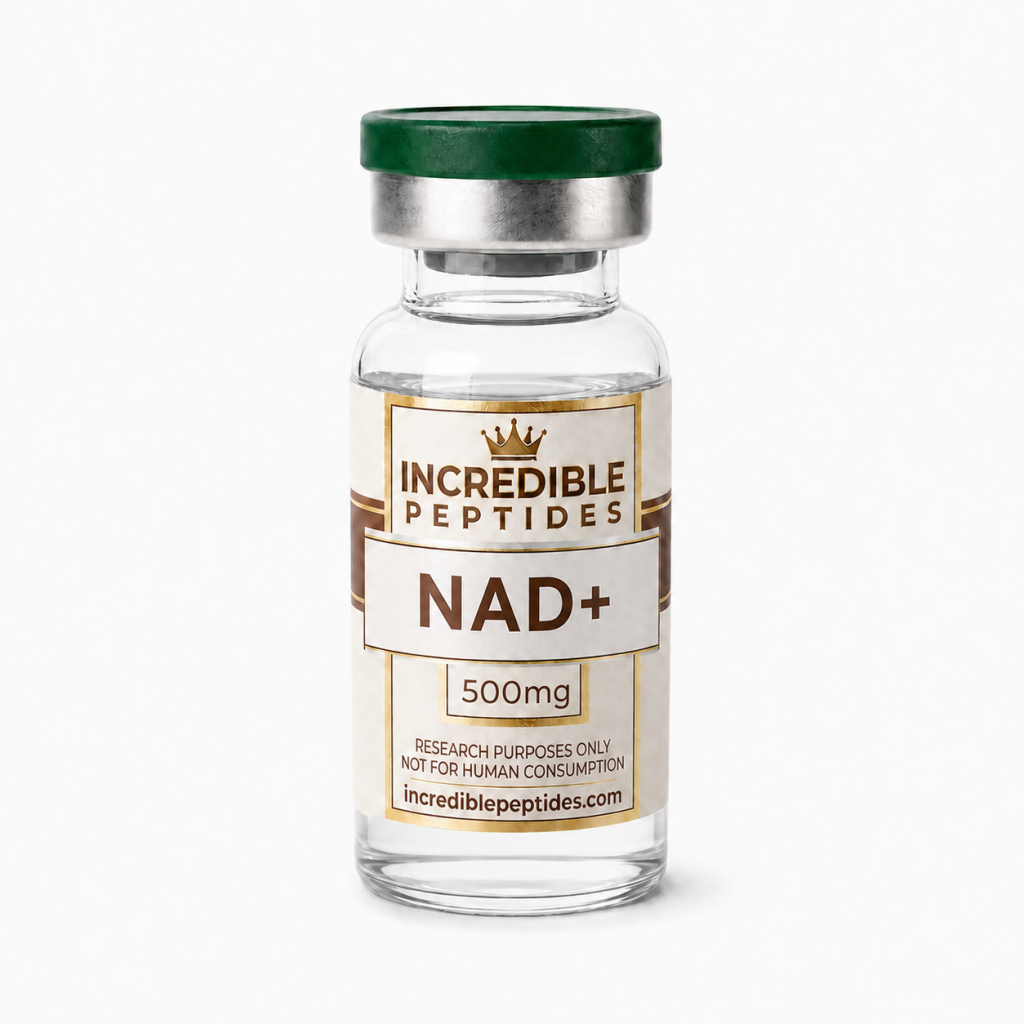
The grouping in catalogs is a matter of convenience. NAD+ is typically supplied as a lyophilised or crystalline powder in vials similar to those used for peptides, it is stored and handled in comparable ways, and it is used by many of the same laboratories. The NAD+ 500 mg research reagent in our catalog is one example of a non-peptide listed among peptide products. Our overview of peptides and what defines them sets out the structural criteria that NAD+ does not meet.
The Structure of NAD+
The oxidised form, NAD+, has the formula C21H27N7O14P2 and an average molecular mass of about 663 g/mol as the free acid. The positive charge in its name refers to the quaternary nitrogen of the nicotinamide ring; at neutral pH the two phosphate groups carry negative charges, so the molecule as a whole is anionic.
| Half of the molecule | Components | Functional role |
|---|---|---|
| Nicotinamide mononucleotide (NMN) | Nicotinamide, ribose, phosphate | Nicotinamide ring accepts and donates a hydride; site of redox chemistry |
| Adenosine monophosphate (AMP) | Adenine, ribose, phosphate | Recognition handle for enzyme binding pockets; strong UV absorbance at 260 nm |
| Linkage | Pyrophosphate (phosphoanhydride) | Joins the two nucleotides; cleaved by pyrophosphatases |
The bond between nicotinamide and its ribose is a β-N-glycosidic linkage. That bond is the one broken when NAD+-consuming enzymes release free nicotinamide, which becomes important in the salvage pathway described below.
Redox Chemistry: NAD+ and NADH
In its classical role, NAD+ is a hydride acceptor for dehydrogenases. During oxidation of a substrate, two electrons and a proton are transferred as a hydride ion to carbon 4 of the nicotinamide ring, producing NADH; a second proton is released to solution. The reverse reaction regenerates NAD+, for example at complex I of the mitochondrial electron transport chain. The phosphorylated relative NADP+ performs a similar function, mostly in reductive biosynthesis.
This chemistry underpins one of the oldest assays in biochemistry. NAD+ and NADH both absorb at 260 nm because of the adenine, but only NADH absorbs strongly at 340 nm, with a molar absorption coefficient of about 6,220 M-1 cm-1. NADH is also fluorescent when excited near 340 nm. Following the change at 340 nm is therefore a direct way to measure dehydrogenase activity in vitro, and many coupled enzyme assays are built around it.
Biosynthesis and the Salvage Pathway
Cells make NAD+ by three routes. The de novo pathway starts from tryptophan via the kynurenine pathway and quinolinic acid. The Preiss-Handler pathway converts nicotinic acid to NAD+ through the deamidated intermediate NAAD. The salvage pathway, quantitatively dominant in most mammalian cells studied, recycles free nicotinamide, much of it released by the NAD+-consuming enzymes described in the next section: nicotinamide phosphoribosyltransferase (NAMPT) converts nicotinamide and PRPP to NMN, and the NMN adenylyltransferases (NMNAT1 to 3) add an AMP moiety from ATP to regenerate NAD+. Nicotinamide riboside enters the same route after phosphorylation to NMN by nicotinamide riboside kinases.
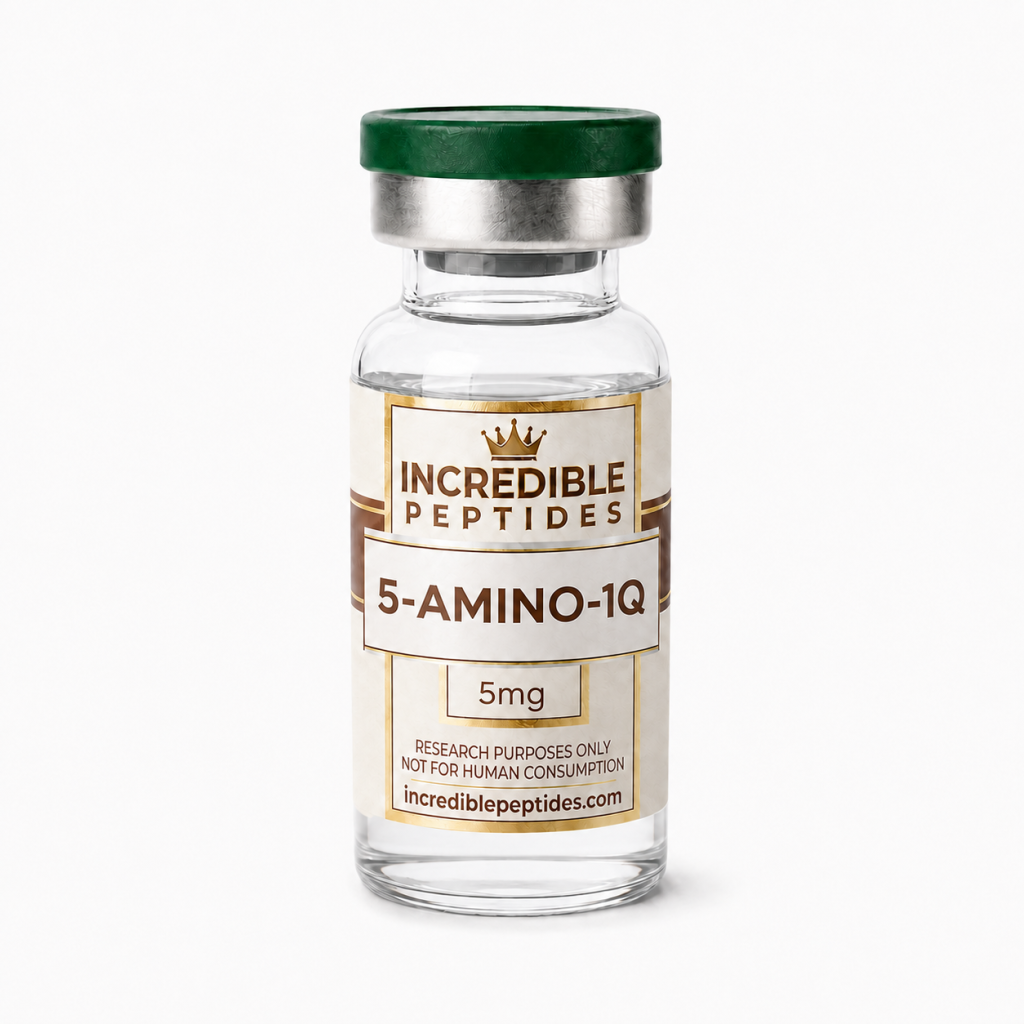
Nicotinamide N-methyltransferase (NNMT) sits at a branch point. It transfers a methyl group from S-adenosylmethionine (SAM) to nicotinamide, producing 1-methylnicotinamide and S-adenosylhomocysteine. Methylated nicotinamide cannot re-enter salvage, so NNMT activity removes substrate from the pathway while also drawing on the cell’s methyl donor supply. That connection is why the small molecule 5-Amino-1MQ, an NNMT inhibitor, appears in NAD+ research: inhibiting the enzyme in cell models is one way to probe how nicotinamide flux and methylation interact. Our companion profile of 5-Amino-1MQ covers that compound’s chemistry.
NAD+-Consuming Enzymes
Redox reactions interconvert NAD+ and NADH without consuming the pool. Several enzyme families, by contrast, cleave NAD+ and release nicotinamide, so they deplete total NAD+ and must be balanced by synthesis.
Sirtuins
Sirtuins are NAD+-dependent protein deacylases; mammals have seven (SIRT1 to SIRT7) with nuclear, cytoplasmic and mitochondrial locations. Each catalytic cycle removes an acyl group from a lysine residue and splits NAD+ into nicotinamide and 2′-O-acyl-ADP-ribose. Because their activity depends on NAD+ availability, sirtuins are often described as sensors that couple protein acylation status to cellular NAD+ levels.
PARPs
Poly(ADP-ribose) polymerases transfer ADP-ribose units from NAD+ onto target proteins, building mono- or poly(ADP-ribose) chains and releasing nicotinamide. PARP1, activated by DNA strand breaks, is a major NAD+ consumer in cultured cells exposed to genotoxic agents.
CD38 and Other NAD+ Glycohydrolases
CD38 is a membrane-associated glycohydrolase that hydrolyses NAD+ to ADP-ribose and nicotinamide and can also generate cyclic ADP-ribose, a calcium-mobilising messenger. SARM1, an NADase studied in neurons, is another member of this functional group.
Handling NAD+ in the Laboratory
NAD+ is a hygroscopic solid and should be stored sealed, dry and cold, with vials allowed to reach room temperature before opening to prevent condensation. In solution its stability depends strongly on pH. NAD+ is comparatively stable in neutral to mildly acidic solution but degrades in alkaline conditions, where the nicotinamide-ribose bond is hydrolysed. NADH shows the opposite pattern: it is unstable in acid and more stable at mildly alkaline pH. NADH is also light-sensitive and, in phosphate buffers, degrades faster than in some alternatives, which matters when a 340 nm baseline drifts.
For assay work, prepare stock solutions in water or a suitable buffer, check concentration spectrophotometrically at 260 nm, divide into single-use aliquots and keep frozen, protected from light. Confirm identity and purity on the certificate for each lot; HPLC with UV detection readily separates NAD+ from common degradation products such as nicotinamide and ADP-ribose. General principles from our guide on peptide storage apply here as well.
A Coenzyme Sold Beside Peptides
NAD+ is a dinucleotide coenzyme whose chemistry is defined by a reactive nicotinamide ring, a pyrophosphate bridge and an adenine recognition handle. It turns over through redox cycling, is consumed by sirtuins, PARPs and CD38, and is regenerated mainly through the NAMPT-dependent salvage route, with NNMT acting as a drain on nicotinamide. Researchers sourcing NAD+ powder for in vitro work will find it alongside peptides in catalogs for practical reasons, but it should be handled, quantified and stored according to nucleotide chemistry.
References
- Nelson DL, Cox MM. Lehninger Principles of Biochemistry. W.H. Freeman.
- Berg JM, Tymoczko JL, Stryer L. Biochemistry. W.H. Freeman.
- Cantó C, Menzies KJ, Auwerx J. NAD+ metabolism and the control of energy homeostasis: a balancing act between mitochondria and the nucleus. Cell Metabolism, 2015.
- Pissios P. Nicotinamide N-methyltransferase: more than a vitamin B3 clearance enzyme. Trends in Endocrinology and Metabolism, 2017.
Research Products in This Article
Educational content for research use only. Not for human consumption. Nothing here is medical advice or a claim about safety or efficacy.
 DO