KLOW Peptide Blend: Composition and Research Considerations
KLOW-type blends are commonly described as a GLOW blend plus KPV. What each component is, why KPV complicates testing, and how to design controls.
 DODaniel Okafor, MSResearch Analyst, Molecular Biology~5 min read
 Compounds
The KLOW peptide is a four-component research blend rather than a single sequence. In the research-peptide market, KLOW-type blends are commonly described as a GLOW-type blend (GHK-Cu, BPC-157 and TB-500) with the tripeptide KPV added, which is where the extra letter in the name comes from. As with any blend, that description is a market convention: the composition and ratio of a particular vial have to be confirmed on its product listing and lot certificate of analysis.
This article sets out the chemistry of the commonly described components, explains why adding KPV makes the analytical work noticeably harder, and outlines how a laboratory can design experiments that remain interpretable when a four-peptide mixture is involved. KLOW is supplied for laboratory research use only and is not for human or veterinary use.
Commonly Described Composition
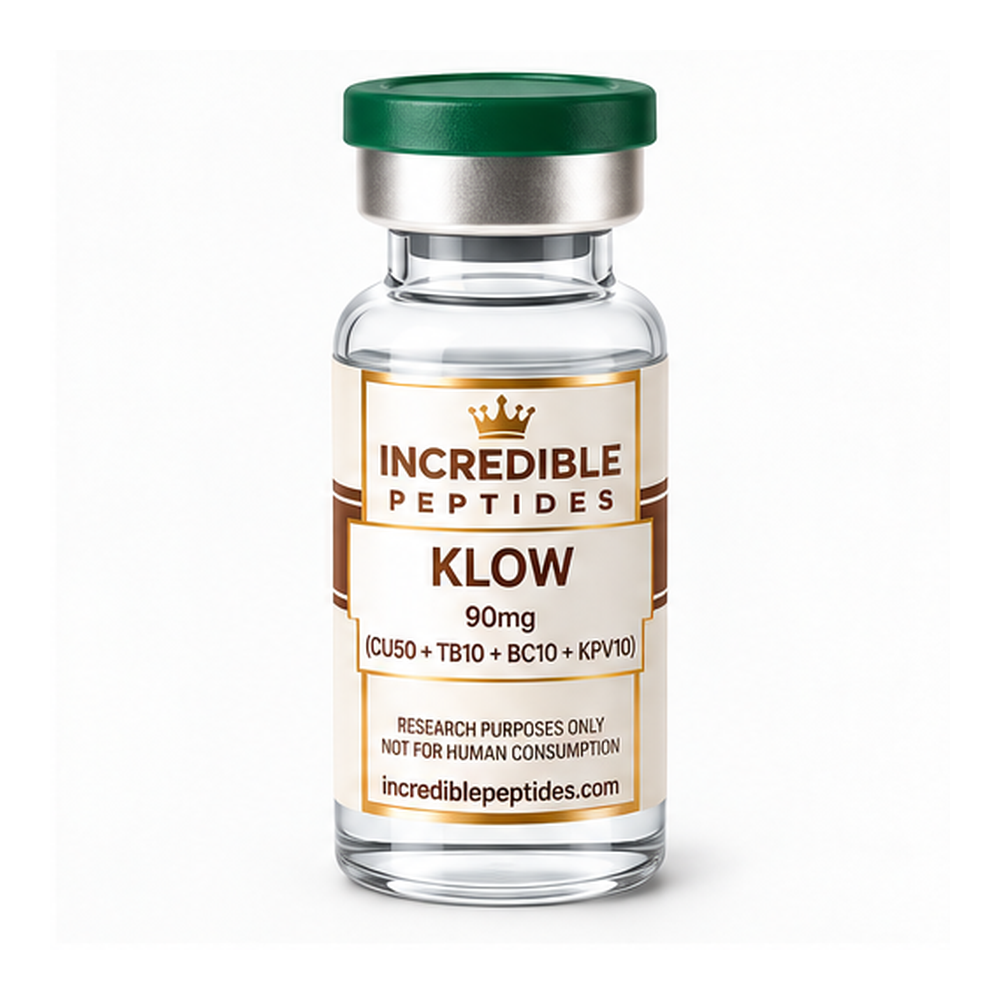
Supplier descriptions of KLOW-type products usually name four components: GHK-Cu, BPC-157, TB-500 and KPV. Labels typically state a total mass for the vial, and for the KLOW 90 mg research blend the listing and lot COA are the documents that should establish what that total is made of. Where the per-component amounts are not stated, they cannot be inferred from the name or from other suppliers’ products, because ratios differ across the market.
Four components spanning roughly a fifteen-fold range in molar mass mean that mass and molar ratios diverge sharply. A milligram of KPV contains roughly four times as many molecules as a milligram of BPC-157, and more than ten times as many as a milligram of full-length thymosin β4. Any experiment that compares the blend with single compounds needs those conversions made explicitly.
| Commonly described component | Sequence or identity | Approximate molar mass |
|---|---|---|
| GHK-Cu | Gly-His-Lys, copper(II) complex | ~340 g/mol (free peptide) |
| BPC-157 | GEPPPGKPADDAGLV | ~1,420 g/mol |
| TB-500 | Usually Ac-LKKTETQ; sometimes full-length thymosin β4 | ~889 or ~4,960 g/mol |
| KPV | Lys-Pro-Val (α-MSH residues 11–13), acid or amide | ~342 g/mol (acid); ~341 g/mol (amide) |
The Component That Distinguishes KLOW: KPV
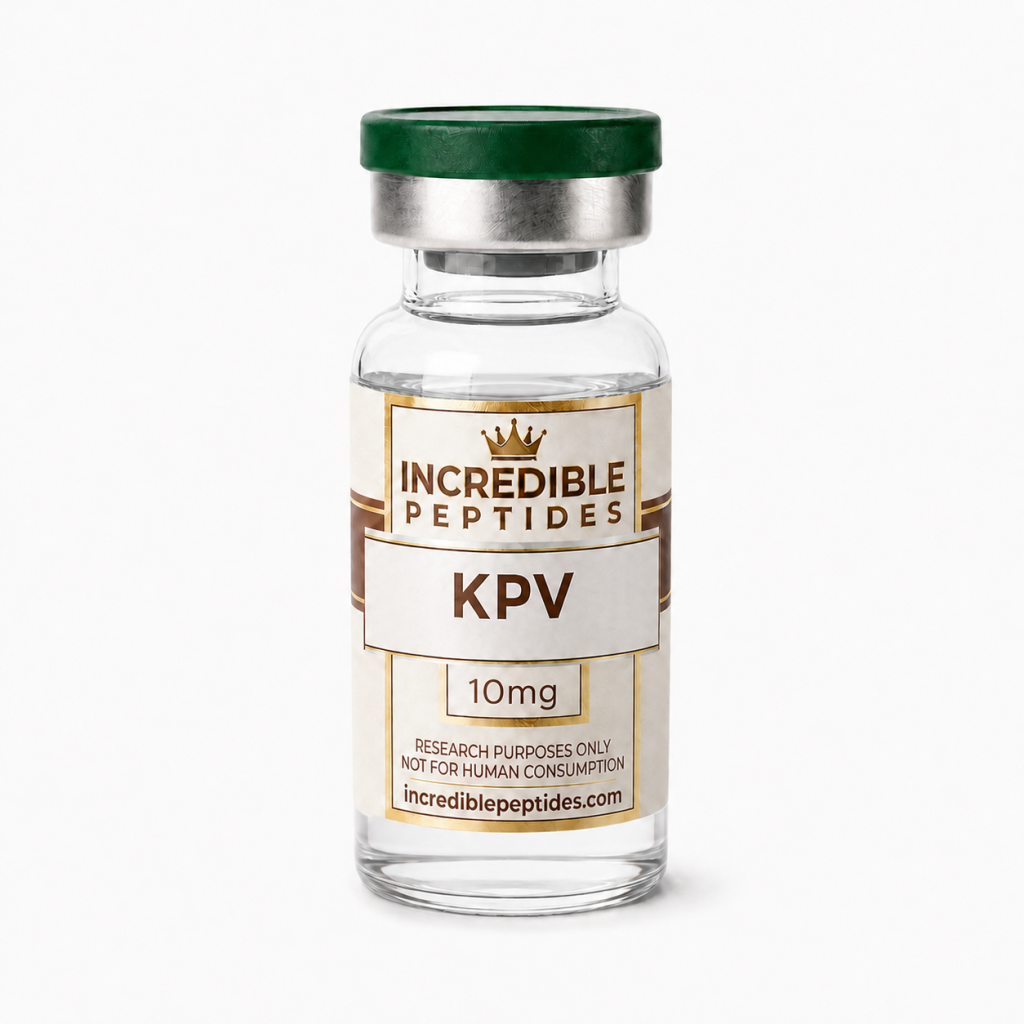
KPV is the C-terminal tripeptide of α-melanocyte-stimulating hormone (α-MSH), the 13-residue melanocortin peptide derived from pro-opiomelanocortin. It lacks the His-Phe-Arg-Trp core that drives melanocortin receptor activation by the parent hormone, and much of its research literature concerns in vitro inflammatory signaling, including reports that it reduces NF-κB activation in intestinal epithelial and immune cell lines. Uptake through the proton-coupled peptide transporter PepT1 has been described in cultured intestinal cells, and animal-model findings in rodents are preclinical. Laboratories wanting to characterise this component on its own can work with KPV as a single research peptide; its background is covered in our KPV peptide profile.
The remaining three components are the same as in a GLOW-type blend. GHK-Cu is a copper-binding tripeptide with mostly in vitro research behind it; BPC-157 is a synthetic pentadecapeptide studied mainly in animal models; and TB-500 refers to a synthetic peptide built on the actin-binding region of thymosin β4, or sometimes to the full-length molecule. Our GLOW peptide blend profile discusses them in more detail.
Why KPV Complicates Blend Analytics
Two Tiny, Polar Tripeptides
KPV and GHK are both small, basic, highly polar tripeptides, and both are poorly retained on standard C18 reversed-phase columns. In a four-component chromatogram they tend to elute early and close together, often near the solvent front where salts and other polar material also appear. Separating them reliably may require shallow low-organic gradients, ion-pairing reagents or hydrophilic interaction chromatography (HILIC). KPV also has no aromatic side chain, so its UV signal at 214 nm comes almost entirely from its two peptide bonds and is weak; its peak area will substantially understate its mass share relative to larger peptides.
Near-Isobaric Masses
Mass spectrometry does not automatically resolve the problem. The protonated free GHK peptide appears at m/z 341.19, KPV with a free C-terminal acid at m/z 343.23, and C-terminally amidated KPV at m/z 342.25. On a low-resolution instrument, the second isotope peak of GHK sits within a fraction of a mass unit of amidated KPV, so the two can be confused unless they are separated chromatographically or analysed at high resolution. Confirming whether the KPV in a blend is the acid or the amide matters for the same reason, and the COA should say which form is present. Our guide to peptide identity testing by mass spectrometry explains isotope patterns and resolution in more detail.
Copper and Stability
As with GLOW-type blends, acidic HPLC conditions dissociate the GHK-copper complex, so copper must be measured separately by an elemental method. KPV contains no histidine or cysteine and is not expected to bind copper strongly, although trace free copper can promote oxidation of other components. KPV also carries a stability liability of its own: peptides with proline in the second position and a free N-terminus can cyclise to form diketopiperazines, releasing the remaining residue. Low temperature, dry storage and prompt use of any solution reduce that risk, and a stability-indicating method should be able to detect the products.
Designing Experiments With a Four-Component Blend
Every component added to a mixture makes attribution harder. If a cell assay responds to a KLOW-type blend, the observation by itself cannot identify which peptide, or which combination, produced the response. Interpretable designs include single-component controls at matched molar concentrations, a GLOW-type control to isolate the contribution of KPV, and a vehicle control prepared in the same buffer. Concentrations should be reported per component in molar units rather than as a total mass of blend.
Documentation deserves equal care. Researchers comparing a KLOW-type four-peptide blend with its components should record the lot number, read the COA for per-component identity and purity, note whether copper and total peptide content were measured, and flag any gap between the listing and the certificate. Those records are what allow a result to be reproduced with a different lot.
Summary for the Laboratory
KLOW-type blends are commonly described as GHK-Cu, BPC-157, TB-500 and KPV in one vial, but only the listing and lot COA can confirm a specific product’s contents. The addition of KPV introduces a second small polar tripeptide with a weak UV signal and a mass close to that of GHK, which raises the bar for both chromatography and mass spectrometry. With per-component testing, molar bookkeeping and proper controls, the blend can be handled as a well-documented research material. KLOW is for laboratory research use only and is not for human or veterinary use.
References
- Catania A, Gatti S, Colombo G, Lipton JM. Targeting melanocortin receptors as a novel strategy to control inflammation. Pharmacological Reviews, 2004.
- Dalmasso G, Charrier-Hisamuddin L, Nguyen HTT, et al. PepT1-mediated tripeptide KPV uptake reduces intestinal inflammation. Gastroenterology, 2008.
- Pickart L, Thaler MM. Tripeptide in human serum which prolongs survival of normal liver cells and stimulates growth in neoplastic liver. Nature New Biology, 1973.
- ICH Q2(R2). Validation of Analytical Procedures. International Council for Harmonisation.
Research Products in This Article
Educational content for research use only. Not for human consumption. Nothing here is medical advice or a claim about safety or efficacy.