Peptides vs Steroids: How the Two Molecule Classes Differ
Are peptides steroids? No. How amino-acid chains and the four-ring steroid scaffold differ in structure, biosynthesis, receptors and laboratory analysis.
 DODaniel Okafor, MSResearch Analyst, Molecular Biology~5 min read
 FundamentalsPhoto: Kjaergaard / Wikimedia Commons
Peptides and steroids are often mentioned in the same breath, yet chemically they have almost nothing in common. One is a polymer of amino acids linked by amide bonds; the other is a compact, fused-ring hydrocarbon scaffold derived from cholesterol. Comparing peptides vs steroids is a useful exercise in biochemistry because the differences in structure flow directly into differences in biosynthesis, solubility, receptor biology and laboratory handling.
So, are peptides steroids? No. The two belong to entirely separate molecular classes, and a molecule cannot be both, although conjugates joining a steroid to a peptide can be made synthetically. This article sets out where each class comes from, how each signals to cells, and how the chemistry changes the way each is analysed and stored.
Structure: Amino-Acid Chains vs a Four-Ring Scaffold
Peptide structure
A peptide is a linear or cyclic chain of amino acids joined by peptide (amide) bonds, with a defined sequence read from the N-terminus to the C-terminus. Its properties come from that sequence: the mix of charged, polar and hydrophobic side chains sets solubility, net charge and conformation. Molecular masses range from a few hundred daltons for di- and tripeptides to several thousand for chains of 30 to 50 residues. Many of the compounds in our research peptides category fall in this range, from short sequences to analogues of around 40 residues.
Steroid structure
A steroid is built on the gonane nucleus: seventeen carbon atoms arranged in three six-membered rings (A, B and C) and one five-membered ring (D), fused into a rigid, largely flat framework. Individual steroids differ in the oxidation state of the rings, the substituents at positions such as C3, C11 and C17, and the side chain at C17. The structures are small and predominantly hydrocarbon. Cortisol has a molecular mass of about 362 Da and estradiol about 272 Da, and both are far less polar than a typical peptide of similar size.
| Property | Peptides | Steroids |
|---|---|---|
| Building blocks | Amino acids linked by amide bonds | Isoprenoid-derived four-ring scaffold |
| Typical mass | About 200 to 6,000 Da | About 250 to 450 Da |
| Polarity | Mostly water-soluble | Lipophilic, poorly water-soluble |
| Biosynthesis | Gene-encoded, ribosomal translation | Enzymatic, from cholesterol |
| Typical receptors | Cell-surface GPCRs and kinase-linked receptors | Intracellular nuclear receptors |
Biosynthesis and Storage in the Cell
Endogenous peptides are gene products. Their sequences are translated on ribosomes, usually as larger precursors that are cleaved and modified in the secretory pathway, then packaged into granules and released by exocytosis when the cell is stimulated. A cell can therefore store a reserve of peptide and release it within seconds.
Steroids are made by enzymes rather than encoded directly. The pathway begins with acetyl-CoA, proceeds through mevalonate and isoprenoid intermediates to squalene, and in animals cyclises to lanosterol before reaching cholesterol. In steroidogenic tissues, the steroidogenic acute regulatory protein delivers cholesterol to the inner mitochondrial membrane, where the side-chain cleavage enzyme CYP11A1 converts it to pregnenolone, the common precursor of the classical steroid hormones. Further cytochrome P450 enzymes and hydroxysteroid dehydrogenases then produce glucocorticoids, mineralocorticoids, androgens, estrogens and progestogens. Because steroids diffuse through membranes, they are not stored in vesicles; output is controlled mainly by the rate of synthesis.
Solubility and Transport
Most peptides dissolve readily in water and circulate largely free in plasma, although lipidated synthetic analogues are designed to bind albumin. Steroids are lipophilic and travel mostly bound to carrier proteins such as corticosteroid-binding globulin and albumin, with only a small free fraction able to reach target cells. In the laboratory the same contrast shows up at the bench: peptides are generally dissolved in aqueous buffers, sometimes with a little acid, base or organic co-solvent for hydrophobic sequences, whereas steroids usually need ethanol, DMSO or another organic solvent before dilution into aqueous media. The research compounds in our peptide catalog are peptides and related materials; no steroids are listed.
Receptor Types and Signalling
Because they cannot easily cross lipid membranes, peptides act at receptors on the cell surface. Many bind G protein-coupled receptors, such as the oxytocin receptor or the GLP-1 receptor, which signal through G proteins and second messengers including cyclic AMP, inositol trisphosphate and calcium. Others bind receptor tyrosine kinases, as insulin and IGF-1 do, or cytokine-type receptors linked to JAK–STAT signalling. These pathways act within seconds to minutes.
Steroids, by contrast, diffuse into the cell and bind members of the nuclear receptor superfamily, such as the glucocorticoid, mineralocorticoid, androgen, estrogen and progesterone receptors. The ligand-bound receptor acts as a transcription factor, binding hormone response elements in DNA and changing gene expression over hours. The boundary is not absolute: some steroid actions are rapid and membrane-initiated, including those through the G protein-coupled estrogen receptor, and thyroid hormones, which are iodinated amino-acid derivatives rather than steroids or peptides, also act through nuclear receptors.
Analytical Handling
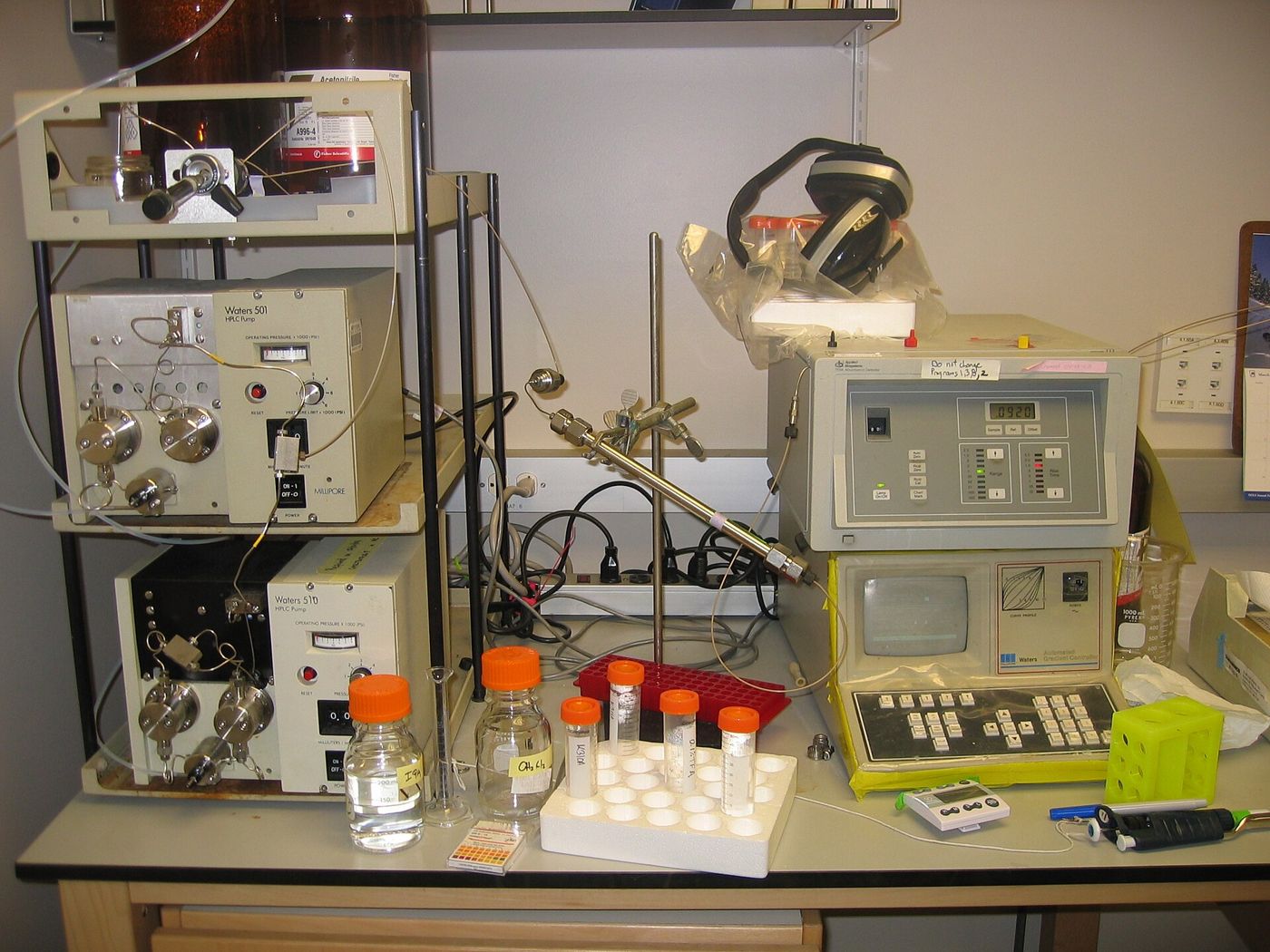
Peptides are usually analysed by reversed-phase HPLC with UV detection near 214 nm, where the amide bond absorbs, and identified by electrospray mass spectrometry, which often produces multiply charged ions. Their analytical profile includes synthesis-related impurities such as deletion sequences, degradation products from oxidation or deamidation, and counter-ions such as trifluoroacetate that affect net peptide content. Steroids are commonly analysed by LC-MS/MS or by GC-MS after derivatisation, and many with a conjugated 3-keto-4-ene system absorb near 240 nm. Immunoassays for steroids can suffer from cross-reactivity between closely related structures, one reason mass spectrometry is preferred for specificity.
Storage needs differ too. Lyophilised peptides are typically kept cold, dry and protected from light, because hydrolysis, oxidation and aggregation can occur once moisture is present. Many crystalline steroids are comparatively robust solids, though light and oxidation still matter for some. Before using any material from our research peptides listings, confirm identity, purity and storage conditions on the lot certificate of analysis; our explainer on HPLC purity testing describes how those values are generated. These materials are for laboratory research use only and are not for human or veterinary use.
Two Distinct Molecule Classes
Peptides are sequence-defined amino-acid polymers, made on ribosomes, stored in vesicles, water-soluble and mostly active at cell-surface receptors. Steroids are small, rigid, lipophilic molecules made enzymatically from cholesterol and active mainly through nuclear receptors that regulate transcription. Recognising those differences clarifies why each class is synthesised, analysed and stored differently, and why the answer to whether peptides are steroids is a clear no. For a related comparison by molecular size, see our article on peptides vs proteins.
References
- Nelson DL, Cox MM. Lehninger Principles of Biochemistry. W. H. Freeman.
- Moss GP. Nomenclature of steroids (IUPAC-IUB Recommendations 1989). Pure and Applied Chemistry, 1989.
- Evans RM. The steroid and thyroid hormone receptor superfamily. Science 1988, 240, 889–895.
- Mangelsdorf DJ, et al. The nuclear receptor superfamily: the second decade. Cell 1995, 83, 835–839.
- Berg JM, Tymoczko JL, Gatto GJ, Stryer L. Biochemistry. W. H. Freeman.
Educational content for research use only. Not for human consumption. Nothing here is medical advice or a claim about safety or efficacy.