
The “Wolverine” Peptide Stack: BPC-157 and TB-500 Together in Research
Setting the nickname aside: a chemical comparison of BPC-157 and TB-500, the design needs of combination studies, and how a two-peptide blend should be tested.
 DODaniel Okafor, MSResearch Analyst, Molecular Biology~5 min read
 CompoundsPhoto: Nadine90 / Wikimedia Commons, CC BY-SA 3.0
“Wolverine peptide” is market slang for the combination of BPC-157 and TB-500, two synthetic peptides that are frequently sold together, either as separate vials or as a single pre-mixed blend. The nickname borrows from a fictional comic-book character, and it carries implied claims that the scientific literature does not support and that this article does not endorse. Underneath the label, though, is a legitimate research chemistry question: what are these two molecules, how do they differ, and what does it take to characterize them properly when they share a vial?
This article compares BPC-157 and TB-500 at the level of sequence, structure and known biochemistry, discusses why combined research formats exist, and explains the analytical considerations that apply to a BPC-157 + TB500 research blend.
Where the nickname comes from
The “Wolverine stack” label emerged from online communities rather than from laboratories. It does not appear as a term in the primary research literature, and it says nothing about the composition, ratio or quality of any particular product. For a researcher, the useful step is to set the name aside and handle the material as what it is: two distinct peptides that need to be identified, quantified and studied on their own terms. Our individual profiles of BPC-157 and TB-500 and thymosin beta-4 cover each compound in more depth.
The two peptides compared
BPC-157 is a 15-residue synthetic peptide, GEPPPGKPADDAGLV, introduced in the early 1990s by a group at the University of Zagreb and described as a partial sequence of a protein fraction from gastric juice. TB-500 is a market name associated with thymosin beta-4 (Tβ4), a 43-residue, N-terminally acetylated peptide that binds monomeric actin. Vendors use “TB-500” for either full-length synthetic Tβ4 or a short fragment from its actin-binding region, often acetylated LKKTETQ, so the thymosin component of any product must be identified from its documentation.
| Property | BPC-157 | TB-500 (thymosin beta-4 related) |
|---|---|---|
| Length | 15 residues | 43 residues (full-length Tβ4) or a short fragment such as Ac-LKKTETQ (7 residues) |
| Approximate average mass | About 1.42 kDa | About 4.96 kDa (full length) or 0.89 kDa (Ac-LKKTETQ) |
| Origin | Synthetic fragment of a reported gastric juice protein | Endogenous, highly conserved actin-binding peptide first isolated from thymus |
| Modifications | None; free termini | N-terminal acetylation |
| Notable residues | Four prolines, no Cys, Met or aromatic residues | Met6 (oxidation-prone); many Lys and Glu |
| Established molecular partner | No specific receptor identified | G-actin (1:1 sequestering complex) |
| Main published evidence | Rodent and in vitro work, largely from one group | Extensive biochemistry and cell biology; preclinical animal studies |
The contrast is instructive. Thymosin beta-4 has a well-defined biochemical role with structural evidence behind it: it sequesters G-actin, and the LKKTETQ segment is part of the binding interface. BPC-157 has no identified receptor or binding partner, and its proposed mechanisms are inferred from downstream signaling changes reported in cell and rodent studies. One molecule is an endogenous protein with decades of independent biochemistry; the other is a synthetic sequence whose literature is concentrated in a small number of laboratories.
Why combined research formats exist
Part of the reason is plainly commercial. Combined products are convenient, and the pairing has become popular in the research-chemical market regardless of what the literature shows. There is also a legitimate experimental reason to study two peptides together: when two compounds are proposed to act through different pathways, a combination experiment can test whether their effects in a given assay are independent, additive or interacting.
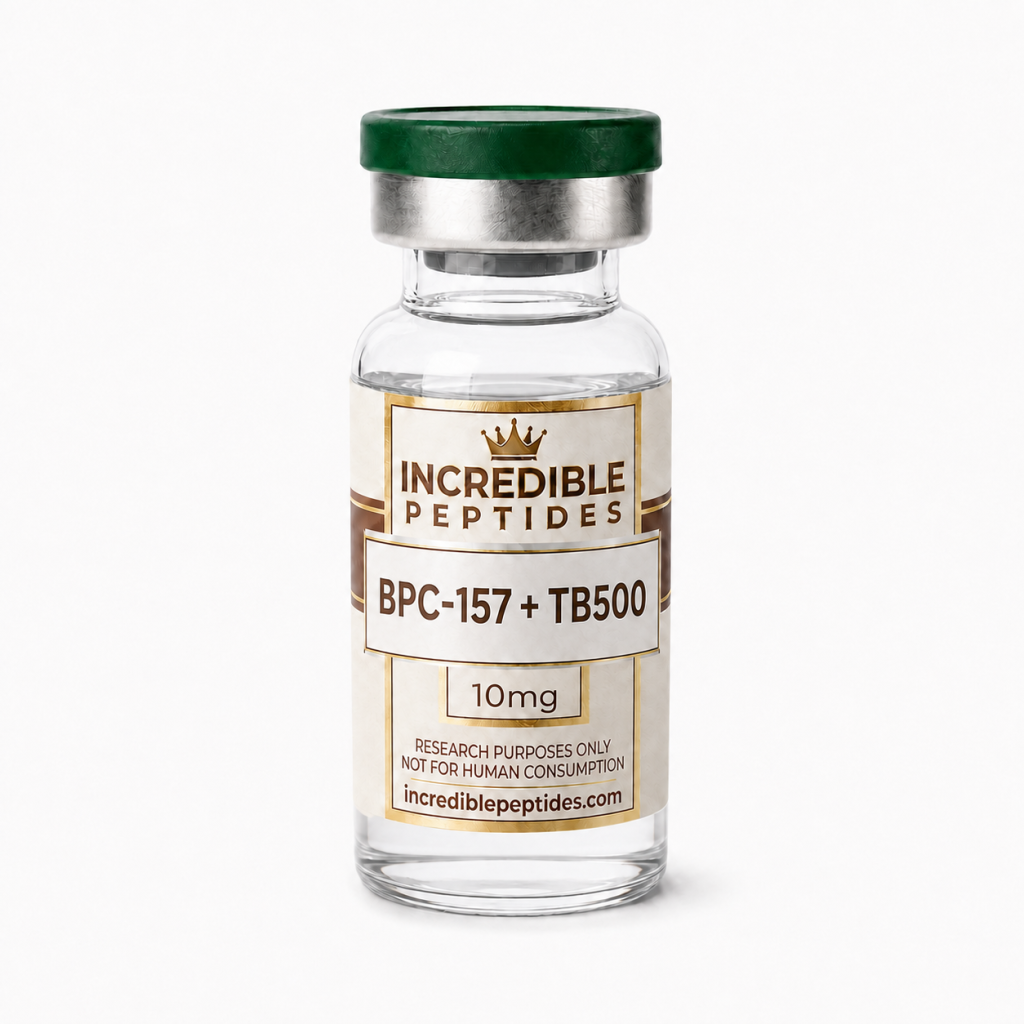
That kind of question has strict design requirements. A meaningful combination study includes each peptide alone, the combination, and a vehicle control, ideally in a factorial layout and across more than one concentration ratio. A pre-mixed blend cannot supply the single-agent arms, so single-component material such as standalone BPC-157 and the matching thymosin peptide are needed alongside it. Without those arms, any result from a blend cannot be attributed to either component, and an apparent interaction cannot be distinguished from the effect of one peptide acting alone. Our article on experimental controls in peptide research covers these design principles.
Analytical considerations for the blend
Characterizing a two-peptide blend is more demanding than characterizing either peptide alone. A single area-percent purity number is ambiguous, because it may describe the sum of two main peaks or one peak against everything else. Useful documentation reports each component separately: an observed mass for each, a chromatogram that resolves both, and a per-component purity and content figure that shows whether the labelled ratio is present.
In practice the pair is fairly easy to separate. BPC-157 and full-length Tβ4 differ in mass by roughly 3.5 kDa, and they differ in charge and hydrophobicity, so reversed-phase HPLC and mass spectrometry distinguish them readily. Detection wavelength needs some thought: BPC-157 has no aromatic residues and absorbs weakly at 280 nm, while Tβ4 has a single phenylalanine, so methods normally detect both at 210 to 220 nm, where the peptide bond absorbs. Relative peak areas at that wavelength still do not translate directly into mass ratios, because absorbance depends on the number of peptide bonds and on side chains, so content should be determined against reference standards for each peptide.
Degradation also has to be tracked per component. Methionine oxidation in thymosin beta-4 (+16 Da) and aspartate-related changes in BPC-157 are the obvious candidates, and a solution prepared for analysis should be checked over time rather than assumed stable. Because the blend’s composition is not stated in detail on every listing, the most important document is the lot certificate for the combined BPC-157 + TB500 vial, which should identify which form of the thymosin component is present and give per-component results.
Looking past the label
The Wolverine nickname describes a market habit, not a scientific finding. Chemically, the pairing combines a short, proline-rich synthetic peptide without an identified receptor and an actin-binding peptide (or a fragment of one) with a well-established biochemical role. Studying them together is reasonable only with single-agent controls and per-component analytical data. Both peptides and the blend are supplied for laboratory research use only; not for human or veterinary use.
References
- Sikiric P, Petek M, Rucman R, et al. J Physiol Paris. 1993 (original description of the gastric juice peptide BPC).
- Safer D, Elzinga M, Nachmias VT. Thymosin beta 4 and Fx, an actin-sequestering peptide, are indistinguishable. J Biol Chem. 1991.
- Huff T, Müller CSG, Otto AM, Netzker R, Hannappel E. β-Thymosins, small acidic peptides with multiple functions. Int J Biochem Cell Biol. 2001.
- ICH Q2(R2). Validation of Analytical Procedures. International Council for Harmonisation.
Research Products in This Article
Educational content for research use only. Not for human consumption. Nothing here is medical advice or a claim about safety or efficacy.