PT-141 (Bremelanotide): A Cyclic Melanocortin Receptor Agonist
Sequence, lactam ring chemistry and melanocortin receptor pharmacology of PT-141 (bremelanotide), with notes on cAMP assays and identity testing.
 DODaniel Okafor, MSResearch Analyst, Molecular Biology~6 min read
 CompoundsPhoto: Lilly_M / Wikimedia Commons, CC BY-SA 3.0
PT-141, also known by its nonproprietary name bremelanotide, is a synthetic cyclic heptapeptide that acts as an agonist at several members of the melanocortin receptor family. For researchers working with the pt 141 peptide, its interest is largely structural and pharmacological: it is a compact, conformationally constrained analogue of the melanocortin pharmacophore, closely related to melanotan II, and it provides a well-defined tool for probing how small lactam-bridged peptides engage class A G protein-coupled receptors (GPCRs).
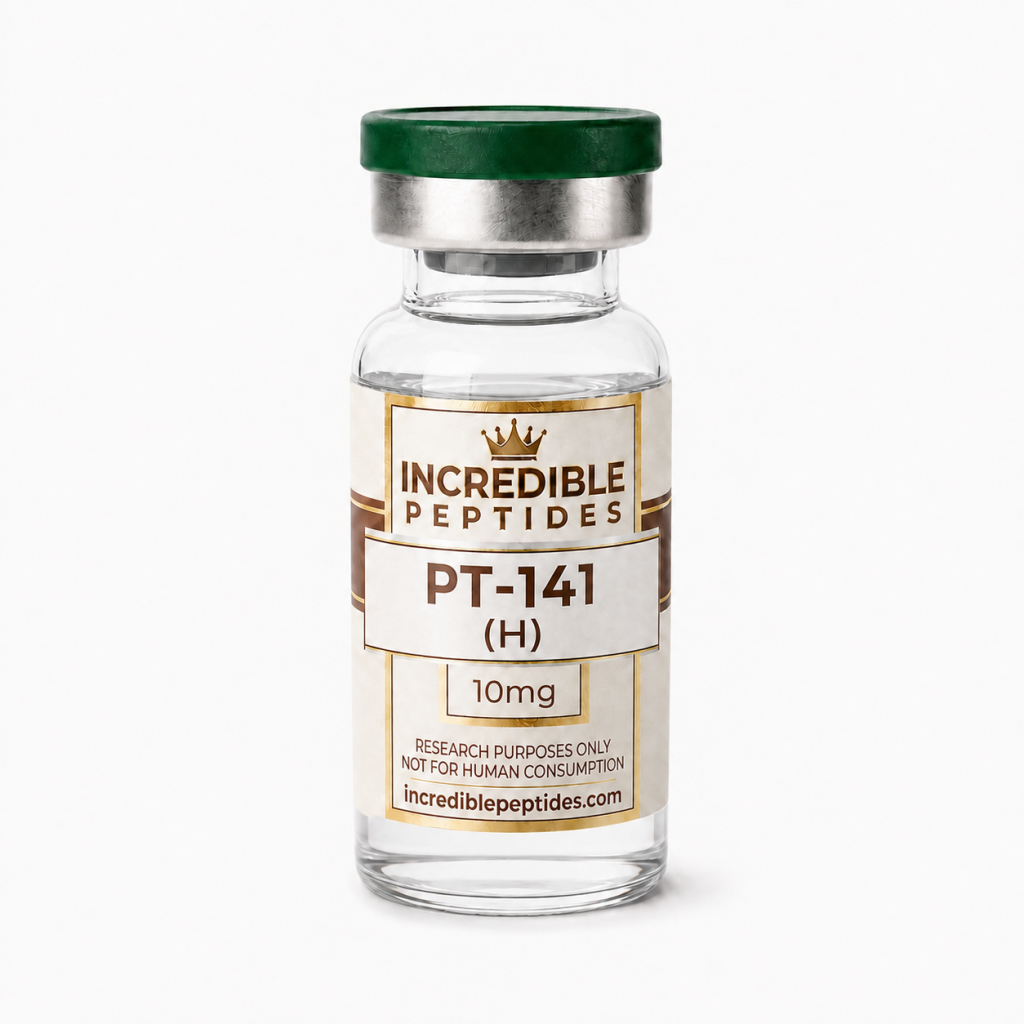
This profile covers the sequence and ring chemistry of PT-141, its relationship to alpha-melanocyte-stimulating hormone (alpha-MSH) and melanotan II, what is known about its receptor selectivity, and how it is typically handled in receptor and signaling assays. Material such as the PT-141 research peptide is supplied for laboratory research use only and is not for human or veterinary use.
Sequence and structure
PT-141 has the sequence Ac-Nle-cyclo[Asp-His-D-Phe-Arg-Trp-Lys]-OH. Seven residues make up the chain: norleucine (Nle), aspartic acid, histidine, D-phenylalanine, arginine, tryptophan and lysine. The N-terminus is acetylated, and the side-chain carboxyl of Asp is joined to the epsilon-amino group of Lys through an amide (lactam) bond, closing a 23-membered ring that spans the six residues from Asp to Lys. The C-terminus is a free carboxylic acid.
The molecular formula is C50H68N14O10, corresponding to an average molecular weight of approximately 1025.2 g/mol. Several design features are inherited from earlier melanocortin work. Norleucine replaces the oxidation-prone methionine found at the equivalent position of alpha-MSH, which improves chemical stability without changing side-chain bulk much. D-phenylalanine in place of L-phenylalanine is a classic potency-enhancing substitution in this peptide family. The lactam bridge restricts backbone flexibility and protects the core from some proteolytic cleavage.
Relationship to melanotan II
PT-141 and melanotan II share the same acetylated, lactam-bridged backbone. The only difference is at the C-terminus: melanotan II ends in a carboxamide (-NH2), whereas PT-141 ends in a free acid (-OH). That single change shifts the formula by one nitrogen and one oxygen, and the mass difference of roughly 1 Da is small enough that identity testing must be planned with care. PT-141 is frequently described in the literature as a metabolite or close derivative of melanotan II. Readers who want the parent compound’s pharmacology in more detail can consult our companion profile of melanotan II structure and receptor pharmacology.
The melanocortin receptor family
Five melanocortin receptors (MC1R to MC5R) were cloned in the early 1990s. All are class A GPCRs, and all couple primarily to the stimulatory G protein Gs, activating adenylyl cyclase and raising intracellular cyclic AMP (cAMP). Their endogenous agonists are peptides derived from pro-opiomelanocortin (POMC), including alpha-, beta- and gamma-MSH and adrenocorticotropic hormone (ACTH).
The receptors differ in tissue distribution and ligand preference. MC1R is the classic receptor on melanocytes. MC2R responds essentially only to ACTH and requires the accessory protein MRAP for trafficking and function. MC3R and MC4R are expressed prominently in the central nervous system, and MC5R is found in a range of peripheral tissues including exocrine glands.
All the MSH peptides share a core tetrapeptide, His-Phe-Arg-Trp, which is the minimal message sequence recognised by MC1R, MC3R, MC4R and MC5R. In PT-141 this motif appears as His-D-Phe-Arg-Trp inside the lactam ring, held in a turn-like conformation that resembles the receptor-bound shape of the native hormone.
Receptor pharmacology of PT-141
In cell-based studies using cloned receptors, PT-141 behaves as a non-selective melanocortin agonist. It activates MC1R, MC3R, MC4R and MC5R, while MC2R, given its strict preference for ACTH, is not a meaningful target. Published rank orders and potency values vary between laboratories because they depend on the expression system, receptor density and readout, so individual numbers should be taken from the primary paper and compared only under matched conditions. Reported potencies at MC1R and MC4R generally fall in the nanomolar range.
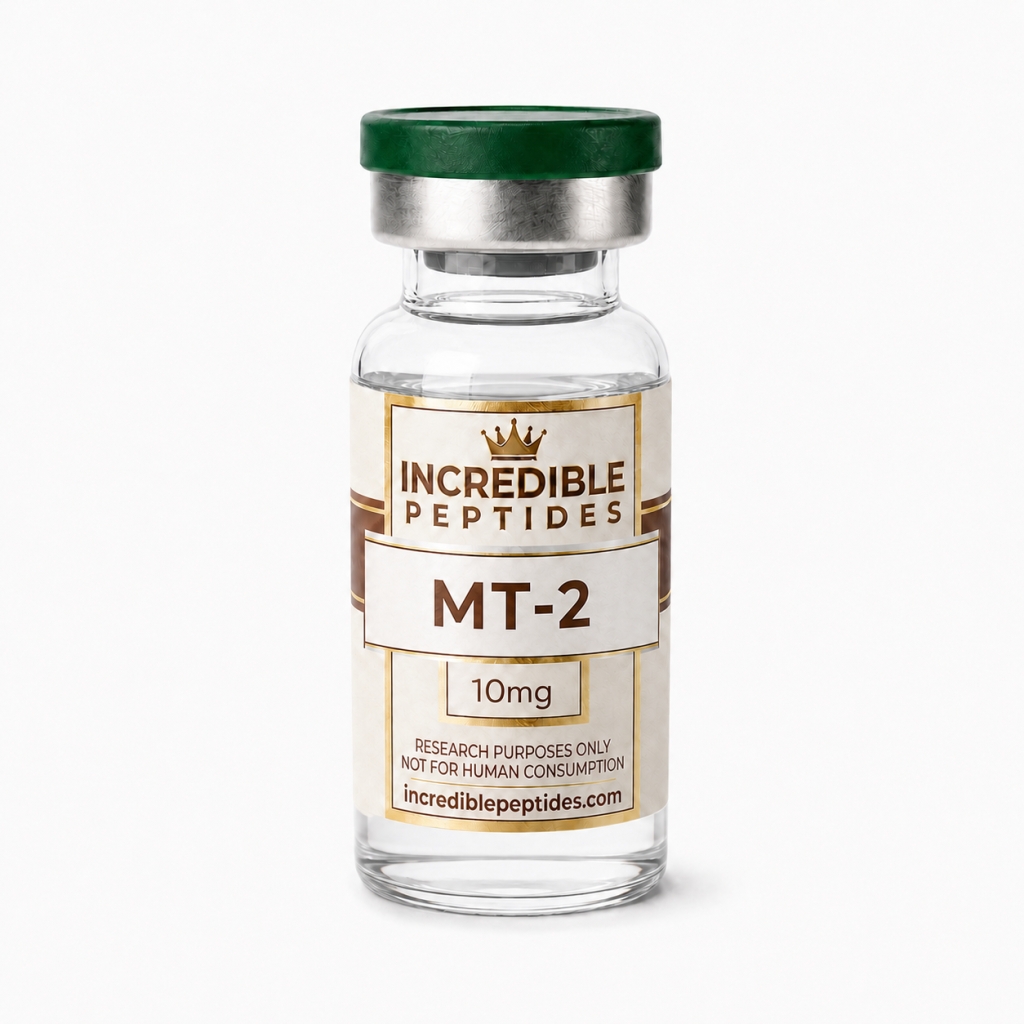
Because the core is shared with melanotan II, much of the structure-activity reasoning for one compound transfers to the other. The C-terminal free acid in PT-141 removes a hydrogen-bond donor and introduces a negative charge at physiological pH, which could in principle alter interactions at the extracellular face of the receptor. Direct side-by-side comparisons of the two peptides under identical assay conditions are the most reliable way to judge whether that change matters for a given receptor subtype. A side-by-side design typically pairs this compound with the melanotan II (MT-2) research peptide as the amidated reference.
Constraint and selectivity
The cyclic melanocortin series is a well-studied example of how small structural changes flip pharmacology. Replacing D-Phe with the bulkier D-2′-naphthylalanine in the melanotan II scaffold gives SHU9119, which acts as an antagonist at MC3R and MC4R while retaining agonist activity at MC1R and MC5R. That observation shows how closely receptor activation depends on the aromatic side chain at this position and underlines why the specific identity of each residue in PT-141 must be confirmed analytically before pharmacological data are interpreted. Our article on peptide structure-activity relationships discusses this kind of analysis more generally.
Measuring activity in vitro
The most common functional assay for PT-141 is cAMP accumulation in a cell line, often HEK293 or CHO, stably expressing a single melanocortin receptor subtype. Cells are exposed to a concentration series of the peptide, usually in the presence of a phosphodiesterase inhibitor such as IBMX, and cAMP is quantified by HTRF, AlphaScreen, ELISA or a luminescent biosensor. Concentration-response curves yield EC50 and Emax values, which are best expressed relative to a reference agonist such as alpha-MSH or NDP-MSH run on the same plate.
Binding is typically measured by competition against a radiolabelled or fluorescent tracer, classically [125I]NDP-MSH, in membrane preparations. Competition data give IC50 values that can be converted to Ki with the Cheng-Prusoff relationship when tracer affinity is known. Reporter, beta-arrestin and ERK readouts can probe pathway bias; the general logic of these assays is covered in our guide to cell signaling assays.
Analytical and handling notes
PT-141 is supplied as a lyophilised acetate or similar salt. Identity is confirmed by mass spectrometry, where the expected monoisotopic and average masses should be checked against the free-acid structure rather than the amidated melanotan II structure. Because the two compounds differ by about 1 Da, high-resolution MS or careful isotope-pattern analysis is useful, and reversed-phase HPLC with a validated method can separate them by retention time. Purity is reported from HPLC peak area at a defined wavelength, commonly 214 or 220 nm.
The peptide contains tryptophan and histidine, both of which are susceptible to oxidation, so lyophilised material is best stored cold, dry and protected from light. Stock solutions should be prepared in a buffer appropriate to the assay, aliquoted to avoid repeated freeze-thaw cycles, and used within a defined window that the laboratory has verified.
Where PT-141 fits in melanocortin research
PT-141 is best understood as one member of a closely related family of lactam-bridged melanocortin peptides. Its value in a research setting comes from its compact, constrained structure, its broad agonism across MC1R, MC3R, MC4R and MC5R, and its near-identity to melanotan II, which makes the pair useful for asking how a single terminal modification affects receptor behaviour. For in vitro work, rigorous identity confirmation, matched reference agonists and careful reporting of assay conditions matter more than any single published potency value, and sourcing a characterised bremelanotide reference material with a lot-specific COA is the practical starting point.
References
- Mountjoy, K. G., Robbins, L. S., Mortrud, M. T. and Cone, R. D. The cloning of a family of genes that encode the melanocortin receptors. Science, 1992.
- Al-Obeidi, F., Castrucci, A. M., Hadley, M. E. and Hruby, V. J. Potent and prolonged acting cyclic lactam analogues of alpha-melanotropin: design based on molecular dynamics. Journal of Medicinal Chemistry, 1989.
- Hruby, V. J. et al. Cyclic lactam alpha-melanotropin analogues of Ac-Nle4-cyclo[Asp5,D-Phe7,Lys10]alpha-melanocyte-stimulating hormone-(4-10)-NH2 with bulky aromatic amino acids at position 7 show high antagonist potency and selectivity at specific melanocortin receptors. Journal of Medicinal Chemistry, 1995.
- Cone, R. D. Studies on the physiological functions of the melanocortin system. Endocrine Reviews, 2006.
- Cheng, Y. and Prusoff, W. H. Relationship between the inhibition constant (K1) and the concentration of inhibitor which causes 50 per cent inhibition (I50) of an enzymatic reaction. Biochemical Pharmacology, 1973.
Research Products in This Article
Educational content for research use only. Not for human consumption. Nothing here is medical advice or a claim about safety or efficacy.