Ipamorelin: A Selective Ghrelin Receptor Agonist Pentapeptide
How a five-residue GHRP derivative with three unnatural amino acids became the first selective ghrelin receptor agonist in animal and pituitary cell studies.
 DODaniel Okafor, MSResearch Analyst, Molecular Biology~4 min read
 CompoundsPhoto: kaibara87 / Wikimedia Commons, CC BY 2.0
The ipamorelin peptide is a small, man-made chain of five amino acids: Aib-His-D-2Nal-D-Phe-Lys-NH2. It switches on the growth hormone secretagogue receptor type 1a (GHS-R1a). This is the receptor for ghrelin, a hormone made in the stomach. A Novo Nordisk team first described ipamorelin in 1998. They called it the first selective growth hormone secretagogue. That claim came from animal and pituitary cell tests. In those tests it released growth hormone without the rise in ACTH and cortisol seen with older compounds such as GHRP-6 and GHRP-2.
This profile covers where ipamorelin came from and how its unusual residues shape its traits. It also covers what we know about GHS-R1a signalling and what “selective” meant in the first study. Last, it lists the test points that matter for the ipamorelin research pentapeptide as a lab reference compound.
From GHRPs to ghrelin
Ipamorelin comes from a family that began before anyone knew which receptor it acted on. In the late 1970s and 1980s, Cyril Bowers and his team started from met-enkephalin analogues. They found small synthetic peptides that made pituitary tissue release growth hormone. These peptides worked in a different way from GHRH. They are called growth hormone-releasing peptides, or GHRPs. The best known is the six-residue peptide GHRP-6, His-D-Trp-Ala-Trp-D-Phe-Lys-NH2. We discuss it in our profile of GHRP-6 and hexarelin.
Howard and his team cloned the receptor in 1996. They used a non-peptide secretagogue to find it in the pituitary and hypothalamus. The natural partner came in 1999. That year, Kojima and his team isolated ghrelin from the stomach. Ghrelin is a peptide of 28 residues. Its Ser3 carries an n-octanoyl ester that it needs to work. In effect, the man-made ligands had mapped a hormone system years before its own peptide was found. Ipamorelin came out of a medicinal chemistry programme built on the GHRP frame. The aim was a smaller and more selective molecule.
Structure: five residues, three of them unnatural
Ipamorelin has the formula C38H49N9O5. Its average mass is about 712 Da. That is small enough to sit between normal peptides and small molecules. Each position does a planned job.
| Position | Residue | Structural role |
|---|---|---|
| 1 | Aib (α-aminoisobutyric acid) | α,α-disubstituted; limits how the backbone can bend and blocks cutting by aminopeptidases |
| 2 | His | Imidazole side chain; kept from the GHRP core |
| 3 | D-2Nal (D-2-naphthylalanine) | Bulky ring group in D-form; takes the place of D-Trp in older GHRPs |
| 4 | D-Phe | Second ring contact; D-form resists breakdown by enzymes |
| 5 | Lys-NH2 | Basic side chain and C-terminal amide; kept across the GHRP family |
The pattern is familiar from peptide SAR work. D-amino acids and unusual residues help the peptide resist enzymes. They also lock the ring-shaped side chains into a shape the receptor knows. The basic C-terminus stays the same. Ipamorelin has two ring-bearing residues and just one basic group. So it is more water-repelling than its size suggests. This shows in how long it stays on a reversed-phase column.
How ipamorelin acts at GHS-R1a
GHS-R1a is a class A, rhodopsin-like G protein-coupled receptor. It mainly works through Gq/11. First, phospholipase C makes inositol trisphosphate and diacylglycerol. Then calcium rises inside the cell, and protein kinase C turns on. In pituitary somatotrophs, that calcium signal helps the cell release growth hormone. The receptor also uses other G proteins and β-arrestins, based on cell type. In transfected cell systems, it is also quite active with no ligand bound. A shorter splice form, GHS-R1b, does not bind ghrelin. It also does not signal in the same way.
In vitro, labs usually measure ipamorelin activity in one of two ways. One is calcium release or inositol phosphate build-up in cell lines that carry GHS-R1a. The other is hormone release from primary rat pituitary cells. Competing with labelled ghrelin or a labelled GHRP gives binding strength.
Pairing with GHRH-receptor ligands
GHS-R1a and the GHRH receptor use different G proteins. So labs often study ipamorelin next to GHRH analogues. This helps show how the two signals meet in the same cell. A pre-mixed CJC-1295 ipamorelin blend exists for that reason. Still, tests need single-compound arms to make sense of any joint response. Our article on the CJC-1295 ipamorelin pairing covers the design issues.
What “selective” meant in the original work
Raun and his team tested ipamorelin in three settings. They used primary rat pituitary cells, rats under anaesthesia and awake pigs. In the cell tests, its potency and peak growth hormone release were close to GHRP-6. The key finding came from the animal tests. GHRP-6 and GHRP-2 raised blood ACTH and cortisol along with growth hormone. Ipamorelin did not raise them past the levels seen with GHRH. This held even at concentrations well above those needed for full growth hormone release.
This kind of selectivity is about effect. It is not about choosing one receptor subtype over another. Ipamorelin and GHRP-6 act at the same receptor. So the difference must come from later steps or from somewhere else. One option is a bias in how each one signals at GHS-R1a. Another is a difference in where each acts, in the brain or in the pituitary. A third is effects on other receptors. The first paper did not settle the cause. Also, the results come from animal models. So they should be read as animal-model data, with the limits of species and test conditions that this brings.
Analytical and handling notes
A pentapeptide like this is simple to test. Reversed-phase HPLC with UV detection gives a clean purity profile. The naphthyl and phenyl groups help here, since they absorb UV light strongly. Electrospray mass spectrometry should show one main ion, with one or two added protons, that fits about 712 Da. Some impurities are worth a check. Diastereomers can form when residues flip form during synthesis. They have the same mass as the parent, so they must be split apart on the column. Deletion peptides are another check. A certificate for ipamorelin sold as a freeze-dried reference material should report purity, mass match and counter-ion. Freeze-dried material is best kept frozen, dry and away from light. It has no methionine, cysteine or asparagine. That makes it more chemically stable than longer peptides.
Ipamorelin as a research tool
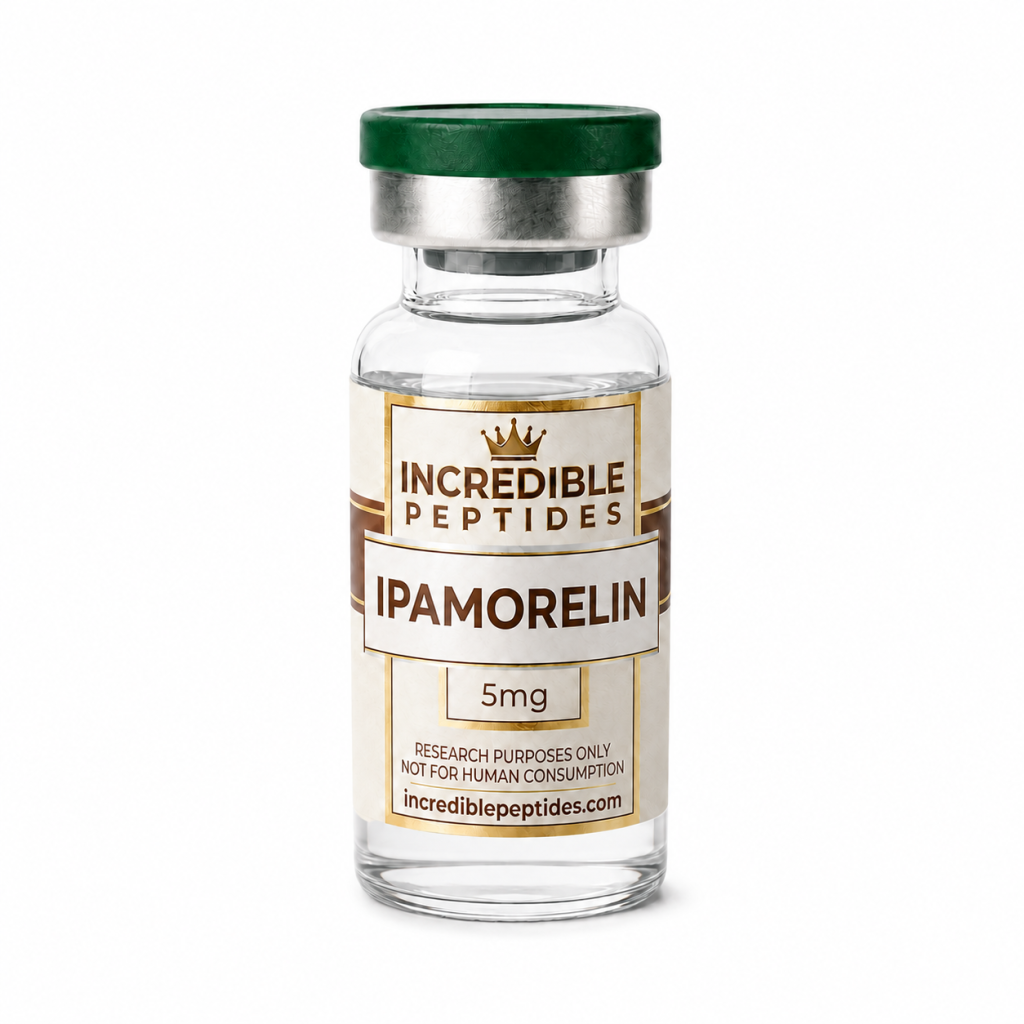
Ipamorelin is a neat example of planned peptide design. It takes the GHRP core and cuts it down to five residues. Unnatural amino acids make it more stable. In animal models, it gave a narrower hormone response than older compounds. For receptor scientists, it is a useful GHS-R1a agonist. It has a known structure and simple testing. Ipamorelin from Incredible Peptides is for laboratory research use only; not for human or veterinary use.
References
- Raun K, Hansen BS, Johansen NL, et al. Ipamorelin, the first selective growth hormone secretagogue. European Journal of Endocrinology, 1998.
- Howard AD, Feighner SD, Cully DF, et al. A receptor in pituitary and hypothalamus that functions in growth hormone release. Science, 1996.
- Kojima M, Hosoda H, Date Y, Nakazato M, Matsuo H, Kangawa K. Ghrelin is a growth-hormone-releasing acylated peptide from stomach. Nature, 1999.
- Bowers CY, et al. Endocrinology, 1984 (in vitro and in vivo activity of the synthetic hexapeptide GHRP-6).
Research Products in This Article
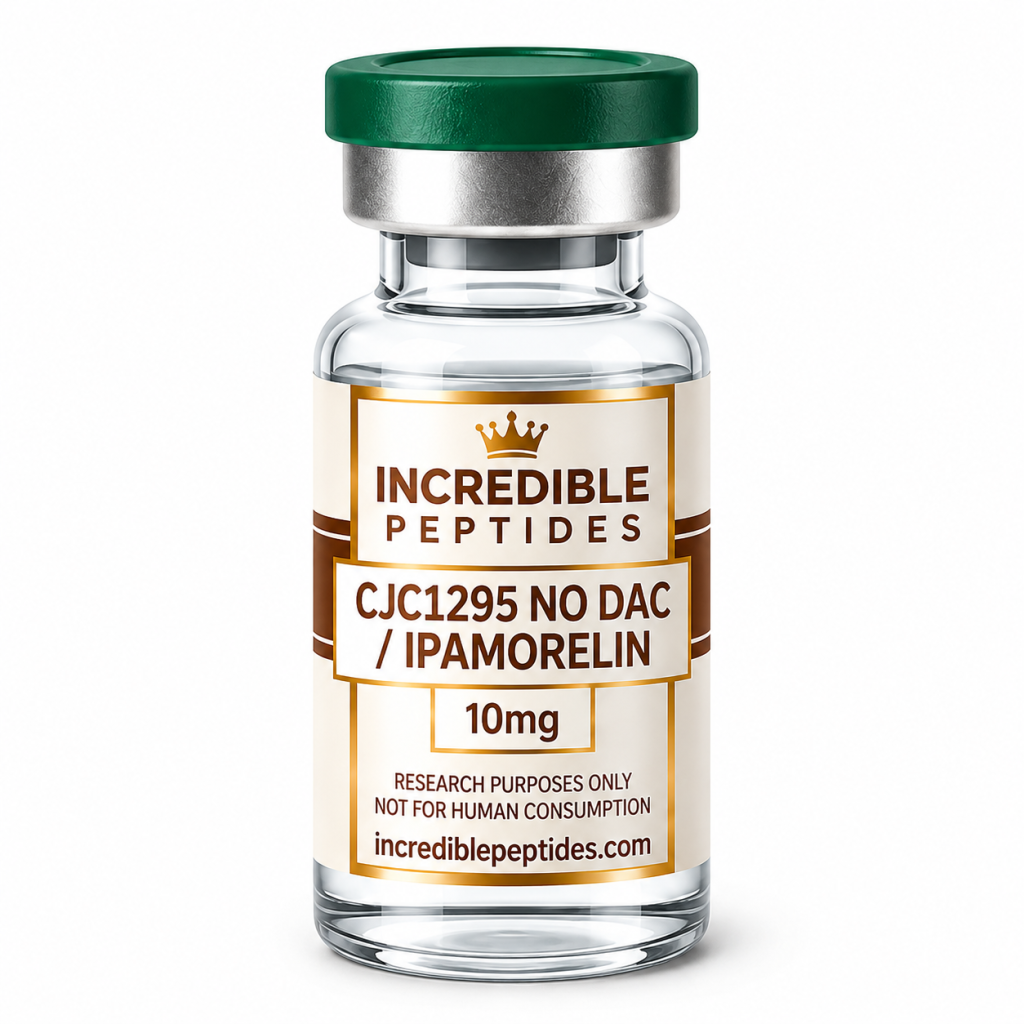
Educational content for research use only. Not for human consumption. Nothing here is medical advice or a claim about safety or efficacy.