Bioregulator Peptides: Short Peptides in Research
The history of the short-peptide bioregulator concept, the main extract-derived and synthetic compounds, proposed mechanisms, and why independent replication matters.
 DODaniel Okafor, MSResearch Analyst, Molecular Biology~5 min read
 Compounds
Bioregulator peptides are a family of short peptides, many only two to four amino acids long, together with the tissue extracts from which the concept grew. The idea that small peptides derived from or modeled on particular organs might regulate gene expression in the corresponding tissues has a distinctive history, a large but concentrated literature, and some unresolved scientific questions that any laboratory working with these compounds should understand.
This article traces the origin of the bioregulator concept, describes the main extract-derived and synthetic compounds, summarizes the proposed mechanisms and their limitations, and outlines the analytical considerations that come with very short peptides. It stays at the level of chemistry, preclinical findings and research methodology.
Origins of the Bioregulator Concept
The concept emerged in the 1970s in Leningrad, now St Petersburg, from work by Vladimir Morozov and Vladimir Khavinson at the Military Medical Academy. Their starting point was organ extracts: polypeptide fractions isolated from animal tissues, most prominently the thymus, a primary lymphoid organ, and the pineal gland. The thymus-derived preparation became known as thymalin and the pineal preparation as epithalamin.
Over the following decades the group, later centered on a dedicated institute in St Petersburg, shifted from extracts to short synthetic peptides. The reasoning was that if an extract’s activity resided in small peptide fragments, it should be possible to identify or design defined sequences that reproduced it. This is why the compounds are often called Khavinson peptides. Our bioregulator peptides category lists research materials associated with this tradition.
From Extracts to Defined Short Peptides
The move from extracts to synthetic sequences matters for research quality. An extract is a heterogeneous mixture whose composition depends on source tissue and isolation method. A synthetic di-, tri- or tetrapeptide is a single defined molecule that can be characterized by HPLC and mass spectrometry and reproduced lot to lot. The table lists several short peptides that appear frequently in this literature.
| Name | Sequence | Length | Described relationship |
|---|---|---|---|
| Vilon | Lys-Glu | Dipeptide | Associated with thymus extract research |
| Thymogen | Glu-Trp | Dipeptide | Associated with thymus extract research |
| Pinealon | Glu-Asp-Arg | Tripeptide | Synthetic short peptide from the same school |
| Epitalon | Ala-Glu-Asp-Gly | Tetrapeptide | Designed with reference to the pineal extract epithalamin |
Thymalin
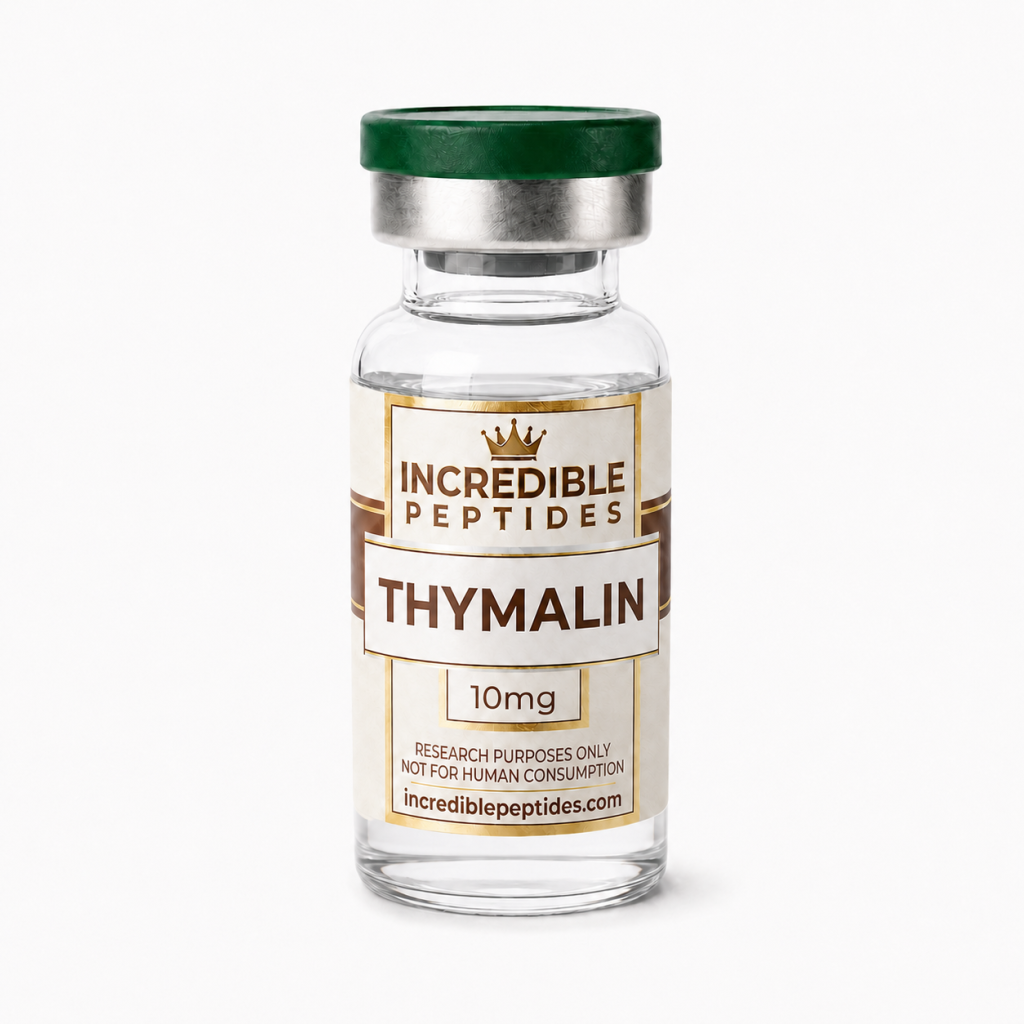
Thymalin occupies a different position from the defined peptides in the table. As originally described it is a polypeptide complex extracted from calf thymus rather than a single sequence. That makes characterization harder: purity in the usual single-peak sense does not apply to a mixture, and lot-to-lot comparability depends on consistent sourcing and fractionation. Researchers working with a lyophilized Thymalin research preparation should confirm from the listing and the lot certificate of analysis what the material actually is and which analytical tests were performed on it.
Epitalon and pinealon
Epitalon and pinealon are defined synthetic peptides, made by standard solid-phase synthesis and characterized like any other short sequence. Each has its own literature, summarized in our profiles of epitalon and pinealon.
Proposed Mechanisms
The central hypothesis of the Khavinson school is that short peptides can enter cells, reach the nucleus and interact with DNA or histone proteins, influencing the expression of specific genes. Support offered for this view includes molecular modeling of peptide binding to DNA sequences, cell-culture studies reporting changes in gene or protein expression after exposure to particular peptides, and preclinical animal studies reporting tissue-level changes.
Parts of the model are plausible. Di- and tripeptides are recognized substrates for proton-coupled oligopeptide transporters such as PEPT1 and PEPT2, so cellular uptake of very short peptides is not in itself surprising. Other parts are harder to reconcile with established biochemistry. Sequence-specific gene regulation normally relies on large proteins with extensive DNA-binding surfaces, and it is not obvious how a two- or three-residue peptide could achieve comparable specificity. Very short peptides are also rapidly hydrolyzed by peptidases in biological matrices, a point discussed in our article on peptidases, which raises questions about how much intact peptide reaches any intracellular target.
Evaluating the Evidence Base
The most important caveat about bioregulator research is concentration. A large share of the published work comes from one research school and its collaborators, much of it originally published in Russian-language journals. That does not make it wrong, but it does mean the field has had less independent replication than its size might suggest.
Several features of the literature deserve attention when reading it. Many studies are preclinical, conducted in cell culture or animal models, and findings in those systems do not establish effects in other species or settings. Sample sizes are often small, and methodological details such as material characterization, randomization and blinding are not always fully reported. Literature beyond preclinical work is outside the scope of this research-chemistry article.
Useful replication would come from independent laboratories using well-characterized synthetic material with a lot-specific COA, appropriate controls such as scrambled sequences and matched free amino acid mixtures, pre-specified outcomes and full reporting of methods. For short peptides in particular, a free amino acid control helps distinguish a sequence-specific effect from a nutritional or osmotic one.
Analytical Considerations for Very Short Peptides
Short peptides present their own analytical problems. Most di- and tripeptides lack aromatic residues, so they absorb weakly except at low UV wavelengths; Glu-Trp is an exception because of its tryptophan. Many are very hydrophilic and retain poorly on conventional reversed-phase columns, which may call for ion-pairing reagents, highly aqueous conditions or hydrophilic interaction chromatography. Mass spectrometry identity confirmation works well, but the low molecular masses mean that counterions and residual water make up a larger fraction of the vial mass, so net peptide content deserves attention. For heterogeneous preparations such as Thymalin 10mg, ask specifically what the COA characterizes, since a single purity figure is less informative for a mixture than for a defined peptide.
Where the Field Stands
Bioregulator peptides sit at an unusual point in peptide science: a coherent, decades-long research program with a clear central hypothesis, alongside limited independent confirmation and an unresolved mechanism. For laboratories, the practical response is careful material characterization, rigorous controls and cautious interpretation. All compounds discussed here are supplied for laboratory research use only and are not for human or veterinary use.
References
- Khavinson VKh, Popovich IG, Linkova NS, Mironova ES, Ilina AR. Peptide Regulation of Gene Expression: A Systematic Review. Molecules.
- Nelson DL, Cox MM. Lehninger Principles of Biochemistry. W.H. Freeman.
- ICH Q6B. Specifications: Test Procedures and Acceptance Criteria for Biotechnological/Biological Products. International Council for Harmonisation.
Research Product in This Article
Educational content for research use only. Not for human consumption. Nothing here is medical advice or a claim about safety or efficacy.