Selank: A Tuftsin-Derived Heptapeptide
Selank extends tuftsin with a Pro-Gly-Pro tail. Here is its structure, stability profile and what rodent and in vitro studies report.
 DODaniel Okafor, MSResearch Analyst, Molecular Biology~5 min read
 Compounds
Selank is a synthetic heptapeptide built by extending the natural tetrapeptide tuftsin with a short proline-rich tail. Its sequence, Thr-Lys-Pro-Arg-Pro-Gly-Pro, is a deliberate piece of peptide engineering: the first four residues reproduce tuftsin, and the C-terminal Pro-Gly-Pro motif was added to slow enzymatic breakdown. For researchers, the selank peptide is interesting mainly as a case study in stabilising a short regulatory peptide and as a subject of rodent and in vitro studies on enzyme inhibition and gene expression.
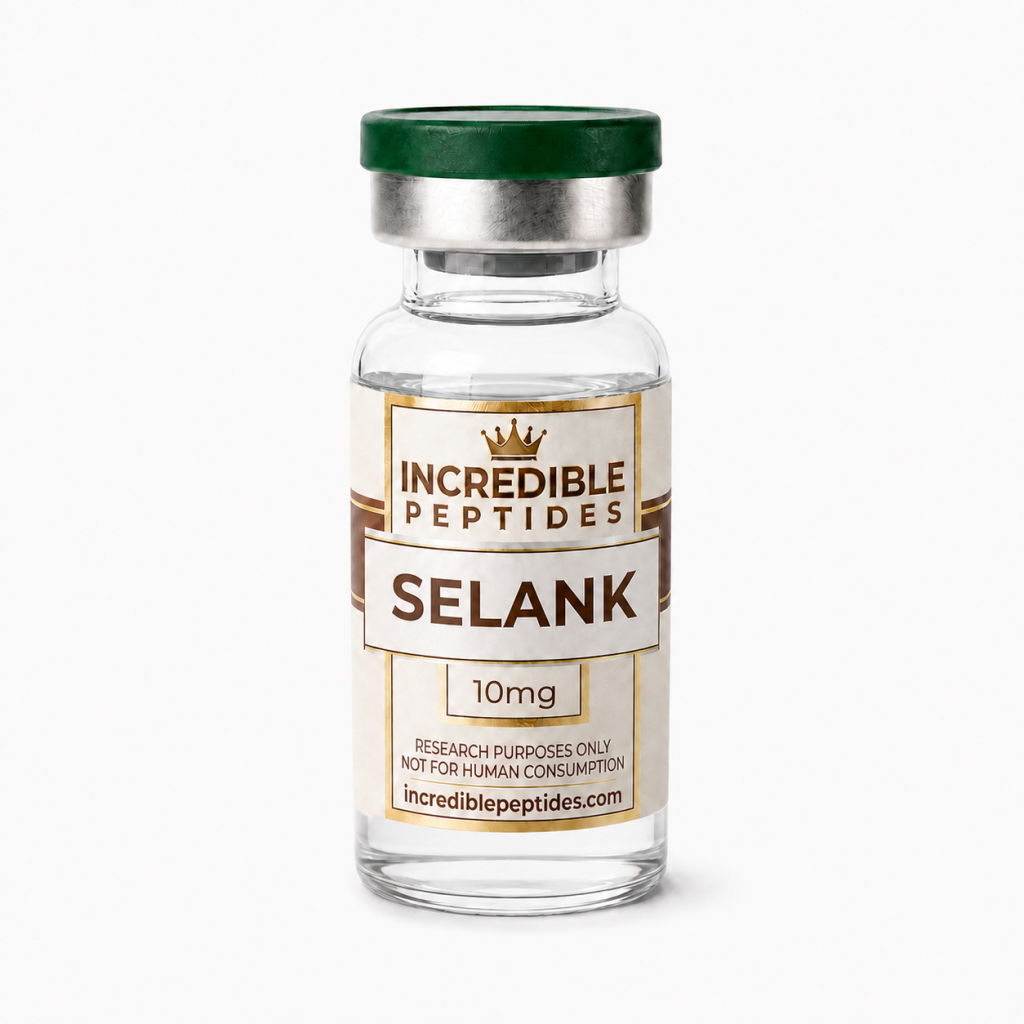
This profile sets out what is known about Selank’s structure, its origins, its stability profile and the preclinical literature, with clear labelling of which findings come from cell or tissue preparations and which from animal models. Material such as the Selank research peptide is supplied for laboratory research use only; not for human or veterinary use.
Tuftsin: the parent sequence
Tuftsin, Thr-Lys-Pro-Arg, was described by Najjar and Nishioka in 1970 as a peptide released from the Fc region of the immunoglobulin G heavy chain by enzymatic cleavage. In the original in vitro work it stimulated phagocytic activity of polymorphonuclear leukocytes, and later studies associated it with binding to receptors on macrophages and microglia, including reports implicating neuropilin-1. Much of this literature is decades old and was obtained in cell and animal systems.
A practical limitation of tuftsin as a research tool is its short lifetime in biological media. Being a small, unmodified linear tetrapeptide with free termini, it is a ready substrate for aminopeptidases and other peptidases. That instability motivated efforts to create longer-lived analogues, and Selank is one result.
Structure and chemistry of Selank
Selank has the sequence H-Thr-Lys-Pro-Arg-Pro-Gly-Pro-OH, with free N- and C-termini and no non-natural residues. Its molecular formula is C33H57N11O9 and its average molecular weight is approximately 751.9 g/mol. Three of its seven residues are proline, and two are strongly basic (Lys and Arg), so the peptide is highly polar, water-soluble and carries a net positive charge near neutral pH. It has no aromatic residues, which means it lacks meaningful absorbance at 280 nm; HPLC detection relies on the peptide-bond absorbance at 210 to 220 nm.
Why Pro-Gly-Pro?
Pro-Gly-Pro belongs to the glyproline family of short proline- and glycine-containing peptides, several of which occur naturally as collagen fragments. Proline restricts backbone rotation and is a poor fit for the active sites of many common peptidases, so peptide bonds adjacent to proline are often cleaved slowly. Appending Pro-Gly-Pro to the C-terminus of tuftsin was intended to protect the active sequence and extend its persistence in tissue and serum preparations. The same tail appears in Semax, a sister peptide from the same research programme, and comparisons with the Semax research peptide are a natural way to study how this motif behaves on two different parent sequences. The general principles of proline-dependent cleavage are covered in our article on peptidases and peptide degradation.
Proline-rich does not mean indestructible. Studies of Selank in biological media have reported shorter fragments, including the tuftsin tetrapeptide and Pro-Gly-Pro-containing pieces, which raises the possibility that some reported activity reflects metabolites rather than the intact heptapeptide. Any experiment that depends on intact Selank should verify its presence over the incubation period by LC-MS.
Origins of the compound
Selank was developed in Russia by researchers at the Institute of Molecular Genetics of the Russian Academy of Sciences, in collaboration with pharmacology groups in Moscow. The same programme produced Semax and a number of other glyproline-extended regulatory peptides. Most of the primary literature on Selank was published in Russian-language journals, with a smaller body available in English translation or international journals, which affects how easily results can be checked and compared. Readers comparing the two peptides may find our profile of Semax and its ACTH(4-7) core useful.
Preclinical findings
Enzyme inhibition in vitro
One line of work examined whether Selank and Semax affect enzymes that degrade enkephalins. In serum preparations in vitro, both peptides were reported to inhibit enkephalin-degrading peptidase activity. Because these are enzyme-level measurements in a cell-free preparation, they show a biochemical interaction but do not establish what happens in an intact organism.
Gene expression in rodent models
Later studies used rodent models and expression profiling to ask which genes change after Selank exposure. Work published in the 2010s reported altered expression of genes related to GABAergic neurotransmission in rat brain tissue, and other reports described changes in expression of cytokine and chemokine genes in cell and animal systems. These are preclinical observations: they were made in rats, mice or cultured cells, often with small group sizes and from a limited number of laboratories, and independent replication is sparse. They are best read as hypothesis-generating rather than as a settled description of mechanism.
What remains unclear
No specific high-affinity receptor for Selank has been identified, and it is uncertain how much of its reported activity is attributable to the tuftsin portion, the glyproline tail, or degradation products. Researchers designing experiments should therefore include tuftsin alone and Pro-Gly-Pro alone as comparators where possible, alongside a scrambled-sequence control.
Analytical and handling considerations
Identity is confirmed by mass spectrometry against the expected mass of about 751.9 Da, with tandem MS useful for confirming sequence order given the repeated prolines. Purity is assessed by reversed-phase HPLC at 214 or 220 nm; because the peptide is very polar it elutes early on standard C18 methods, and an ion-pairing agent or a shallow gradient helps resolve it from truncated sequences. Counter-ion content should be stated on the certificate of analysis, since basic peptides commonly carry acetate or trifluoroacetate.
Lyophilised Selank is relatively robust because it has no oxidation-prone residues such as Met, Cys or Trp, but it is hygroscopic and should be stored cold and dry. Solutions are best aliquoted and frozen, and stability in the chosen assay medium should be measured rather than assumed.
Selank in context
Selank is a good example of a design strategy that recurs across peptide chemistry: take a short, biologically interesting but unstable sequence and attach a protease-resistant motif. Its chemistry is simple and well defined, while its biology rests on a modest body of preclinical work that would benefit from independent replication with careful analytical control. For laboratories that want to explore that space, a characterised Selank peptide (TKPRPGP heptapeptide) reference material with lot-specific identity and purity data is the essential starting point.
References
- Najjar, V. A. and Nishioka, K. Tuftsin: a natural phagocytosis stimulating peptide. Nature, 1970.
- Volkova, A. et al. Selank administration affects the expression of some genes involved in GABAergic neurotransmission. Frontiers in Pharmacology, 2016.
- Vanhoof, G., Goossens, F., De Meester, I., Hendriks, D. and Scharpe, S. Proline motifs in peptides and their biological processing. FASEB Journal, 1995.
Research Products in This Article
Educational content for research use only. Not for human consumption. Nothing here is medical advice or a claim about safety or efficacy.