IGF-1 LR3: Structure of a Long-Acting IGF-1 Analogue
IGF-1 LR3 adds a 13-residue extension and an Arg3 substitution to IGF-1, reducing IGFBP binding. Its structure, signalling and analysis explained.
 DODaniel Okafor, MSResearch Analyst, Molecular Biology~5 min read
 CompoundsPhoto: Masur / Wikimedia Commons, CC BY-SA 3.0
IGF-1 LR3, short for Long Arg3 insulin-like growth factor-I, is an engineered analogue of the 70-residue growth factor IGF-1. Two changes distinguish it from the native sequence: a 13-residue extension at the N-terminus and the replacement of glutamate at position 3 with arginine. Together they produce an 83-residue protein that binds the IGF-binding proteins (IGFBPs) far more weakly than native IGF-1 while still activating the type 1 IGF receptor, which is why it is so widely used as a cell culture supplement and as a research tool for IGF receptor signalling.
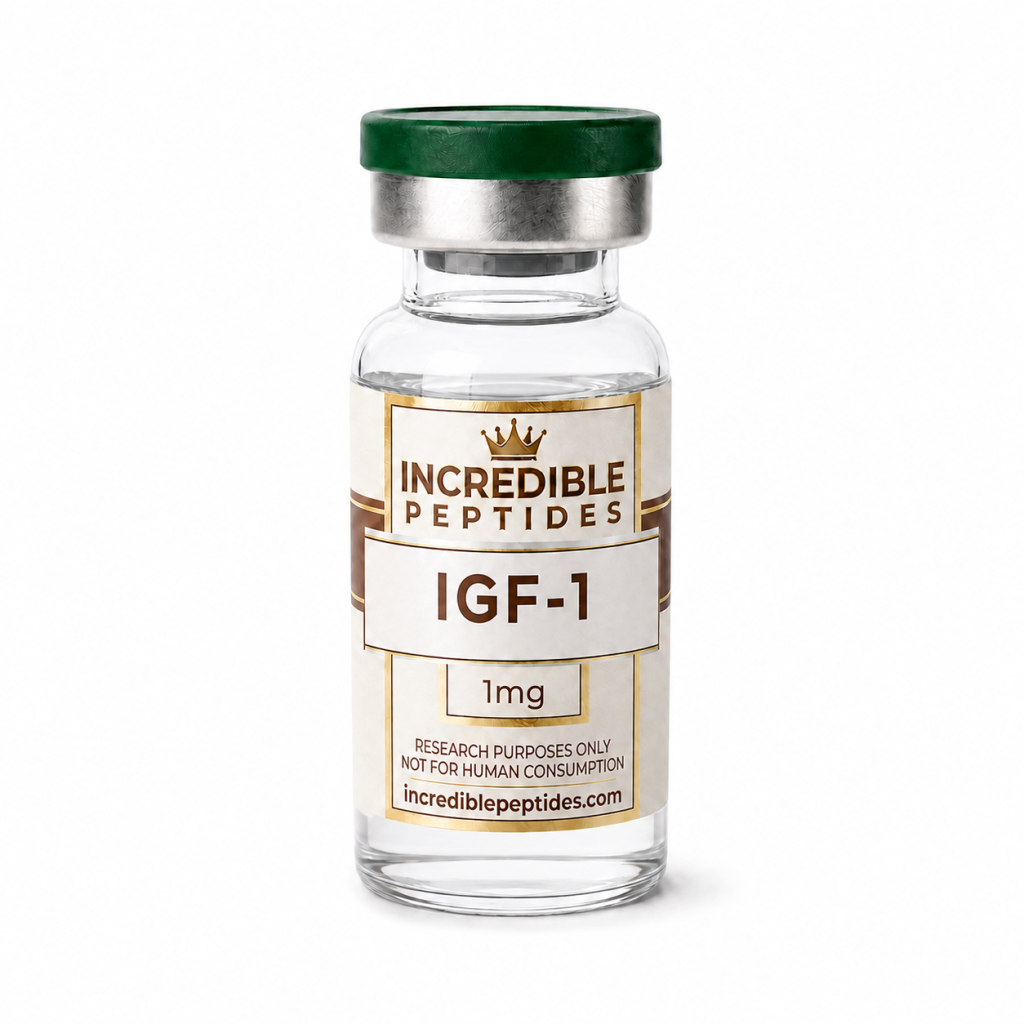
This profile describes the native molecule, the structural changes in LR3, why reduced IGFBP binding matters in culture, the intracellular pathways the receptor activates, and the analytical points that apply to a disulfide-bonded protein of this size. The IGF-1 LR3 1 mg research material discussed here is supplied for laboratory research use only and is not for human or veterinary use.
Native IGF-1 in Brief
IGF-1 is a single-chain polypeptide of 70 amino acids with an average mass of about 7.6 kDa. It is structurally related to proinsulin, and its sequence is divided into four domains: B (residues 1 to 29), C (30 to 41), A (42 to 62) and a short D domain (63 to 70). Unlike insulin, IGF-1 keeps its C domain, so it remains one continuous chain. Three disulfide bonds, Cys6-Cys48, Cys18-Cys61 and Cys47-Cys52, hold the B and A regions together in an insulin-like fold.
In biological fluids almost all IGF-1 circulates bound to one of six high-affinity IGFBPs, usually in ternary complexes. The IGFBPs regulate how much free ligand is available to receptors, and cultured cells often secrete their own IGFBPs into the medium. That background is the key to understanding why LR3 was designed. At 70 to 83 residues, IGF-1 and its analogues sit at the boundary between peptides and small proteins; our article on peptides vs proteins discusses where that line falls.
What Changes in LR3
LR3 combines two modifications that were explored by researchers in Adelaide, Australia, in the early 1990s. The N-terminal extension, Met-Phe-Pro-Ala-Met-Pro-Leu-Ser-Ser-Leu-Phe-Val-Asn, is derived from the N-terminal region of porcine growth hormone and was introduced in the context of recombinant expression. The E3R substitution targets a residue known to matter for IGFBP binding: a naturally occurring truncated form, des(1-3)IGF-1, which lacks the first three residues, had already been shown to bind IGFBPs poorly and to be more potent than full-length IGF-1 in many cell assays.
| Property | Native IGF-1 | IGF-1 LR3 |
|---|---|---|
| Length | 70 residues | 83 residues |
| N-terminus | Gly-Pro-Glu-Thr… | 13-residue extension, then Gly-Pro-Arg-Thr… |
| Position 3 (native numbering) | Glutamate | Arginine |
| Disulfide bonds | 3 | 3 (same connectivity) |
| Average mass (oxidised) | about 7,649 Da | about 9,111 Da |
| IGFBP binding | High affinity | Markedly reduced (as reported) |
In the original characterisation, analogues carrying the extension and the Arg3 substitution showed strongly reduced IGFBP binding and greater apparent potency than native IGF-1 in cell-based assays where IGFBPs were present. Binding to the IGF-1 receptor itself was reported to be similar to or somewhat lower than that of native IGF-1. The greater potency in culture therefore reflects ligand availability rather than a stronger receptor interaction. This distinction matters when comparing LR3 results with experiments that used native IGF-1.
Researchers studying other components of the growth hormone and IGF axis can find related sequences among the research peptides in our catalog, including GHRH analogues and the growth hormone fragment discussed in our profile of AOD-9604.
IGF-1 Receptor Signalling in Cells
The type 1 IGF receptor (IGF-1R) is a receptor tyrosine kinase built as a disulfide-linked α2β2 heterotetramer. Ligand binding to the extracellular α subunits causes a conformational change that activates the kinase domains in the β subunits, leading to trans-autophosphorylation of tyrosine residues in the activation loop and juxtamembrane region. These phosphotyrosines recruit adaptor proteins, chiefly insulin receptor substrates (IRS-1 and IRS-2) and Shc.
Two downstream branches dominate most cell studies. Through IRS proteins, phosphoinositide 3-kinase generates PIP3 at the membrane, which recruits PDK1 and Akt; Akt then regulates mTORC1, FOXO transcription factors and other targets involved in protein synthesis, survival and cell-cycle control. Through Shc and Grb2-SOS, Ras activates the Raf-MEK-ERK cascade, which is associated mainly with proliferation and gene expression. IGF-1 also binds the insulin receptor with lower affinity, and in many cell types IGF-1R and insulin receptor half-receptors assemble into hybrid receptors, so receptor expression profiles should be characterised when interpreting results. Common readouts include phospho-IGF-1R, phospho-Akt and phospho-ERK immunoblots, reporter assays and proliferation measurements; our article on cell signaling assays covers the methods.
Use in Cell Culture and Bioprocessing
The practical consequence of weak IGFBP binding is that LR3 remains available to receptors in media conditioned by cells that secrete IGFBPs. This has made media-grade LR3 a common component of serum-free and chemically defined media, where it is used in place of, or alongside, insulin to support growth of production cell lines such as Chinese hamster ovary (CHO) cells. In this setting it functions as a defined growth factor that reduces reliance on animal serum, contributing to more consistent and better documented culture conditions. In academic research it is used as a standard IGF-1R agonist where IGFBP interference would complicate interpretation.
Analytical and Handling Considerations
At 83 residues with three disulfides, LR3 is analytically closer to a small protein than to a short synthetic peptide. Correct disulfide pairing is essential, and misfolded isomers have exactly the same mass as the native fold, so intact mass spectrometry alone cannot confirm structure. Reversed-phase HPLC usually separates folding isomers, and peptide mapping after enzymatic digestion under non-reducing conditions can confirm disulfide connectivity. The sequence contains three methionines, two in the extension and Met59 in the native region, so oxidised variants at +16 Da increments are a typical impurity class.
Like native IGF-1, LR3 adsorbs to plastic and glass at low concentrations, and working solutions in culture are normally prepared in media containing carrier protein. Lyophilised material is generally dissolved in dilute acid as a stock and stored in aliquots at low temperature to avoid repeated freeze-thaw cycles.
A Well-Defined Tool for IGF Receptor Research
IGF-1 LR3 is one of the clearer examples of rational protein engineering: two targeted changes reduce IGFBP sequestration while keeping IGF-1R activation largely intact. That property explains its established role in bioprocessing media and its use as a reference agonist in cell signalling studies. Before relying on any lot of IGF-1 LR3, the long-acting IGF-1 analogue, confirm intact mass, chromatographic purity and, where possible, folding state on the certificate of analysis.
References
- Francis GL, Ross M, Ballard FJ, et al. Novel recombinant fusion protein analogues of insulin-like growth factor (IGF)-I indicate the relative importance of IGF-binding protein and receptor binding for enhanced biological potency. Journal of Molecular Endocrinology, 1992.
- Jones JI, Clemmons DR. Insulin-like growth factors and their binding proteins: biological actions. Endocrine Reviews, 1995.
- UniProt Consortium. UniProtKB entry P05019, Insulin-like growth factor I (IGF1).
- ICH Q6B. Specifications: Test Procedures and Acceptance Criteria for Biotechnological/Biological Products.
Research Product in This Article
Educational content for research use only. Not for human consumption. Nothing here is medical advice or a claim about safety or efficacy.